

Smoked Snack Stick
Health
Nutrition
Nutri-Score data warning
Nutrition label

Nutrition facts
| Nutrition facts | As sold for 100 g / 100 ml |
|---|---|
| Energy | ~ 2054.54545454545 kJ (472 kcal) |
| Fat | 36.3636363636364 g |
| Saturated fat | 12.7272727272727 g |
| Trans fat | 0 g |
| Cholesterol | 0.109090909090909 g |
| Carbohydrates | 18.1818181818182 g |
| Sugars | 3.63636363636364 g |
| Added sugars | 1.86046511627907 g |
| Starch | 0 g |
| Dietary fiber | 3.63636363636364 g |
| Proteins | 21.8181818181818 g |
| Salt | 4.09090909090909 g |
| Sodium | 1.63636363636364 g |
| Vitamin B6 | 0.000392857142857143 g |
| Iron | 0.00254175744371823 g |
| Fruits, vegetables and legumes | ~ 0 % |
| Choline | 0 g |
Nutrition facts (Detailed data)
| Nutrition facts | As sold for 100 g / 100 ml | As sold Per 100 g (packaging) | As sold Per serving (27.5 g) (packaging) | As sold Per 100 g (estimate) |
|---|---|---|---|---|
| Energy | ~ 2054.54545454545 kJ (472 kcal) | ? (472 kcal) | ? (130 kcal) | ? |
| Fat | 36.3636363636364 g | ? | 10 g | ? |
| Saturated fat | 12.7272727272727 g | ? | 3.5 g | ? |
| Trans fat | 0 g | ? | 0 g | ? |
| Cholesterol | 0.109090909090909 g | ? | 0.03 g | ? |
| Carbohydrates | 18.1818181818182 g | ? | 5 g | ? |
| Sugars | 3.63636363636364 g | ? | 1 g | ? |
| Added sugars | 1.86046511627907 g | 1.86046511627907 g | ? | ~ 3.51 g |
| Starch | 0 g | ? | 0 g | ? |
| Dietary fiber | 3.63636363636364 g | ? | 1 g | ? |
| Proteins | 21.8181818181818 g | ? | 6 g | ? |
| Salt | 4.09090909090909 g | ? | 1.125 g | ? |
| Sodium | 1.63636363636364 g | ? | 0.45 g | ? |
| Vitamin B6 | 0.000392857142857143 g | 0.392857142857143 mg | ? | ? |
| Iron | 0.00254175744371823 g | 2.54175744371823 mg | ? | ? |
| Fruits, vegetables and legumes | ~ 0 % | ? | ? | ~ 0 % |
| Choline | 0 g | ? | 0 g | ? |
Serving size
Ingredients
Ingredients image
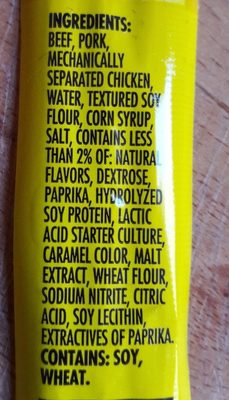
Ingredients list
Ingredient information
Added sugars
Allergens
Ingredients analysis
Palm oil content unknown
Unrecognized: en:mechanically separated chicken water, en:textured so flour, en:contains less than 2% of, en:natura flavors, en:dextrose paprika, en:lactic acid starter culture caramel color, en:wheat flour sodium 'nitrite
Contains non-vegan ingredients.
Unrecognized: en:mechanically separated chicken water, en:textured so flour, en:natura flavors, en:dextrose paprika, en:lactic acid starter culture caramel color, en:wheat flour sodium 'nitrite
Contains non-vegetarian ingredients.
Unrecognized: en:mechanically separated chicken water, en:textured so flour, en:natura flavors, en:dextrose paprika, en:lactic acid starter culture caramel color, en:wheat flour sodium 'nitrite
Food Processing
NOVA group
 Ultra-processed food and drink products
Elements that indicate the product is in NOVA group 4
How NOVA works
Additives
E150a - Plain caramel EFSA overexposure risk: noColour
Caramel color or caramel coloring is a water-soluble food coloring.
E250 - Sodium nitrite EFSA overexposure risk: highPreservative
Sodium nitrite (E250) is a salt used for curing and preserving meat products.
It plays a critical role in preventing the growth of Clostridium botulinum, the bacterium responsible for botulism, in cured meats like bacon, ham, and sausages. It also provides the characteristic pink color and flavor.
However, nitrites can react with amines in the stomach to form nitrosamines, which are potent carcinogens. High intake of processed meats containing nitrites is associated with an increased risk of colorectal cancer. Regulatory bodies have set strict limits on its use in food.
E322 - LecithinsAntioxidantEmulsifier
Lecithins are natural compounds commonly used in the food industry as emulsifiers and stabilizers.
Extracted from sources like soybeans and eggs, lecithins consist of phospholipids that enhance the mixing of oil and water, ensuring smooth textures in various products like chocolates, dressings, and baked goods.
They do not present any known health risks.
E322i - LecithinAntioxidantEmulsifier
Lecithins are natural compounds commonly used in the food industry as emulsifiers and stabilizers.
Extracted from sources like soybeans and eggs, lecithins consist of phospholipids that enhance the mixing of oil and water, ensuring smooth textures in various products like chocolates, dressings, and baked goods.
They do not present any known health risks.
E330 - Citric acidAntioxidantSequestrant
Citric acid is a natural organic acid found in citrus fruits such as lemons, oranges, and limes.
It is widely used in the food industry as a flavor enhancer, acidulant, and preservative due to its tart and refreshing taste.
Citric acid is safe for consumption when used in moderation and is considered a generally recognized as safe (GRAS) food additive by regulatory agencies worldwide.
Environment
Green-Score, origins bonus, and transportation impact are shown for Worldwide .
Green Score
Overall grade
 Unknown environmental impact
About Green-Score
Current scope
Green-Score availability
Bonuses and maluses
Declared origins
Packaging impact
Packaging
Packaging impact
Data precision
Transportation
Declared origins
Forest footprint
Forest footprint
Deforestation risk details
Data Source
Product data comes from Open Food Facts. Food Benchmark also adds translations, category comparisons and explanatory calculations.
The database is licensed under ODbL 1.0, individual contents under DbCL 1.0, and product photos under CC BY-SA 3.0.
Product added on June 17, 2018 at 6:11:46 PM UTC by kiliweb .
Last edit on October 26, 2026 at 3:44:51 AM UTC by foodless .
Product page also edited by anonymous-aaagtn2gawmps, bojackhorseman, foodless, inf, kiliweb, macrofactor, maldan, municorn-calorie-counter-app, openfoodfacts-contributors, roboto-app, scanbot, yuka.UTU1UkRyaFFvZjBicGZKZzBFamIrOWhvN2IydVVFT0ZjN1F6SVE9PQ, yuka.sY2b0xO6T85zoF3NwEKvlksZSILnqRXkCAXtsmSmyvzeL5-0Y4xO3rLrI6g, yuka.sY2b0xO6T85zoF3NwEKvllB5bOaG_ReaNzfmpEOO5oiIAba1PIFX8prLHKs, yuka.sY2b0xO6T85zoF3NwEKvlnRaDejaiTfDPCPnwhaZ5Y7eEIfLZv1t6bKnNKg.