

Crunchy
Labels
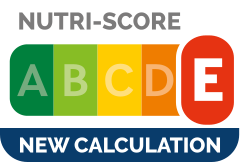 Bad nutritional quality
 Ultra-processed food and drink products
 Low environmental impact
Health
Nutrition
Label
Bad nutritional qualityNutrient levels
Fat in high quantity (35.3%)
Saturated fat in high quantity (5.3%)
Sugars in low quantity (3.53%)
Salt in high quantity (1.77%)
Nutrition label

Nutrition facts
| Nutrition facts | As sold for 100 g / 100 ml |
|---|---|
| Energy | 2,365 kJ (565 kcal) |
| FAT | 35.34 g |
| Saturated fat | 5.3 g |
| Trans fat | 0 g |
| Cholesterol | 0 g |
| Carbohydrates | ? |
| Sugars | 3.53 g |
| Dietary fiber | < 3.53 g |
| Proteins | 7.07 g |
| Salt | ~ 1.77 g |
| Sodium | 0.71 g |
| Vitamins | |
| Vitamin D | 0 g |
| Minerals | |
| Potassium | 0.21 g |
| Calcium | 0.04 g |
| Iron | 0 g |
| Fruits, vegetables and legumes | ~ 0 % |
| Carbohydrates Total | 53 g |
Nutrition facts (Detailed data)
| Nutrition facts | As sold for 100 g / 100 ml | As sold Per 100 g (packaging) | As sold Per serving (28.3 g) (packaging) | As sold Per 100 g (estimate) |
|---|---|---|---|---|
| Energy | 2,365 kJ (565 kcal) | ? | ? (160 kcal) | ? |
| FAT | 35.34 g | ? | 10 g | ? |
| Saturated fat | 5.3 g | ? | 1.5 g | ? |
| Trans fat | 0 g | ? | 0 g | ? |
| Cholesterol | 0 g | ? | 0 mg | ? |
| Carbohydrates | ? | ? | ? | ? |
| Sugars | 3.53 g | ? | 1 g | ? |
| Added sugars | ~ 0 g | ? | ? | ~ 0 g |
| Dietary fiber | < 3.53 g | ? | < 1 g | ? |
| Proteins | 7.07 g | ? | 2 g | ? |
| Salt | ~ 1.77 g | ? | ? | ? |
| Sodium | 0.71 g | ? | 200 mg | ? |
| Vitamins | ||||
| Vitamin D | 0 g | ? | 0 µg | ? |
| Minerals | ||||
| Potassium | 0.21 g | ? | 60 mg | ? |
| Calcium | 0.04 g | ? | 10 mg | ? |
| Iron | 0 g | ? | 0.6 mg | ? |
| Fruits, vegetables and legumes | ~ 0 % | ? | ? | ~ 0 % |
| Carbohydrates Total | 53 g | ? | 15 g | ? |
Serving size
Estimated Activity Time
Approximate time needed to burn the energy in 100 g / 100 ml: 2,365 kJ. Reference adult weight: 70 kg. Energy density: High.
Ingredients
Ingredients image

Ingredients list
Ingredient information
Allergens
Ingredients analysis
No ingredients containing palm oil.
Contains non-vegan ingredients.
Vegetarian status unknown
Food Processing
NOVA group
Ultra-processed food and drink productsElements that indicate the product is in NOVA group 4
How NOVA works
Additives
E110 - Sunset yellow FCFColour
Sunset Yellow FCF (also known as Orange Yellow S, or C.I. 15985) is a petroleum-derived orange azo dye with a pH dependent maximum absorption at about 480 nm at pH 1 and 443 nm at pH 13 with a shoulder at 500 nm. When added to foods sold in the US it is known as FD&C Yellow 6; when sold in Europe, it is denoted by E Number E110.
E270 - Lactic acid
LACTIC ACID is an organic compound with the formula CH3CH(OH)CO2H. In the form of its conjugate base called lactate (this is thus different and kept as a separate ingredient). Lactic acid is chiral, consisting of two optical isomers. One is known as L-(+)-lactic acid or (S)-lactic acid and the other, its mirror image, is D-(−)-lactic acid or (R)-lactic acid in food the L-variant is used
E330 - Citric acidAntioxidantSequestrant
Citric acid is a natural organic acid found in citrus fruits such as lemons, oranges, and limes.
It is widely used in the food industry as a flavor enhancer, acidulant, and preservative due to its tart and refreshing taste.
Citric acid is safe for consumption when used in moderation and is considered a generally recognized as safe (GRAS) food additive by regulatory agencies worldwide.
E621 - Monosodium glutamateFlavour Enhancer
Monosodium glutamate (MSG), or E621, is the sodium salt of glutamic acid, an amino acid found naturally in many foods.
It is widely used as a flavor enhancer to provide an "umami" or savory taste to a variety of processed foods, including soups, snack chips, and frozen meals.
MSG is generally recognized as safe (GRAS) by food authorities. However, some people report sensitivity to MSG, experiencing short-term symptoms like headaches and flushing, though scientific studies have not shown a consistent link.
Environment
Green-Score, origins bonus, and transportation impact are shown for Worldwide .
Green Score
Overall grade
Low environmental impactAbout Green-Score
Current scope
Life cycle analysis
Average impact of the category
 Puffed salty snacks, made from maize/corn, without peanuts • Score: 89/100
Life-cycle reference
Overall environmental impact by stage (PEF)
The overall environmental impact figure (PEF) comes from ADEME's Agribalyse database, for the category: Puffed salty snacks, made from maize/corn, without peanuts. Source: ADEME Agribalyse Database.
| Stage | Impact |
|---|---|
| Agriculture | 66.3 % |
| Processing | 18.6 % |
| Packaging | 5.7 % |
| Transportation | 7.0 % |
| Distribution | 2.6 % |
| Consumption | 0.0 % |
Bonuses and maluses
Declared origins
Packaging impact
Green-Score for this product
Green-Score for this product
Final score: 74/100Final score breakdown
Carbon footprint
Carbon footprint
Climate impact by stage (CO2e)
The carbon emission figure comes from ADEME's Agribalyse database, for the category: Puffed salty snacks, made from maize/corn, without peanuts. Source: ADEME Agribalyse Database.
| Stage | Impact |
|---|---|
| Agriculture | 59.5 % |
| Processing | 14.8 % |
| Packaging | 11.9 % |
| Transportation | 11.8 % |
| Distribution | 1.7 % |
| Consumption | 0.0 % |
Packaging
Packaging impact
Packaging materials
| Material | % | Packaging weight | Packaging weight per 100 g of product |
|---|---|---|---|
| Plastic | 100 % | ||
| Total | 100 % |
Declared packaging
Transportation
Manufacturing locations
Declared origins
Data Source
Data presented on this page is sourced from the Open Food Facts database. This platform does not alter the original dataset; its purpose is solely to enhance data visualization and user accessibility.
Product added on November 5, 2016 at 7:39:20 AM UTC by hackathon .
Last edit on March 18, 2026 at 6:29:02 AM UTC by 5m4u9 .
Product page also edited by 5m4u9, baslad01, bot-tags-and-languages, chevalstar, desmondgreene, ecoscore-impact-estimator, foodless, hackathon, inf, intolerapp, macrofactor, municorn-calorie-counter-app, openfoodfacts-contributors, packbot, phil987, pokusinskaja, roboto-app, tacite, tmbe7, tracir12, wycre, yuka.Vm9ZYU5MUVQrcUkwd2ZNRHBRclI2UFJQbnBDbFpHbVpCdTA3SUE9PQ.