
Hormel, compleats, macaroni & cheese
Health
Nutrition
Nutri-Score
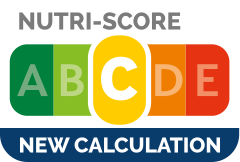 Average nutritional quality
Nutri-Score data warning
Nutrient levels
Fat in moderate quantity (7.51%)
Saturated fat in moderate quantity (3.29%)
Sugars in low quantity (0.469%)
Salt in moderate quantity (1.13%)
Nutrition facts
| Nutrition facts | As sold for 100 g / 100 ml |
|---|---|
| Energy | 589 kcal (141 kcal) |
| Fat | 7.51 g |
| Saturated fat | 3.29 g |
| Trans fat | 0 g |
| Cholesterol | 0.0211 g |
| Carbohydrates | 13.6 g |
| Sugars | 0.469 g |
| Added sugars | 0 g |
| Dietary fiber | 1.88 g |
| Proteins | 4.69 g |
| Salt | 1.13 g |
| Sodium | 0.451 g |
| Vitamin D | 0 g |
| Potassium | 0.131 g |
| Calcium | 0.0939 g |
| Iron | 0.000329 g |
| Fruits, vegetables and legumes | ? |
Nutrition facts (Detailed data)
| Nutrition facts | As sold for 100 g / 100 ml | As sold Per serving (legacy) |
|---|---|---|
| Energy | 589 kcal (141 kcal) | 1255 kcal (300 kcal) |
| Fat | 7.51 g | 16 g |
| Saturated fat | 3.29 g | 7 g |
| Trans fat | 0 g | 0 g |
| Cholesterol | 0.0211 g | 0.045 g |
| Carbohydrates | 13.6 g | 29 g |
| Sugars | 0.469 g | 1 g |
| Added sugars | 0 g | 0 g |
| Dietary fiber | 1.88 g | 4 g |
| Proteins | 4.69 g | 10 g |
| Salt | 1.13 g | 2.4 g |
| Sodium | 0.451 g | 0.96 g |
| Vitamin D | 0 g | 0 g |
| Potassium | 0.131 g | 0.28 g |
| Calcium | 0.0939 g | 0.2 g |
| Iron | 0.000329 g | 0.0007 g |
| Fruits, vegetables and legumes | ? | ? |
Serving size
Ingredients
Ingredients list
Ingredient information
Allergens
Ingredients analysis
Palm oil content unknown
Contains non-vegan ingredients.
Unrecognized: en:iron, en:pasteurized-process-swiss, en:contains-2-and-less-of-canola-oil, en:powdered-cellulose-to-prevent-caking, en:sorbic-acid-to-protect-flavor, en:annatto-color
Vegetarian status unknown
Unrecognized: en:iron, en:pasteurized-process-swiss, en:contains-2-and-less-of-canola-oil, en:powdered-cellulose-to-prevent-caking, en:sorbic-acid-to-protect-flavor, en:annatto-color
Food Processing
NOVA group
 Ultra-processed food and drink products
Elements that indicate the product is in NOVA group 4
How NOVA works
Additives
E160a - caroteneColour
β-Carotene is an organic, strongly colored red-orange pigment abundant in plants and fruits. It is a member of the carotenes, which are terpenoids (isoprenoids), synthesized biochemically from eight isoprene units and thus having 40 carbons. Among the carotenes, β-carotene is distinguished by having beta-rings at both ends of the molecule. β-Carotene is biosynthesized from geranylgeranyl pyrophosphate.β-Carotene is the most common form of carotene in plants. When used as a food coloring, it has the E number E160a. The structure was deduced by Karrer et al. in 1930. In nature, β-carotene is a precursor (inactive form) to vitamin A via the action of beta-carotene 15,15'-monooxygenase.Isolation of β-carotene from fruits abundant in carotenoids is commonly done using column chromatography. It can also be extracted from the beta-carotene rich algae, Dunaliella salina. The separation of β-carotene from the mixture of other carotenoids is based on the polarity of a compound. β-Carotene is a non-polar compound, so it is separated with a non-polar solvent such as hexane. Being highly conjugated, it is deeply colored, and as a hydrocarbon lacking functional groups, it is very lipophilic.
E200 - Sorbic acid EFSA overexposure risk: highPreservative
SORBIC ACID, or 2,4-hexadienoic acid, is a natural organic compound used as a food preservative. It has the chemical formula CH3(CH)4CO2H.
E270 - Lactic acid
LACTIC ACID is an organic compound with the formula CH3CH(OH)CO2H. In the form of its conjugate base called lactate (this is thus different and kept as a separate ingredient). Lactic acid is chiral, consisting of two optical isomers. One is known as L-(+)-lactic acid or (S)-lactic acid and the other, its mirror image, is D-(−)-lactic acid or (R)-lactic acid in food the L-variant is used
E304 - Fatty acid esters of ascorbic acidAntioxidant
ASCORBYL PALMITATE is an ester formed from ascorbic acid and palmitic acid creating a fat-soluble form of vitamin C.
E304i - Ascorbyl palmitateAntioxidant
No additive description is available yet.
E307 - Alpha-tocopherol
α-Tocopherol is a type of vitamin E. It has E number "E307". Vitamin E exists in eight different forms, four tocopherols and four tocotrienols. All feature a chromane ring, with a hydroxyl group that can donate a hydrogen atom to reduce free radicals and a hydrophobic side chain which allows for penetration into biological membranes. Compared to the others, α-tocopherol is preferentially absorbed and accumulated in humans.
E315 - Erythorbic acid EFSA overexposure risk: noAntioxidant
Erythorbic acid (isoascorbic acid, D-araboascorbic acid) is a stereoisomer of ascorbic acid (vitamin C). It is synthesized by a reaction between methyl 2-keto-D-gluconate and sodium methoxide. It can also be synthesized from sucrose or by strains of Penicillium that have been selected for this feature. It is denoted by E number E315, and is widely used as an antioxidant in processed foods.Clinical trials have been conducted to investigate aspects of the nutritional value of erythorbic acid. One such trial investigated the effects of erythorbic acid on vitamin C metabolism in young women; no effect on vitamin C uptake or clearance from the body was found. A later study found that erythorbic acid is a potent enhancer of nonheme-iron absorption.Since the U.S. Food and Drug Administration banned the use of sulfites as a preservative in foods intended to be eaten fresh (such as salad bar ingredients), the use of erythorbic acid as a food preservative has increased. It is also used as a preservative in cured meats and frozen vegetables.It was first synthesized in 1933 by the German chemists Kurt Maurer and Bruno Schiedt.
E410 - Locust bean gumEmulsifierStabiliserThickener
Locust bean gum (LBG, also known as carob gum, carob bean gum, carobin, E410) is a thickening agent and a gelling agent used in food technology.
E473 - Sucrose esters of fatty acids EFSA overexposure risk: highEmulsifierStabiliser
No additive description is available yet.
Environment
Green-Score, origins bonus, and transportation impact are shown for Worldwide .
Green Score
Overall grade
 Unknown environmental impact
About Green-Score
Current scope
Green-Score availability
Bonuses and maluses
Declared origins
Packaging impact
Packaging
Packaging impact
Data precision
Transportation
Declared origins
Forest footprint
Forest footprint
Ingredients linked to forest pressure
| Ingredient | Type | Percent in product | Forest footprint |
|---|---|---|---|
| EGG White | Oeufs Importés | 2.95 % | 0.00 |
Data Source
Product data comes from Open Food Facts. Food Benchmark also adds translations, category comparisons and explanatory calculations.
The database is licensed under ODbL 1.0, individual contents under DbCL 1.0, and product photos under CC BY-SA 3.0.
Product added on March 9, 2017 at 11:19:24 AM UTC by usda-ndb-import .
Last edit on February 4, 2026 at 12:57:06 AM UTC by macrofactor .
Product page also edited by macrofactor, org-database-usda, usda-ndb-import.
Source List
- usda-ndb
- database-usda