

Lotza Motzza Cheese Pizza
Health
Nutrition
Nutri-Score
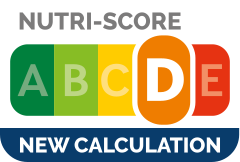 Lower nutritional quality
Nutri-Score data warning
Nutrient levels
Fat in moderate quantity (10.1%)
Saturated fat in high quantity (6.2%)
Sugars in low quantity (2.33%)
Salt in moderate quantity (1.22%)
Nutrition label

Nutrition facts
| Nutrition facts | As sold for 100 g / 100 ml |
|---|---|
| Energy | ~ 1017.93 kJ (282 kcal) |
| Fat | 10.08 g |
| Saturated fat | 6.2 g |
| Arachidic acid | 0.027 g |
| Alpha linolenic acid | 0.349 g |
| Arachidonic acid | 0.0014 g |
| Trans fat | 0 g |
| Cholesterol | 0.027 g |
| Carbohydrates | 21.71 g |
| Sugars | 2.33 g |
| Added sugars | 0 g |
| Starch | 0 g |
| Dietary fiber | 1.55 g |
| Proteins | 15.5 g |
| Salt | 1.2208 g |
| Sodium | 0.48832 g |
| Vitamin A | 0 g |
| Vitamin D | 0.00000014084507042254 g |
| Vitamin E | 0 g |
| Vitamin K | 0 g |
| Vitamin C | 0 g |
| Potassium | 0.246478873239437 g |
| Calcium | 0.349 g |
| Phosphorus | 0 g |
| Iron | 0.00147887323943662 g |
| Magnesium | 0 g |
| Zinc | 0 g |
| Copper | 0 g |
| Manganese | 0 g |
| Selenium | 0 g |
| Caffeine | 0 g |
| Fruits, vegetables and legumes | ~ 2.34375 % |
| Choline | 0 g |
Nutrition facts (Detailed data)
| Nutrition facts | As sold for 100 g / 100 ml | As sold Per 100 g (packaging) | As sold Per serving (142 g) (packaging) | As sold Per 100 g (estimate) |
|---|---|---|---|---|
| Energy | ~ 1017.93 kJ (282 kcal) | ? (282 kcal) | ? (330 kcal) | ? |
| Fat | 10.08 g | 10.08 g | 13 g | ? |
| Saturated fat | 6.2 g | 6.2 g | 7 g | ? |
| Arachidic acid | 0.027 g | 0.027 g | ? | ? |
| Alpha linolenic acid | 0.349 g | 0.349 g | ? | ? |
| Arachidonic acid | 0.0014 g | 0.0014 g | ? | ? |
| Trans fat | 0 g | 0 g | ? | ? |
| Cholesterol | 0.027 g | 0.027 g | 0.035 g | ? |
| Carbohydrates | 21.71 g | 21.71 g | 37 g | ? |
| Sugars | 2.33 g | 2.33 g | 5 g | ? |
| Added sugars | 0 g | 0 g | 1 g | ~ 0.18310546875 g |
| Starch | 0 g | 0 g | ? | ? |
| Dietary fiber | 1.55 g | 1.55 g | 2 g | ? |
| Proteins | 15.5 g | 15.5 g | 14 g | ? |
| Salt | 1.2208 g | 1.2208 g | ? | ? |
| Sodium | 0.48832 g | 0.48832 g | 0.74 g | ? |
| Vitamin A | 0 g | 0 g | ? | ? |
| Vitamin D | 0.00000014084507042254 g | ? | 0.0000002 g | ? |
| Vitamin E | 0 g | 0 g | ? | ? |
| Vitamin K | 0 g | 0 g | ? | ? |
| Vitamin C | 0 g | 0 g | ? | ? |
| Potassium | 0.246478873239437 g | ? | 0.35 g | ? |
| Calcium | 0.349 g | 0.349 g | 0.38 g | ? |
| Phosphorus | 0 g | 0 g | ? | ? |
| Iron | 0.00147887323943662 g | 0.00147887323943662 g | 0.0022 g | ? |
| Magnesium | 0 g | 0 g | ? | ? |
| Zinc | 0 g | 0 g | ? | ? |
| Copper | 0 g | 0 g | ? | ? |
| Manganese | 0 g | 0 g | ? | ? |
| Selenium | 0 g | 0 g | ? | ? |
| Caffeine | 0 g | 0 g | ? | ? |
| Fruits, vegetables and legumes | ~ 2.34375 % | ? | ? | ~ 2.34375 % |
| Choline | 0 g | 0 g | ? | ? |
Serving size
Ingredients
Ingredients image

Ingredients list
Ingredient information
Added sugars
Allergens
Ingredients analysis
No ingredients containing palm oil.
Contains non-vegan ingredients.
Unrecognized: en:propyl-gallate-with-citric-acid-added-to-help-protect-flavor, en:monohydrochloride
Contains non-vegetarian ingredients.
Unrecognized: en:propyl-gallate-with-citric-acid-added-to-help-protect-flavor, en:monohydrochloride
Food Processing
NOVA group
 Ultra-processed food and drink products
Elements that indicate the product is in NOVA group 4
How NOVA works
Additives
E320 - Butylated hydroxyanisole (bha)Antioxidant
Butylated hydroxyanisole (BHA) is an antioxidant consisting of a mixture of two isomeric organic compounds, 2-tert-butyl-4-hydroxyanisole and 3-tert-butyl-4-hydroxyanisole. It is prepared from 4-methoxyphenol and isobutylene. It is a waxy solid used as a food additive with the E number E320. The primary use for BHA is as an antioxidant and preservative in food, food packaging, animal feed, cosmetics, rubber, and petroleum products. BHA also is commonly used in medicines, such as isotretinoin, lovastatin, and simvastatin, among others.
E920 - l-cysteine
Cysteine (symbol Cys or C; ) is a semi-essential proteinogenic amino acid with the formula HO2CCH(NH2)CH2SH. The thiol side chain in cysteine often participates in enzymatic reactions, as a nucleophile. The thiol is susceptible to oxidation to give the disulfide derivative cystine, which serves an important structural role in many proteins. When used as a food additive, it has the E number E920. It is encoded by the codons UGU and UGC. Cysteine has the same structure as serine, but with one of its oxygen atoms replaced by sulfur; replacing it with selenium gives selenocysteine. (Like other natural proteinogenic amino acids cysteine has (L) chirality in the older D/L notation based on homology to D and L glyceraldehyde. In the newer R/S system of designating chirality, based on the atomic numbers of atoms near the asymmetric carbon, cysteine (and selenocysteine) have R chirality, because of the presence of sulfur (resp. selenium) as a second neighbor to the asymmetric carbon. The remaining chiral amino acids, having lighter atoms in that position, have S chirality.)
Environment
Green-Score, origins bonus, and transportation impact are shown for Worldwide .
Green Score
Overall grade
 Unknown environmental impact
About Green-Score
Current scope
Green-Score availability
Bonuses and maluses
Declared origins
Packaging impact
Packaging
Packaging impact
Data precision
Transportation
Declared origins
Data Source
Product data comes from Open Food Facts. Food Benchmark also adds translations, category comparisons and explanatory calculations.
The database is licensed under ODbL 1.0, individual contents under DbCL 1.0, and product photos under CC BY-SA 3.0.
Product added on March 9, 2017 at 1:24:05 PM UTC by usda-ndb-import .
Last edit on March 18, 2026 at 1:21:52 AM UTC by municorn-calorie-counter-app .
Product page also edited by allergies-app-chakib, kiliweb, macrofactor, municorn-calorie-counter-app, openfoodfacts-contributors, org-database-usda, roboto-app, usda-ndb-import, yuka.sY2b0xO6T85zoF3NwEKvlh1dcvrShRLuFx7ksHSpn8iBIobLS9hA55XGCKs.
Source List
- usda-ndb
- database-usda