
Twin cherries gummi candy
Health
Nutrition
Nutri-Score
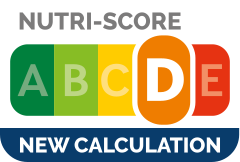 Lower nutritional quality
Nutri-Score data warning
Nutrient levels
Fat in low quantity (0.5%)
Saturated fat in low quantity (0.1%)
Sugars in high quantity (45%)
Salt in low quantity (0.01%)
Nutrition label

Nutrition facts
| Nutrition facts | As sold for 100 g / 100 ml | Compared to: Candies |
|---|---|---|
| Energy | 1446 kJ (340 kcal) | 1,499.536 kJ (349 kcal) (-4%) |
| Fat | 0.5 g | 1.532 g (-67%) |
| Saturated fat | 0.1 g | 0.854 g (-88%) |
| Carbohydrates | 77 g | 82.957 g (-7%) |
| Sugars | 45 g | 54.88 g (-18%) |
| Dietary fiber | ? | ? |
| Proteins | 6.3 g | 2.152 g (+193%) |
| Salt | 0.01 g | 0.127 g (-92%) |
| Sodium | 0.004 g | 0.051 g (-92%) |
| Fruits, vegetables and legumes | ~ 0.323392427884606 % | ? |
Nutrition facts (Detailed data)
| Nutrition facts | As sold for 100 g / 100 ml | As sold Per 100 g (packaging) | As sold Per 100 g (estimate) |
|---|---|---|---|
| Energy | 1446 kJ (340 kcal) | 1446 kJ (340 kcal) | ? |
| Fat | 0.5 g | 0.5 g | ? |
| Saturated fat | 0.1 g | 0.1 g | ? |
| Carbohydrates | 77 g | 77 g | ? |
| Sugars | 45 g | 45 g | ? |
| Dietary fiber | ? | ? | ? |
| Proteins | 6.3 g | 6.3 g | ? |
| Salt | 0.01 g | 0.01 g | ? |
| Sodium | 0.004 g | 0.004 g | ? |
| Fruits, vegetables and legumes | ~ 0.323392427884606 % | ? | ~ 0.323392427884606 % |
Ingredients
Ingredients image

Ingredients list
Ingredient information
Added sugars
Allergens
Ingredients analysis
No ingredients containing palm oil.
Contains non-vegan ingredients.
Unrecognized: fr:cire-d-abeille-blanche-etjaune
Contains non-vegetarian ingredients.
Unrecognized: fr:cire-d-abeille-blanche-etjaune
Food Processing
NOVA group
 Ultra-processed food and drink products
Elements that indicate the product is in NOVA group 4
How NOVA works
Additives
E330 - Citric acidAntioxidantSequestrant
Citric acid is a natural organic acid found in citrus fruits such as lemons, oranges, and limes.
It is widely used in the food industry as a flavor enhancer, acidulant, and preservative due to its tart and refreshing taste.
Citric acid is safe for consumption when used in moderation and is considered a generally recognized as safe (GRAS) food additive by regulatory agencies worldwide.
E428 - Gelatine
No additive description is available yet.
E901 - white and yellow beeswaxCarrierEmulsifierStabiliserThickener
Beeswax (cera alba) is a natural wax produced by honey bees of the genus Apis. The wax is formed into "scales" by eight wax-producing glands in the abdominal segments of worker bees, which discard it in or at the hive. The hive workers collect and use it to form cells for honey storage and larval and pupal protection within the beehive. Chemically, beeswax consists mainly of esters of fatty acids and various long-chain alcohols. Beeswax has long-standing applications in human food and flavoring. For example, it is used as a glazing agent or as a light/heat source. It is edible, in the sense of having similar negligible toxicity to plant waxes, and is approved for food use in most countries and the European Union under the E number E901. However, the wax monoesters in beeswax are poorly hydrolysed in the guts of humans and other mammals, so they have insignificant nutritional value. Some birds, such as honeyguides, can digest beeswax. Beeswax is the main diet of wax moth larvae.
E903 - Carnauba waxCarrier
Carnauba (; Portuguese: carnaúba [kaʁnɐˈubɐ]), also called Brazil wax and palm wax, is a wax of the leaves of the palm Copernicia prunifera (Synonym: Copernicia cerifera), a plant native to and grown only in the northeastern Brazilian states of Piauí, Ceará, Maranhão, Bahia, and Rio Grande do Norte. It is known as "queen of waxes" and in its pure state, usually comes in the form of hard yellow-brown flakes. It is obtained from the leaves of the carnauba palm by collecting and drying them, beating them to loosen the wax, then refining and bleaching the wax.
Environment
Green-Score, origins bonus, and transportation impact are shown for Worldwide .
Green Score
Overall grade
 Low environmental impact
About Green-Score
Current scope
Life cycle analysis
Average impact of the category
 Candies, all types • Score: 88/100
Life-cycle reference
Overall environmental impact by stage (PEF)
The overall environmental impact figure (PEF) comes from ADEME's Agribalyse database, for the category: Candies, all types. Source: ADEME Agribalyse Database.
| Stage | Impact |
|---|---|
| Agriculture | 47.6 % |
| Processing | 28.1 % |
| Packaging | 17.3 % |
| Transportation | 4.5 % |
| Distribution | 2.3 % |
| Consumption | 0.0 % |
Bonuses and maluses
Declared origins
Packaging impact
Green-Score for this product
Green-Score for this product
Final score: 68/100Final score breakdown
Carbon footprint
Carbon footprint
Climate impact by stage (CO2e)
The carbon emission figure comes from ADEME's Agribalyse database, for the category: Candies, all types. Source: ADEME Agribalyse Database.
| Stage | Impact |
|---|---|
| Agriculture | 46.7 % |
| Processing | 27.1 % |
| Packaging | 16.4 % |
| Transportation | 8.7 % |
| Distribution | 1.5 % |
| Consumption | 0.0 % |
Packaging
Packaging impact
Data precision
Transportation
Declared origins
Forest footprint
Forest footprint
Deforestation risk details
Data Source
Product data comes from Open Food Facts. Food Benchmark also adds translations, category comparisons and explanatory calculations.
The database is licensed under ODbL 1.0, individual contents under DbCL 1.0, and product photos under CC BY-SA 3.0.
Product added on October 6, 2017 at 9:36:55 AM UTC by kiliweb .
Last edit on March 18, 2026 at 12:11:02 AM UTC by new-nutrition-bot .
Product page also edited by boukipedia, kiliweb, new-nutrition-bot, openfoodfacts-contributors, yuka.U29JQUFLUllpT0FQb3M4NSt3eVA1Tk5mbnArYkJYdUdkZXNlSVE9PQ, yuka.WUowc0VJSU5vUEl1bk1VUCtRN1I0ZjVKL2M2c1UxanVMT29hSVE9PQ.