

Coca-Cola Zero Sugar
Health
Nutrition
Nutri-Score
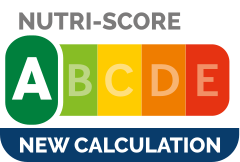 Very good nutritional quality
Nutri-Score data warning
Nutrient levels
Fat in low quantity (0%)
Saturated fat in low quantity (0%)
Sugars in low quantity (0%)
Salt in low quantity (0.1%)
Nutrition label

Nutrition facts
| Nutrition facts | As sold for 100 ml | Compared to: Carbonated soft drinks without fruit juice with sugar and artificial sweeteners |
|---|---|---|
| Energy | ~ 0 kJ (0 kcal) | 46.474 kJ (10 kcal) (-100%) |
| Fat | 0 g | 0 g |
| Saturated fat | 0 g | 0 g |
| Trans fat | 0 g | ? |
| Cholesterol | 0 g | ? |
| Carbohydrates | 0 g | 2.466 g (-100%) |
| Sugars | 0 g | 2.438 g (-100%) |
| Added sugars | 0 g | 2.235 g (-100%) |
| Starch | 0 g | ? |
| Dietary fiber | 0 g | ? |
| Proteins | 0 g | 0.022 g (-100%) |
| Salt | 0.1 g | 0.031 g (+223%) |
| Sodium | 0.04 g | 0.013 g (+208%) |
| Potassium | 0.0169014084507042 g | ? |
| Fruits, vegetables and legumes | ~ 0 % | ? |
| Choline | 0 g | ? |
Nutrition facts (Detailed data)
| Nutrition facts | As sold for 100 ml | As sold Per 100 ml (packaging) | As sold Per serving (355 ml) (packaging) | As sold Per 100 g (estimate) |
|---|---|---|---|---|
| Energy | ~ 0 kJ (0 kcal) | ? (0 kcal) | ? (0 kcal) | ? |
| Fat | 0 g | 0 g | 0 g | ? |
| Saturated fat | 0 g | 0 g | 0 g | ? |
| Trans fat | 0 g | ? | 0 g | ? |
| Cholesterol | 0 g | ? | 0 g | ? |
| Carbohydrates | 0 g | 0 g | 0 g | ? |
| Sugars | 0 g | 0 g | 0 g | ? |
| Added sugars | 0 g | ? | 0 g | ~ 0 g |
| Starch | 0 g | ? | 0 g | ? |
| Dietary fiber | 0 g | 0 g | 0 g | ? |
| Proteins | 0 g | 0 g | 0 g | ? |
| Salt | 0.1 g | 0.1 g | 0.1 g | ? |
| Sodium | 0.04 g | 40 mg | 0.04 g | ? |
| Potassium | 0.0169014084507042 g | ? | 0.06 g | ? |
| Fruits, vegetables and legumes | ~ 0 % | ? | ? | ~ 0 % |
| Choline | 0 g | ? | 0 g | ? |
Serving size
Ingredients
Ingredients image

Ingredients list
Ingredient information
Ingredients analysis
Palm oil content unknown
Unrecognized: es:carbonated-water, es:caramel-color, es:phosphoric-acid, es:potassium-benzoate, es:to-protect-taste, es:potassium-citrate, es:acesulfame-potassium, es:caffeine
Vegan status unknown
Unrecognized: es:carbonated-water, es:caramel-color, es:phosphoric-acid, es:to-protect-taste, es:potassium-citrate, es:acesulfame-potassium, es:caffeine
Vegetarian status unknown
Unrecognized: es:carbonated-water, es:caramel-color, es:phosphoric-acid, es:to-protect-taste, es:potassium-citrate, es:acesulfame-potassium, es:caffeine
Food Processing
NOVA group
 Ultra-processed food and drink products
Elements that indicate the product is in NOVA group 4
How NOVA works
Additives
E150c - Ammonia caramel EFSA overexposure risk: moderateColour
No additive description is available yet.
E212 - Potassium benzoate EFSA overexposure risk: highPreservative
Potassium benzoate (E212), the potassium salt of benzoic acid, is a food preservative that inhibits the growth of mold, yeast and some bacteria. It works best in low-pH products, below 4.5, where it exists as benzoic acid. Acidic foods and beverages such as fruit juice (citric acid), sparkling drinks (carbonic acid), soft drinks (phosphoric acid), pickles (vinegar), and frogurt toppings may be preserved with potassium benzoate. It is approved for use in most countries including Canada, the U.S., and the EU, where it is designated by the E number E212. Potassium benzoate is also used in the whistle in many fireworks.
E338 - Phosphoric acid EFSA overexposure risk: highAntioxidantSequestrant
Phosphoric acid (also known as orthophosphoric acid or phosphoric(V) acid) is a weak acid with the chemical formula H3PO4. Orthophosphoric acid refers to phosphoric acid, which is the IUPAC name for this compound. The prefix ortho- is used to distinguish the acid from related phosphoric acids, called polyphosphoric acids. Orthophosphoric acid is a non-toxic acid, which, when pure, is a solid at room temperature and pressure. The conjugate base of phosphoric acid is the dihydrogen phosphate ion, H2PO−4, which in turn has a conjugate base of hydrogen phosphate, HPO2−4, which has a conjugate base of phosphate, PO3−4. Phosphates are essential for life.The most common source of phosphoric acid is an 85% aqueous solution; such solutions are colourless, odourless, and non-volatile. The 85% solution is a syrupy liquid, but still pourable. Although phosphoric acid does not meet the strict definition of a strong acid, the 85% solution is acidic enough to be corrosive. Because of the high percentage of phosphoric acid in this reagent, at least some of the orthophosphoric acid is condensed into polyphosphoric acids; for the sake of labeling and simplicity, the 85% represents H3PO4 as if it were all in the ortho form. Dilute aqueous solutions of phosphoric acid exist in the ortho form.
E950 - Acesulfame kSweetener
Acesulfame potassium ( AY-see-SUL-faym), also known as acesulfame K (K is the symbol for potassium) or Ace K, is a calorie-free sugar substitute (artificial sweetener) often marketed under the trade names Sunett and Sweet One. In the European Union, it is known under the E number (additive code) E950. It was discovered accidentally in 1967 by German chemist Karl Clauss at Hoechst AG (now Nutrinova). In chemical structure, acesulfame potassium is the potassium salt of 6-methyl-1,2,3-oxathiazine-4(3H)-one 2,2-dioxide. It is a white crystalline powder with molecular formula C4H4KNO4S and a molecular weight of 201.24 g/mol.
E951 - Aspartame EFSA overexposure risk: noSweetener
Aspartame (E951) is a low-calorie artificial sweetener composed of two amino acids.
It is used as a sugar substitute in thousands of "sugar-free" or "diet" products, such as carbonated soft drinks, chewing gum, yogurts, and tabletop sweeteners, to provide sweetness without the calories of sugar.
Despite being one of the most rigorously tested food additives, its safety remains controversial. While major regulatory bodies like the FDA and EFSA deem it safe for the general public, the IARC has classified it as "possibly carcinogenic to humans" (Group 2B). It must also be avoided by individuals with the genetic condition phenylketonuria (PKU).
Environment
Green-Score, origins bonus, and transportation impact are shown for Worldwide .
Green Score
Overall grade
 Unknown environmental impact
About Green-Score
Current scope
Green-Score availability
Bonuses and maluses
Declared origins
Packaging impact
Packaging
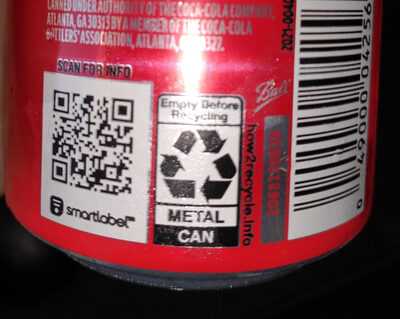
Packaging impact
Packaging components
| Shape | Material | Recycling | Impact |
|---|---|---|---|
| CAN | Heavy Aluminium | Unknown | Medium |
Declared packaging
Transportation
Declared origins
Data Source
Product data comes from Open Food Facts. Food Benchmark also adds translations, category comparisons and explanatory calculations.
The database is licensed under ODbL 1.0, individual contents under DbCL 1.0, and product photos under CC BY-SA 3.0.
Product added on October 8, 2016 at 3:51:04 PM UTC by kusuriya .
Last edit on March 18, 2026 at 12:44:37 AM UTC by nutria-chile .
Product page also edited by aaronasachimp, acrfb, aleene, baslad01, clon, ecoscore-impact-estimator, foodiq, hereticalhominid, inf, jim7061, kusuriya, macrofactor, municorn-calorie-counter-app, munkhtulgabt, nutria-chile, openfoodfacts-contributors, packbot, qalzy, roboto-app, swipe-studio.