

Sunny d, chillers, citrus punch, lemonade
Health
Nutrition
Nutri-Score
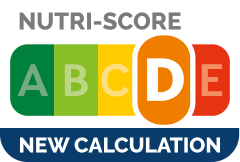 Lower nutritional quality
Nutri-Score data warning
Nutrient levels
Fat in low quantity (0%)
Saturated fat in low quantity (0%)
Sugars in moderate quantity (5.42%)
Salt in moderate quantity (0.177%)
Nutrition facts
| Nutrition facts | As sold for 100 g / 100 ml | Compared to: Lemonades |
|---|---|---|
| Energy | 88 kcal (21 kcal) | 114.404 kJ (27 kcal) |
| Energy from fat | 0 kcal | ? |
| Fat | 0 g | 0.046 g (-100%) |
| Saturated fat | 0 g | 0.011 g (-100%) |
| Trans fat | 0 g | 0 g |
| Cholesterol | 0 mg | 0 mg |
| Carbohydrates | 5.83 g | 6.51 g (-10%) |
| Sugars | 5.42 g | 6.285 g (-14%) |
| Dietary fiber | 0 g | ? |
| Proteins | 0 g | 0.057 g (-100%) |
| Salt | 0.1775 mg | 0.01 g (-98%) |
| Sodium | 0.071 mg | 0.004 g (-98%) |
| Vitamin A | 0 % DV | 0 µg |
| Vitamin C | 0.025 mg | ? |
| Vitamin B1 | 0 mg | ? |
| Potassium | 0 mg | 11.846 mg (-100%) |
| Calcium | 0 % DV | 11.033 mg |
| Iron | 0 % DV | 0.027 mg |
| Fruits, vegetables and legumes | ? | ? |
Nutrition facts (Detailed data)
| Nutrition facts | As sold for 100 g / 100 ml | As sold Per serving (legacy) |
|---|---|---|
| Energy | 88 kcal (21 kcal) | 211 kcal (50 kcal) |
| Energy from fat | 0 kcal | 0 kcal |
| Fat | 0 g | 0 g |
| Saturated fat | 0 g | 0 g |
| Trans fat | 0 g | 0 g |
| Cholesterol | 0 mg | 0 mg |
| Carbohydrates | 5.83 g | 14 g |
| Sugars | 5.42 g | 13 g |
| Dietary fiber | 0 g | 0 g |
| Proteins | 0 g | 0 g |
| Salt | 0.1775 mg | 0.426 mg |
| Sodium | 0.071 mg | 0.17 mg |
| Vitamin A | 0 % DV | 0 % DV |
| Vitamin C | 0.025 mg | 0.06 mg |
| Vitamin B1 | 0 mg | 0 mg |
| Potassium | 0 mg | 0 mg |
| Calcium | 0 % DV | 0 % DV |
| Iron | 0 % DV | 0 % DV |
| Fruits, vegetables and legumes | ? | ? |
Serving size
Ingredients
Ingredients list
Ingredient information
Added sugars
Allergens
Ingredients analysis
No ingredients containing palm oil.
Unrecognized: en:and-less-of-each-of-the-following, en:potassium-sorbate-to-protect-flavor
Vegan status unknown
Unrecognized: en:and-less-of-each-of-the-following, en:vitamin-c, en:thiamin-hydrochloride, en:thiamin, en:sodium-citrate, en:potassium-sorbate-to-protect-flavor
Vegetarian status unknown
Unrecognized: en:and-less-of-each-of-the-following, en:vitamin-c, en:thiamin-hydrochloride, en:thiamin, en:sodium-citrate, en:potassium-sorbate-to-protect-flavor
Food Processing
NOVA group
 Ultra-processed food and drink products
Elements that indicate the product is in NOVA group 4
How NOVA works
Additives
E102 - TartrazineColour
Tartrazine (E102) is a synthetic lemon-yellow azo dye used as a food coloring.
It is found in a wide range of products such as soft drinks, desserts, candies, and snack foods to give them a vibrant yellow appearance.
While approved by many regulatory agencies, tartrazine has been linked to allergic reactions, such as hives, in a small portion of the population. Some studies have also suggested a link to increased hyperactivity in children, particularly when consumed with other additives like benzoates.
E296 - Malic acid
MALIC ACID is an organic compound with the molecular formula C4H6O5. Malic acid has two stereoisomeric forms (L- and D-enantiomers), though only the L-isomer exists naturally.
E330 - Citric acidAntioxidantSequestrant
Citric acid is a natural organic acid found in citrus fruits such as lemons, oranges, and limes.
It is widely used in the food industry as a flavor enhancer, acidulant, and preservative due to its tart and refreshing taste.
Citric acid is safe for consumption when used in moderation and is considered a generally recognized as safe (GRAS) food additive by regulatory agencies worldwide.
E331 - Sodium citratesEmulsifierSequestrantStabiliser
DISODIUM CITRATE, more properly, disodium hydrogen citrate, is an acid salt of citric acid with the chemical formula Na2C6H6O7. It is used as an antioxidant in food and to improve the effects of other antioxidants. It is also used as an acidity regulator and sequestrant. Typical products include gelatin, jam, sweets, ice cream, carbonated beverages, milk powder, wine, and processed cheeses.
E452 - Polyphosphates EFSA overexposure risk: highEmulsifierHumectantSequestrantStabiliserThickener
No additive description is available yet.
E452i - Sodium polyphosphateEmulsifierHumectantSequestrantStabiliserThickener
No additive description is available yet.
E466 - Sodium carboxy methyl celluloseEmulsifierHumectantStabiliserThickener
Carboxymethyl cellulose (CMC) or cellulose gum or tylose powder is a cellulose derivative with carboxymethyl groups (-CH2-COOH) bound to some of the hydroxyl groups of the glucopyranose monomers that make up the cellulose backbone. It is often used as its sodium salt, sodium carboxymethyl cellulose.
E955 - SucraloseSweetener
Sucralose is an artificial sweetener and sugar substitute. The majority of ingested sucralose is not broken down by the body, so it is noncaloric. In the European Union, it is also known under the E number E955. It is produced by chlorination of sucrose. Sucralose is about 320 to 1,000 times sweeter than sucrose, three times as sweet as both aspartame and acesulfame potassium, and twice as sweet as sodium saccharin. Evidence of benefit is lacking for long-term weight loss with some data supporting weight gain and heart disease risks.It is stable under heat and over a broad range of pH conditions. Therefore, it can be used in baking or in products that require a long shelf life. The commercial success of sucralose-based products stems from its favorable comparison to other low-calorie sweeteners in terms of taste, stability, and safety. Common brand names of sucralose-based sweeteners are Splenda, Zerocal, Sukrana, SucraPlus, Candys, Cukren, and Nevella. Canderel Yellow also contains sucralose, but the original Canderel and Green Canderel do not.
Environment
Green-Score, origins bonus, and transportation impact are shown for Worldwide .
Green Score
Overall grade
About Green-Score
Current scope
Green-Score availability
Bonuses and maluses
Declared origins
Packaging impact
Packaging
Packaging impact
Data precision
Transportation
Declared origins
Data Source
Product data comes from Open Food Facts. Food Benchmark also adds translations, category comparisons and explanatory calculations.
The database is licensed under ODbL 1.0, individual contents under DbCL 1.0, and product photos under CC BY-SA 3.0.
Product added on January 18, 2015 at 9:24:14 PM UTC by tacinte .
Last edit on April 22, 2020 at 7:37:37 PM UTC by org-database-usda .
Product page also edited by bdwyer, tacinte, upcbot, usda-ndb-import, org-database-usda.
Source List
- usda-ndb
- database-usda