
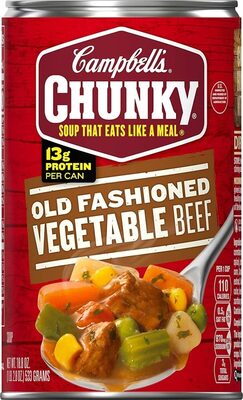
Chunky Old Fashioned Vegetable Beef
Health
Nutrition
Nutri-Score
 Good nutritional quality
Nutri-Score data warning
Nutrient levels
Fat in low quantity (0.833%)
Saturated fat in low quantity (0.313%)
Sugars in low quantity (1.46%)
Salt in moderate quantity (0.453%)
Nutrition facts
| Nutrition facts | As sold for 100 ml | Compared to: Canned vegetable soups |
|---|---|---|
| Energy | ~ 210.833333333333 kJ (47 kcal) | 186.499 kJ (43 kcal) (+13%) |
| Fat | 0.833333333333333 g | 1.499 g (-44%) |
| Saturated fat | 0.3125 g | 0.393 g (-20%) |
| Cholesterol | 0.00520833333333333 g | 1.195 mg (+336%) |
| Carbohydrates | 7.29166666666667 g | 5.477 g (+33%) |
| Sugars | 1.45833333333333 g | 1.613 g (-10%) |
| Added sugars | 0 g | 0.117 g (-100%) |
| Dietary fiber | 1.25 g | ? |
| Proteins | 2.70833333333333 g | 1.423 g (+90%) |
| Salt | 0.453125 g | 0.647 g (-30%) |
| Sodium | 0.395833333333333 g | 0.261 g (+52%) |
| Vitamin D | 0 g | 67,465.52 µg (-100%) |
| Potassium | 0.1875 g | 175.442 mg (+7%) |
| Calcium | 0.0166666666666667 g | 19.839 mg (-16%) |
| Iron | 0.0005 g | 0.468 mg (+7%) |
| Fruits, vegetables and legumes | ~ 16.1676432291667 % | ? |
Nutrition facts (Detailed data)
| Nutrition facts | As sold for 100 ml | As sold Per serving (480 ml) (packaging) | As sold Per 100 g (estimate) |
|---|---|---|---|
| Energy | ~ 210.833333333333 kJ (47 kcal) | ? (230 kcal) | ? |
| Fat | 0.833333333333333 g | 4 g | ? |
| Saturated fat | 0.3125 g | 1.5 g | ? |
| Cholesterol | 0.00520833333333333 g | 0.025 g | ? |
| Carbohydrates | 7.29166666666667 g | 35 g | ? |
| Sugars | 1.45833333333333 g | 7 g | ? |
| Added sugars | 0 g | 0 g | ~ 0 g |
| Dietary fiber | 1.25 g | 6 g | ? |
| Proteins | 2.70833333333333 g | 13 g | ? |
| Salt | 0.453125 g | 2.175 g | ? |
| Sodium | 0.395833333333333 g | 1.9 g | ? |
| Vitamin D | 0 g | 0 g | ? |
| Potassium | 0.1875 g | 0.9 g | ? |
| Calcium | 0.0166666666666667 g | 0.08 g | ? |
| Iron | 0.0005 g | 0.0024 g | ? |
| Fruits, vegetables and legumes | ~ 16.1676432291667 % | ? | ~ 16.1676432291667 % |
Serving size
Ingredients
Ingredients image

Ingredients list
Ingredient information
Allergens
Ingredients analysis
Palm oil content unknown
Contains non-vegan ingredients.
Unrecognized: en:beef-tallow
Contains non-vegetarian ingredients.
Unrecognized: en:beef-tallow
Food Processing
NOVA group
 Ultra-processed food and drink products
Elements that indicate the product is in NOVA group 4
How NOVA works
Additives
E150c - Ammonia caramel EFSA overexposure risk: moderateColour
No additive description is available yet.
E322 - LecithinsAntioxidantEmulsifier
Lecithins are natural compounds commonly used in the food industry as emulsifiers and stabilizers.
Extracted from sources like soybeans and eggs, lecithins consist of phospholipids that enhance the mixing of oil and water, ensuring smooth textures in various products like chocolates, dressings, and baked goods.
They do not present any known health risks.
E322i - LecithinAntioxidantEmulsifier
Lecithins are natural compounds commonly used in the food industry as emulsifiers and stabilizers.
Extracted from sources like soybeans and eggs, lecithins consist of phospholipids that enhance the mixing of oil and water, ensuring smooth textures in various products like chocolates, dressings, and baked goods.
They do not present any known health risks.
E415 - Xanthan gumEmulsifierStabiliserThickener
Xanthan gum (E415) is a natural polysaccharide derived from fermented sugars, often used in the food industry as a thickening and stabilizing agent.
This versatile food additive enhances texture and prevents ingredient separation in a wide range of products, including salad dressings, sauces, and gluten-free baked goods.
It is considered safe for consumption even at high intake amounts.
E620 - Glutamic acid
Glutamic acid (symbol Glu or E) is an α-amino acid that is used by almost all living beings in the biosynthesis of proteins. It is non-essential in humans, meaning the body can synthesize it. It is also an excitatory neurotransmitter, in fact the most abundant one, in the vertebrate nervous system. It serves as the precursor for the synthesis of the inhibitory gamma-aminobutyric acid (GABA) in GABA-ergic neurons. It has a formula C5H9O4N. Its molecular structure could be idealized as HOOC-CH(NH2)-(CH2)2-COOH, with two carboxyl groups -COOH and one amino group -NH2. However, in the solid state and mildly acid water solutions, the molecule assumes an electrically neutral zwitterion structure −OOC-CH(NH+3)-(CH2)2-COOH. It is encoded by the codons GAA or GAG. The acid can lose one proton from its second carboxyl group to form the conjugate base, the singly-negative anion glutamate −OOC-CH(NH+3)-(CH2)2-COO−. This form of the compound is prevalent in neutral solutions. The glutamate neurotransmitter plays the principal role in neural activation. This anion is also responsible for the savory flavor (umami) of certain foods, and used in glutamate flavorings such as MSG. In highly alkaline solutions the doubly negative anion −OOC-CH(NH2)-(CH2)2-COO− prevails. The radical corresponding to glutamate is called glutamyl.
Environment
Green-Score, origins bonus, and transportation impact are shown for Worldwide .
Green Score
Overall grade
 Very low environmental impact
About Green-Score
Current scope
Life cycle analysis
Average impact of the category
 Soup, mixed vegetables, prepacked, to be reheated • Score: 98/100
Life-cycle reference
Overall environmental impact by stage (PEF)
The overall environmental impact figure (PEF) comes from ADEME's Agribalyse database, for the category: Soup, mixed vegetables, prepacked, to be reheated. Source: ADEME Agribalyse Database.
| Stage | Impact |
|---|---|
| Agriculture | 20.9 % |
| Processing | 40.1 % |
| Packaging | 11.6 % |
| Transportation | 15.1 % |
| Distribution | 6.4 % |
| Consumption | 5.9 % |
Bonuses and maluses
Origins of ingredients
Packaging impact
Green-Score for this product
Green-Score for this product
Final score: 89/100Final score breakdown
Carbon footprint
Carbon footprint
Climate impact by stage (CO2e)
The carbon emission figure comes from ADEME's Agribalyse database, for the category: Soup, mixed vegetables, prepacked, to be reheated. Source: ADEME Agribalyse Database.
| Stage | Impact |
|---|---|
| Agriculture | 17.3 % |
| Processing | 30.0 % |
| Packaging | 19.1 % |
| Transportation | 28.2 % |
| Distribution | 3.3 % |
| Consumption | 2.2 % |
Packaging
Packaging impact
Packaging materials
| Material | % | Packaging weight | Packaging weight per 100 g of product |
|---|---|---|---|
| Metal | 100 % | ||
| Total | 100 % |
Packaging components
| Shape | Material | Recycling | Impact |
|---|---|---|---|
| 1 Food CAN | Metal | Recycle | High |
Data precision
Transportation
Manufacturing locations
Origins of ingredients
Origins breakdown
| Origin | Percent of ingredients | Impact |
|---|---|---|
| United States | 100 % | Medium |
Data Source
Product data comes from Open Food Facts. Food Benchmark also adds translations, category comparisons and explanatory calculations.
The database is licensed under ODbL 1.0, individual contents under DbCL 1.0, and product photos under CC BY-SA 3.0.
Product added on December 24, 2019 at 10:26:43 PM UTC by openfoodfacts-contributors .
Last edit on March 18, 2026 at 2:37:11 AM UTC by macrofactor .
Product page also edited by 5m4u9, inf, kiliweb, macrofactor, openfoodfacts-contributors, org-database-usda, wolfgang8741, yuka.sY2b0xO6T85zoF3NwEKvlnJJd8H-si7caDrRpxLa24qPNZCxfYl_uNjoFKs.
Source List
- database-usda