

CREAMY PEANUT BUTTER
Health
Nutrition
Nutri-Score
 Average nutritional quality
Nutri-Score data warning
Nutrient levels
Fat in high quantity (48.5%)
Saturated fat in high quantity (10.6%)
Sugars in moderate quantity (9.09%)
Salt in moderate quantity (1.06%)
Nutrition label

Nutrition facts
| Nutrition facts | As sold for 100 g / 100 ml | Compared to: Creamy peanut butters |
|---|---|---|
| Energy | ~ 2615.15151515152 kJ (575 kcal) | 2,573.488 kJ (606 kcal) (+2%) |
| Fat | 48.4848484848485 g | 49.216 g (-1%) |
| Saturated fat | 10.6060606060606 g | 8.47 g (+25%) |
| Trans fat | 0 g | ? |
| Cholesterol | 0 g | ? |
| Carbohydrates | 24.2424242424242 g | 16.81 g (+44%) |
| Sugars | 9.09090909090909 g | 7.113 g (+28%) |
| Added sugars | 6.06060606060606 g | 2.019 g (+200%) |
| Starch | 0 g | 3.725 g (-100%) |
| Dietary fiber | 6.06060606060606 g | ? |
| Proteins | 21.2121212121212 g | 24.544 g (-14%) |
| Salt | 1.06060606060606 g | 0.628 g (+69%) |
| Sodium | 0.424242424242424 g | 0.249 g (+70%) |
| Vitamin A | 0 g | ? |
| Vitamin E | 0.00606060606060606 g | 2.339 mg (+159%) |
| Vitamin K | 0 g | ? |
| Vitamin C | 0 g | ? |
| Potassium | 0.557575757575758 g | 604.342 mg (-8%) |
| Calcium | 0.0515151515151515 g | 60.019 mg (-14%) |
| Phosphorus | 0 g | ? |
| Iron | 0.00151515151515152 g | 2 mg (-24%) |
| Magnesium | 0 g | ? |
| Zinc | 0 g | ? |
| Copper | 0 g | ? |
| Manganese | 0 g | ? |
| Selenium | 0 g | ? |
| Caffeine | 0 g | ? |
| Fruits, vegetables and legumes | ~ 0.75 % | ? |
| Choline | 0 g | 0 g |
Nutrition facts (Detailed data)
| Nutrition facts | As sold for 100 g / 100 ml | As sold Per 100 g (packaging) | As sold Per serving (33 g) (packaging) | As sold Per 100 g (estimate) |
|---|---|---|---|---|
| Energy | ~ 2615.15151515152 kJ (575 kcal) | ? (575 kcal) | ? (190 kcal) | ~ 2396.625 kJ (577 kcal) |
| Fat | 48.4848484848485 g | ? | 16 g | ~ 44.754525 g |
| Saturated fat | 10.6060606060606 g | ? | 3.5 g | ~ 6.56775 g |
| Trans fat | 0 g | ? | 0 g | ? |
| Cholesterol | 0 g | ? | 0 mg | ~ 0.0016607025 g |
| Carbohydrates | 24.2424242424242 g | ? | 8 g | ~ 20.07015 g |
| Sugars | 9.09090909090909 g | ? | 3 g | ~ 6.465525 g |
| Added sugars | 6.06060606060606 g | 6.06060606060606 g | 2 g | ~ 3 g |
| Starch | 0 g | ? | 0 g | ~ 11.352825 g |
| Dietary fiber | 6.06060606060606 g | ? | 2 g | ~ 6.94305 g |
| Proteins | 21.2121212121212 g | ? | 7 g | ~ 20.2662 g |
| Salt | 1.06060606060606 g | ? | 0.35 g | ~ 2.508087 g |
| Sodium | 0.424242424242424 g | ? | 140 mg | ~ 0.9843026 g |
| Vitamin A | 0 g | ? | 0 g | ~ 0 g |
| Vitamin E | 0.00606060606060606 g | 6.06060606060606 mg | 0.002 g | ~ 0.00157626 g |
| Vitamin K | 0 g | ? | 0 g | ? |
| Vitamin C | 0 g | ? | 0 g | ~ 0.00056295 g |
| Potassium | 0.557575757575758 g | ? | 0.184 g | ~ 0.5963352875 g |
| Calcium | 0.0515151515151515 g | ? | 0.017 g | ~ 0.0705908375 g |
| Phosphorus | 0 g | ? | 0 g | ~ 0.41008225 g |
| Iron | 0.00151515151515152 g | 1.51515151515152 mg | 0.0005 g | ~ 0.00319478875 g |
| Magnesium | 0 g | ? | 0 g | ~ 0.15019588125 g |
| Zinc | 0 g | ? | 0 g | ~ 0.0027691745 g |
| Copper | 0 g | ? | 0 g | ~ 0.00103349625 g |
| Manganese | 0 g | ? | 0 g | ~ 0.0018307815 g |
| Selenium | 0 g | ? | 0 g | ~ 0.0000095366875 g |
| Caffeine | 0 g | ? | 0 g | ? |
| Fruits, vegetables and legumes | ~ 0.75 % | ? | ? | ~ 0.75 % |
| Choline | 0 g | ? | 0 g | ? |
Serving size
Ingredients
Ingredients image
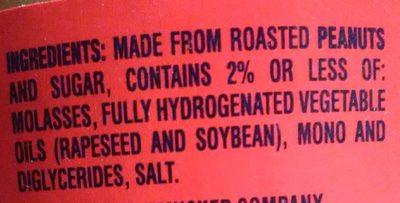
Ingredients list
Ingredient information
Added sugars
Allergens
Ingredients analysis
Palm oil content unknown
Vegan status unknown
Vegetarian status unknown
Food Processing
NOVA group
 Ultra-processed food and drink products
Elements that indicate the product is in NOVA group 4
How NOVA works
Additives
E471 - Mono- and diglycerides of fatty acidsEmulsifierStabiliser
Mono- and diglycerides of fatty acids (E471), are food additives commonly used as emulsifiers in various processed foods.
These compounds consist of glycerol molecules linked to one or two fatty acid chains, which help stabilize and blend water and oil-based ingredients. E471 enhances the texture and shelf life of products like margarine, baked goods, and ice cream, ensuring a smooth and consistent texture.
It is generally considered safe for consumption within established regulatory limits.
Environment
Green-Score, origins bonus, and transportation impact are shown for Worldwide .
Green Score
Overall grade
 High environmental impact
About Green-Score
Current scope
Life cycle analysis
Average impact of the category
 Peanut butter or peanut paste • Score: 49/100
Life-cycle reference
Overall environmental impact by stage (PEF)
The overall environmental impact figure (PEF) comes from ADEME's Agribalyse database, for the category: Peanut butter or peanut paste. Source: ADEME Agribalyse Database.
| Stage | Impact |
|---|---|
| Agriculture | 64.0 % |
| Processing | 12.5 % |
| Packaging | 14.1 % |
| Transportation | 5.4 % |
| Distribution | 1.7 % |
| Consumption | 2.4 % |
Bonuses and maluses
Declared origins
Packaging impact
Green-Score for this product
Green-Score for this product
Final score: 34/100Final score breakdown
Carbon footprint
Carbon footprint
Climate impact by stage (CO2e)
The carbon emission figure comes from ADEME's Agribalyse database, for the category: Peanut butter or peanut paste. Source: ADEME Agribalyse Database.
| Stage | Impact |
|---|---|
| Agriculture | 45.8 % |
| Processing | 11.6 % |
| Packaging | 24.4 % |
| Transportation | 9.4 % |
| Distribution | 0.9 % |
| Consumption | 8.0 % |
Packaging

Packaging impact
Packaging components
| Shape | Material | Recycling | Impact |
|---|---|---|---|
| JAR | Plastic | Unknown | High |
Declared packaging
Data precision
Transportation
Manufacturing locations
Declared origins
Forest footprint
Forest footprint
Deforestation risk details
Data Source
Product data comes from Open Food Facts. Food Benchmark also adds translations, category comparisons and explanatory calculations.
The database is licensed under ODbL 1.0, individual contents under DbCL 1.0, and product photos under CC BY-SA 3.0.
Product added on March 24, 2013 at 12:03:10 AM UTC by openfoodfacts-contributors .
Last edit on March 17, 2026 at 4:16:32 PM UTC by municorn-calorie-counter-app .
Product page also edited by aleene, allergies-app-chakib, baslad01, beniben, cbosdo, dieter501, duhowpi, ecoscore-impact-estimator, foodiq, foodless, foodvisor, hereticalhominid, inf, kiliweb, macrofactor, municorn-calorie-counter-app, openfoodfacts-contributors, packbot, roboto-app, sioul, tacite-mass-editor, teolemon, upcbot, yuka.U0t4YkxxSXR0UFE2b2RnNDVCUGwrdXh3L2NLQ2VtV3NJdWdjSVE9PQ, yuka.UUwwZ0NxUTcrZm94ZzlnUW95cmYwODkzdzRDclcwS05OYk5CSUE9PQ, yuka.Wi9BUkNhVTlpT0FhaWZFQ296Zkk2c0pwOVpDVlprcWxCK01BSWc9PQ, yuka.WnF4UVBKazVwL2MwZ1BBejhDdnUyOTVNNThLbVdXK05FczROSWc9PQ, yuka.sY2b0xO6T85zoF3NwEKvlkprS_7avWnoZz7nh2aA2YyMLL_QReEj8qrjD6s, yukafix.