

Swedish Fish mini
Health
Nutrition
Nutri-Score
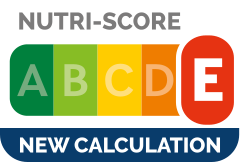 Lower nutritional quality
Nutri-Score data warning
Nutrient levels
Fat in low quantity (0%)
Saturated fat in low quantity (0%)
Sugars in high quantity (77%)
Salt in low quantity (0.11%)
Nutrition label

Nutrition facts
| Nutrition facts | As sold for 100 g / 100 ml | Compared to: Candies |
|---|---|---|
| Energy | 1494 kcal (357 kcal) | 1,498.506 kJ (350 kcal) |
| Fat | 0 g | 1.573 g (-100%) |
| Saturated fat | 0 g | 0.879 g (-100%) |
| Carbohydrates | 89 g | 82.849 g (+7%) |
| Sugars | 77 g | 54.883 g (+40%) |
| Added sugars | 67.6470588235294 g | 52.407 g (+29%) |
| Starch | 0 g | 3.542 g (-100%) |
| Dietary fiber | ? | ? |
| Proteins | 0 g | 2.159 g (-100%) |
| Salt | 0.11 g | 0.13 g (-15%) |
| Sodium | 0.044 g | 0.052 g (-15%) |
| Vitamin A | 0 mcg | 3.526 µg (-100%) |
| Vitamin E | 0 mg | 0.602 mg (-100%) |
| Vitamin K | 0 mcg | 0 µg |
| Vitamin C | 0 mg | ? |
| Vitamin B1 | 0 mg | ? |
| Vitamin B2 | 0 mg | ? |
| Vitamin B6 | 0 mg | ? |
| Vitamin B9 | 0 mcg | ? |
| Vitamin B12 | 0 mcg | ? |
| Phosphorus | 0 mg | 31.54 mg (-100%) |
| Iron | 0 mg | 0.352 mg (-100%) |
| Magnesium | 0 mg | 10.931 mg (-100%) |
| Zinc | 0 mg | 0.233 mg (-100%) |
| Copper | 0 mg | 0.043 mg (-100%) |
| Manganese | 0 mg | 0.151 mg (-100%) |
| Selenium | 0 mcg | 4.027 µg (-100%) |
| Caffeine | 0 mg | 0 mg |
| Fruits, vegetables and legumes | ? | ? |
| Choline | 0 mg | 0 g |
Nutrition facts (Detailed data)
| Nutrition facts | As sold for 100 g / 100 ml | As sold Per serving (legacy) |
|---|---|---|
| Energy | 1494 kcal (357 kcal) | 448 kcal (107 kcal) |
| Fat | 0 g | 0 g |
| Saturated fat | 0 g | 0 g |
| Carbohydrates | 89 g | 26.7 g |
| Sugars | 77 g | 23.1 g |
| Added sugars | 67.6470588235294 g | 20.3 g |
| Starch | 0 g | 0 g |
| Dietary fiber | ? | ? |
| Proteins | 0 g | 0 g |
| Salt | 0.11 g | 0.033 g |
| Sodium | 0.044 g | 0.0132 g |
| Vitamin A | 0 mcg | 0 mcg |
| Vitamin E | 0 mg | 0 mg |
| Vitamin K | 0 mcg | 0 mcg |
| Vitamin C | 0 mg | 0 mg |
| Vitamin B1 | 0 mg | 0 mg |
| Vitamin B2 | 0 mg | 0 mg |
| Vitamin B6 | 0 mg | 0 mg |
| Vitamin B9 | 0 mcg | 0 mcg |
| Vitamin B12 | 0 mcg | 0 mcg |
| Phosphorus | 0 mg | 0 mg |
| Iron | 0 mg | 0 mg |
| Magnesium | 0 mg | 0 mg |
| Zinc | 0 mg | 0 mg |
| Copper | 0 mg | 0 mg |
| Manganese | 0 mg | 0 mg |
| Selenium | 0 mcg | 0 mcg |
| Caffeine | 0 mg | 0 mg |
| Fruits, vegetables and legumes | ? | ? |
| Choline | 0 mg | 0 mg |
Serving size
Ingredients
Ingredients list
Ingredient information
Added sugars
Ingredients analysis
No ingredients containing palm oil.
Unrecognized: en:contains-less-than-2-of-citric-acid, en:white-mineral-oil
Vegan status unknown
Unrecognized: en:invert-sugar, en:contains-less-than-2-of-citric-acid, en:white-mineral-oil
Vegetarian status unknown
Unrecognized: en:invert-sugar, en:contains-less-than-2-of-citric-acid, en:white-mineral-oil
Food Processing
NOVA group
 Ultra-processed food and drink products
Elements that indicate the product is in NOVA group 4
How NOVA works
Additives
E129 - Allura red EFSA overexposure risk: noColour
Allura Red AC is a red azo dye that goes by several names, including FD&C Red 40. It is used as a food dye and has the E number E129. It is usually supplied as its red sodium salt, but can also be used as the calcium and potassium salts. These salts are soluble in water. In solution, its maximum absorbance lies at about 504 nm.
E330 - Citric acidAntioxidantSequestrant
Citric acid is a natural organic acid found in citrus fruits such as lemons, oranges, and limes.
It is widely used in the food industry as a flavor enhancer, acidulant, and preservative due to its tart and refreshing taste.
Citric acid is safe for consumption when used in moderation and is considered a generally recognized as safe (GRAS) food additive by regulatory agencies worldwide.
E903 - Carnauba waxCarrier
Carnauba (; Portuguese: carnaúba [kaʁnɐˈubɐ]), also called Brazil wax and palm wax, is a wax of the leaves of the palm Copernicia prunifera (Synonym: Copernicia cerifera), a plant native to and grown only in the northeastern Brazilian states of Piauí, Ceará, Maranhão, Bahia, and Rio Grande do Norte. It is known as "queen of waxes" and in its pure state, usually comes in the form of hard yellow-brown flakes. It is obtained from the leaves of the carnauba palm by collecting and drying them, beating them to loosen the wax, then refining and bleaching the wax.
E905 - Synthetic wax
Microcrystalline waxes are a type of wax produced by de-oiling petrolatum, as part of the petroleum refining process. In contrast to the more familiar paraffin wax which contains mostly unbranched alkanes, microcrystalline wax contains a higher percentage of isoparaffinic (branched) hydrocarbons and naphthenic hydrocarbons. It is characterized by the fineness of its crystals in contrast to the larger crystal of paraffin wax. It consists of high molecular weight saturated aliphatic hydrocarbons. It is generally darker, more viscous, denser, tackier and more elastic than paraffin waxes, and has a higher molecular weight and melting point. The elastic and adhesive characteristics of microcrystalline waxes are related to the non-straight chain components which they contain. Typical microcrystalline wax crystal structure is small and thin, making them more flexible than paraffin wax. It is commonly used in cosmetic formulations. Microcrystalline waxes when produced by wax refiners are typically produced to meet a number of ASTM specifications. These include congeal point (ASTM D938), needle penetration (D1321), color (ASTM D6045), and viscosity (ASTM D445). Microcrystalline waxes can generally be put into two categories: "laminating" grades and "hardening" grades. The laminating grades typically have a melt point of 140-175 F (60 - 80 oC) and needle penetration of 25 or above. The hardening grades will range from about 175-200 F (80 - 93 oC), and have a needle penetration of 25 or below. Color in both grades can range from brown to white, depending on the degree of processing done at the refinery level. Microcrystalline waxes are derived from the refining of the heavy distillates from lubricant oil production. This by-product must then be de-oiled at a wax refinery. Depending on the end use and desired specification, the product may then have its odor removed and color removed (which typically starts as a brown or dark yellow). This is usually done by means of a filtration method or by hydro-treating the wax material.
E905a - mineral oil
Microcrystalline waxes are a type of wax produced by de-oiling petrolatum, as part of the petroleum refining process. In contrast to the more familiar paraffin wax which contains mostly unbranched alkanes, microcrystalline wax contains a higher percentage of isoparaffinic (branched) hydrocarbons and naphthenic hydrocarbons. It is characterized by the fineness of its crystals in contrast to the larger crystal of paraffin wax. It consists of high molecular weight saturated aliphatic hydrocarbons. It is generally darker, more viscous, denser, tackier and more elastic than paraffin waxes, and has a higher molecular weight and melting point. The elastic and adhesive characteristics of microcrystalline waxes are related to the non-straight chain components which they contain. Typical microcrystalline wax crystal structure is small and thin, making them more flexible than paraffin wax. It is commonly used in cosmetic formulations. Microcrystalline waxes when produced by wax refiners are typically produced to meet a number of ASTM specifications. These include congeal point (ASTM D938), needle penetration (D1321), color (ASTM D6045), and viscosity (ASTM D445). Microcrystalline waxes can generally be put into two categories: "laminating" grades and "hardening" grades. The laminating grades typically have a melt point of 140-175 F (60 - 80 oC) and needle penetration of 25 or above. The hardening grades will range from about 175-200 F (80 - 93 oC), and have a needle penetration of 25 or below. Color in both grades can range from brown to white, depending on the degree of processing done at the refinery level. Microcrystalline waxes are derived from the refining of the heavy distillates from lubricant oil production. This by-product must then be de-oiled at a wax refinery. Depending on the end use and desired specification, the product may then have its odor removed and color removed (which typically starts as a brown or dark yellow). This is usually done by means of a filtration method or by hydro-treating the wax material.
Environment
Green-Score, origins bonus, and transportation impact are shown for Worldwide .
Green Score
Overall grade
 High environmental impact
About Green-Score
Current scope
Life cycle analysis
Average impact of the category
 Candies, all types • Score: 62/100
Life-cycle reference
Overall environmental impact by stage (PEF)
The overall environmental impact figure (PEF) comes from ADEME's Agribalyse database, for the category: Candies, all types. Source: ADEME Agribalyse Database.
| Stage | Impact |
|---|---|
| Agriculture | 78.2 % |
| Processing | 10.6 % |
| Packaging | 5.5 % |
| Transportation | 4.5 % |
| Distribution | 1.1 % |
| Consumption | 0.0 % |
Bonuses and maluses
Declared origins
Packaging impact
Green-Score for this product
Green-Score for this product
Final score: 42/100Final score breakdown
Carbon footprint
Carbon footprint
Climate impact by stage (CO2e)
The carbon emission figure comes from ADEME's Agribalyse database, for the category: Candies, all types. Source: ADEME Agribalyse Database.
| Stage | Impact |
|---|---|
| Agriculture | 52.2 % |
| Processing | 19.5 % |
| Packaging | 15.7 % |
| Transportation | 11.6 % |
| Distribution | 1.0 % |
| Consumption | 0.0 % |
Packaging
Packaging impact
Data precision
Transportation
Declared origins
Data Source
Product data comes from Open Food Facts. Food Benchmark also adds translations, category comparisons and explanatory calculations.
The database is licensed under ODbL 1.0, individual contents under DbCL 1.0, and product photos under CC BY-SA 3.0.
Product added on March 9, 2017 at 3:47:16 PM UTC by usda-ndb-import .
Last edit on August 29, 2025 at 4:27:55 PM UTC by municorn-calorie-counter-app .
Product page also edited by kiliweb, municorn-calorie-counter-app, org-database-usda, usda-ndb-import, wolfgang8741, yuka.sY2b0xO6T85zoF3NwEKvlhMaTsTVsAjoPCX6h3aGnveENofhYfpA24P6bqs, yuka.sY2b0xO6T85zoF3NwEKvlnwZcteAuW_NbiX6nUiSy4eJMczIYvxJ7In5Cqs.
Source List
- usda-ndb
- database-usda