

Blueberry Flavored Fruit & Grain Cereal Bars
Health
Nutrition
Nutri-Score
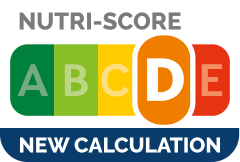 Lower nutritional quality
Nutri-Score data warning
Nutrient levels
Fat in moderate quantity (8.11%)
Saturated fat in low quantity (1.35%)
Sugars in high quantity (29.7%)
Salt in moderate quantity (0.372%)
Nutrition label

Nutrition facts
| Nutrition facts | As sold for 100 g / 100 ml | Compared to: Snacks |
|---|---|---|
| Energy | ~ 1583.78378378378 kJ (351 kcal) | 1,863.949 kJ (445 kcal) (-15%) |
| Fat | 8.10810810810811 g | 20.37 g (-60%) |
| Saturated fat | 1.35135135135135 g | 8.164 g (-83%) |
| Carbohydrates | 67.5675675675676 g | 55.72 g (+21%) |
| Sugars | 29.7297297297297 g | 27.383 g (+9%) |
| Added sugars | 27.027027027027 g | 20.23 g (+34%) |
| Dietary fiber | 5.40540540540541 g | ? |
| Proteins | 5.40540540540541 g | 6.501 g (-17%) |
| Salt | 0.371621621621622 g | 0.557 g (-33%) |
| Sodium | 0.148648648648649 g | 0.223 g (-33%) |
| Vitamin A | 0.000567567567567568 g | 22.704 µg (+2400%) |
| Vitamin PP | 0.0365243243243243 g | ? |
| Vitamin B6 | 0.00127027027027027 g | ? |
| Potassium | 0.162162162162162 g | 271.602 mg (-40%) |
| Calcium | 0.540540540540541 g | 58.953 mg (+817%) |
| Iron | 0.00621621621621622 g | 1.68 mg (+270%) |
| Zinc | 0.00378378378378378 g | 0.926 mg (+309%) |
| Fruits, vegetables and legumes | ~ 0 % | ? |
Nutrition facts (Detailed data)
| Nutrition facts | As sold for 100 g / 100 ml | As sold Per 100 g (packaging) | As sold Per 100 g (estimate) | As sold Per serving (37 g) (packaging) |
|---|---|---|---|---|
| Energy | ~ 1583.78378378378 kJ (351 kcal) | ? (351 kcal) | ? | ? (130 kcal) |
| Fat | 8.10810810810811 g | ? | ? | 3 g |
| Saturated fat | 1.35135135135135 g | ? | ? | 0.5 g |
| Carbohydrates | 67.5675675675676 g | ? | ? | 25 g |
| Sugars | 29.7297297297297 g | ? | ? | 11 g |
| Added sugars | 27.027027027027 g | 27.027027027027 g | ~ 42.6967007506128 g | 10 g |
| Dietary fiber | 5.40540540540541 g | ? | ? | 2 g |
| Proteins | 5.40540540540541 g | ? | ? | 2 g |
| Salt | 0.371621621621622 g | ? | ? | 0.1375 g |
| Sodium | 0.148648648648649 g | ? | ? | 0.055 g |
| Vitamin A | 0.000567567567567568 g | ? | ? | 0.00021 g |
| Vitamin PP | 0.0365243243243243 g | ? | ? | 0.013514 g |
| Vitamin B6 | 0.00127027027027027 g | 1.27027027027027 mg | ? | ? |
| Potassium | 0.162162162162162 g | ? | ? | 0.06 g |
| Calcium | 0.540540540540541 g | ? | ? | 0.2 g |
| Iron | 0.00621621621621622 g | 6.21621621621622 mg | ? | 0.0023 g |
| Zinc | 0.00378378378378378 g | 3.78378378378378 mg | ? | 0.0014 g |
| Fruits, vegetables and legumes | ~ 0 % | ? | ~ 0 % | ? |
Serving size
Ingredients
Ingredients list
Ingredient information
Added sugars
Allergens
Ingredients analysis
Contains ingredients containing palm oil.
Contains non-vegan ingredients.
Unrecognized: en:blueberry-filling, en:reduced-iron, en:natural-and-artificial-vanilla-flavor, en:reduced-iron, en:zinc-oxide
Vegetarian status unknown
Unrecognized: en:blueberry-filling, en:reduced-iron, en:natural-and-artificial-vanilla-flavor, en:reduced-iron, en:zinc-oxide
Food Processing
NOVA group
 Ultra-processed food and drink products
Elements that indicate the product is in NOVA group 4
How NOVA works
Additives
E129 - Allura red EFSA overexposure risk: noColour
Allura Red AC is a red azo dye that goes by several names, including FD&C Red 40. It is used as a food dye and has the E number E129. It is usually supplied as its red sodium salt, but can also be used as the calcium and potassium salts. These salts are soluble in water. In solution, its maximum absorbance lies at about 504 nm.
E133 - Brilliant blue FCF EFSA overexposure risk: moderateColour
BRILLIANT BLUE FCF (Blue 1) is an organic compound classified as a blue triarylmethane dye, reflecting its chemical structure. Known under various commercial names, it is a colorant for foods and other substances.
E296 - Malic acid
MALIC ACID is an organic compound with the molecular formula C4H6O5. Malic acid has two stereoisomeric forms (L- and D-enantiomers), though only the L-isomer exists naturally.
E319 - Tertiary-butylhydroquinone (tbhq)Antioxidant
tert-Butylhydroquinone (TBHQ, tertiary butylhydroquinone) is a synthetic aromatic organic compound which is a type of phenol. It is a derivative of hydroquinone, substituted with a tert-butyl group.
E322 - LecithinsAntioxidantEmulsifier
Lecithins are natural compounds commonly used in the food industry as emulsifiers and stabilizers.
Extracted from sources like soybeans and eggs, lecithins consist of phospholipids that enhance the mixing of oil and water, ensuring smooth textures in various products like chocolates, dressings, and baked goods.
They do not present any known health risks.
E322i - LecithinAntioxidantEmulsifier
Lecithins are natural compounds commonly used in the food industry as emulsifiers and stabilizers.
Extracted from sources like soybeans and eggs, lecithins consist of phospholipids that enhance the mixing of oil and water, ensuring smooth textures in various products like chocolates, dressings, and baked goods.
They do not present any known health risks.
E330 - Citric acidAntioxidantSequestrant
Citric acid is a natural organic acid found in citrus fruits such as lemons, oranges, and limes.
It is widely used in the food industry as a flavor enhancer, acidulant, and preservative due to its tart and refreshing taste.
Citric acid is safe for consumption when used in moderation and is considered a generally recognized as safe (GRAS) food additive by regulatory agencies worldwide.
E341 - Calcium phosphates EFSA overexposure risk: highEmulsifierHumectantSequestrantStabiliserThickener
Calcium phosphate is a family of materials and minerals containing calcium ions (Ca2+) together with inorganic phosphate anions. Some so-called calcium phosphates contain oxide and hydroxide as well. They are white solids of nutritious value.
E341i - Monocalcium phosphateEmulsifierHumectantSequestrantStabiliserThickener
No additive description is available yet.
E341ii - Dicalcium phosphateEmulsifierHumectantSequestrantStabiliserThickener
No additive description is available yet.
E401 - sodium alginateCarrierEmulsifierHumectantSequestrantStabiliserThickener
No additive description is available yet.
E415 - Xanthan gumEmulsifierStabiliserThickener
Xanthan gum (E415) is a natural polysaccharide derived from fermented sugars, often used in the food industry as a thickening and stabilizing agent.
This versatile food additive enhances texture and prevents ingredient separation in a wide range of products, including salad dressings, sauces, and gluten-free baked goods.
It is considered safe for consumption even at high intake amounts.
E422 - GlycerolHumectantThickener
Glycerol (; also called glycerine or glycerin; see spelling differences) is a simple polyol compound. It is a colorless, odorless, viscous liquid that is sweet-tasting and non-toxic. The glycerol backbone is found in all lipids known as triglycerides. It is widely used in the food industry as a sweetener and humectant and in pharmaceutical formulations. Glycerol has three hydroxyl groups that are responsible for its solubility in water and its hygroscopic nature.
E461 - methyl celluloseEmulsifierStabiliserThickener
METHYL CELLULOSE is a chemical compound derived from cellulose. Methyl cellulose is added to food products, to generate their characteristic thick consistency, for example ice cream or croquette.
E491 - Sorbitan monostearate EFSA overexposure risk: highEmulsifier
Sorbitan monostearate is an ester of sorbitan (a sorbitol derivative) and stearic acid and is sometimes referred to as a synthetic wax. It is primarily used as an emulsifier to keep water and oils mixed. Sorbitan monostearate is used in the manufacture of food and healthcare products and is a non-ionic surfactant with emulsifying, dispersing, and wetting properties. It is also employed to create synthetic fibers, metal machining fluid, and brighteners in the leather industry, and as an emulsifier in coatings, pesticides, and various applications in the plastics, food and cosmetics industries. Sorbitans are also known as "Spans". Sorbitan monostearate has been approved by the European Union for use as a food additive (emulsifier) (E number: E 491)
E501 - Potassium carbonatesStabiliser
Potassium carbonate (K2CO3) is a white salt, which is soluble in water (insoluble in ethanol) and forms a strongly alkaline solution. It can be made as the product of potassium hydroxide's absorbent reaction with carbon dioxide. It is deliquescent, often appearing a damp or wet solid. Potassium carbonate is used in the production of soap and glass.
E501ii - Potassium hydrogen carbonateStabiliser
No additive description is available yet.
Environment
Green-Score, origins bonus, and transportation impact are shown for Worldwide .
Green Score
Overall grade
 Unknown environmental impact
About Green-Score
Current scope
Green-Score availability
Bonuses and maluses
Declared origins
Threatened species risk
Packaging impact
Packaging
Packaging impact
Data precision
Transportation
Declared origins
Forest footprint
Forest footprint
Deforestation risk details
Data Source
Product data comes from Open Food Facts. Food Benchmark also adds translations, category comparisons and explanatory calculations.
The database is licensed under ODbL 1.0, individual contents under DbCL 1.0, and product photos under CC BY-SA 3.0.
Product added on March 9, 2017 at 12:12:40 PM UTC by usda-ndb-import .
Last edit on February 23, 2026 at 5:36:57 PM UTC by municorn-calorie-counter-app .
Product page also edited by kiliweb, macrofactor, municorn-calorie-counter-app, org-database-usda, teolemon, usda-ndb-import, yuka.sY2b0xO6T85zoF3NwEKvlkJVDePSnQuYZxnkp0m6_uukCafEYclzzdTcMKg.
Source List
- usda-ndb
- database-usda