
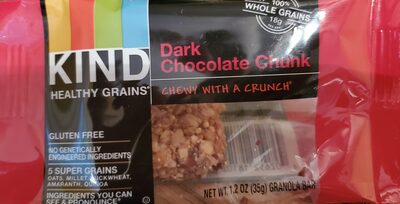
Healthy Grains Bar Dark Chocolate Chunk
Health
Nutrition
Nutri-Score
 Lower nutritional quality
Nutri-Score data warning
Nutrient levels
Fat in moderate quantity (14.3%)
Saturated fat in moderate quantity (4.29%)
Sugars in high quantity (22.9%)
Salt in moderate quantity (0.5%)
Nutrition label

Nutrition facts
| Nutrition facts | As sold for 100 g / 100 ml |
|---|---|
| Energy | ~ 1799.67 kJ (429 kcal) |
| Fat | 14.29 g |
| Saturated fat | 4.29 g |
| Trans fat | 0 g |
| Cholesterol | 0 g |
| Carbohydrates | 65.71 g |
| Sugars | 22.86 g |
| Dietary fiber | 7.1 g |
| Proteins | 5.71 g |
| Salt | 0.5 g |
| Sodium | 0.2 g |
| Vitamin A | 0 g |
| Vitamin C | 0 g |
| Calcium | 0.057 g |
| Iron | 0.00309 g |
| Fruits, vegetables and legumes | ~ 1.46484375 % |
Nutrition facts (Detailed data)
| Nutrition facts | As sold for 100 g / 100 ml | As sold Per 100 g (packaging) | As sold Per 100 g (estimate) |
|---|---|---|---|
| Energy | ~ 1799.67 kJ (429 kcal) | ? (429 kcal) | ? |
| Fat | 14.29 g | 14.29 g | ? |
| Saturated fat | 4.29 g | 4.29 g | ? |
| Trans fat | 0 g | 0 g | ? |
| Cholesterol | 0 g | 0 g | ? |
| Carbohydrates | 65.71 g | 65.71 g | ? |
| Sugars | 22.86 g | 22.86 g | ? |
| Dietary fiber | 7.1 g | 7.1 g | ? |
| Proteins | 5.71 g | 5.71 g | ? |
| Salt | 0.5 g | 0.5 g | ? |
| Sodium | 0.2 g | 0.2 g | ? |
| Vitamin A | 0 g | 0 g | ? |
| Vitamin C | 0 g | 0 g | ? |
| Calcium | 0.057 g | 0.057 g | ? |
| Iron | 0.00309 g | 0.00309 g | ? |
| Fruits, vegetables and legumes | ~ 1.46484375 % | ? | ~ 1.46484375 % |
Serving size
Ingredients
Ingredients list
Ingredient information
Allergens
Ingredients analysis
No ingredients containing palm oil.
Contains non-vegan ingredients.
No non-vegetarian ingredients.
Food Processing
NOVA group
 Ultra-processed food and drink products
Elements that indicate the product is in NOVA group 4
How NOVA works
Additives
E322 - LecithinsAntioxidantEmulsifier
Lecithins are natural compounds commonly used in the food industry as emulsifiers and stabilizers.
Extracted from sources like soybeans and eggs, lecithins consist of phospholipids that enhance the mixing of oil and water, ensuring smooth textures in various products like chocolates, dressings, and baked goods.
They do not present any known health risks.
E322i - LecithinAntioxidantEmulsifier
Lecithins are natural compounds commonly used in the food industry as emulsifiers and stabilizers.
Extracted from sources like soybeans and eggs, lecithins consist of phospholipids that enhance the mixing of oil and water, ensuring smooth textures in various products like chocolates, dressings, and baked goods.
They do not present any known health risks.
E414 - Acacia gumCarrierEmulsifierStabiliserThickener
Gum arabic, also known as acacia gum, arabic gum, gum acacia, acacia, Senegal gum and Indian gum, and by other names, is a natural gum consisting of the hardened sap of various species of the acacia tree. Originally, gum arabic was collected from Acacia nilotica which was called the "gum arabic tree"; in the present day, gum arabic is collected from acacia species, predominantly Acacia senegal and Vachellia (Acacia) seyal; the term "gum arabic" does not indicate a particular botanical source. In a few cases so‐called "gum arabic" may not even have been collected from Acacia species, but may originate from Combretum, Albizia or some other genus. Producers harvest the gum commercially from wild trees, mostly in Sudan (80%) and throughout the Sahel, from Senegal to Somalia—though it is historically cultivated in Arabia and West Asia. Gum arabic is a complex mixture of glycoproteins and polysaccharides. It is the original source of the sugars arabinose and ribose, both of which were first discovered and isolated from it, and are named after it. Gum arabic is soluble in water. It is edible, and used primarily in the food industry as a stabilizer, with EU E number E414. Gum arabic is a key ingredient in traditional lithography and is used in printing, paint production, glue, cosmetics and various industrial applications, including viscosity control in inks and in textile industries, though less expensive materials compete with it for many of these roles. While gum arabic is now produced throughout the African Sahel, it is still harvested and used in the Middle East.
Environment
Green-Score, origins bonus, and transportation impact are shown for Worldwide .
Green Score
Overall grade
 Unknown environmental impact
About Green-Score
Current scope
Green-Score availability
Bonuses and maluses
Declared origins
Packaging impact
Packaging
Packaging impact
Data precision
Transportation
Declared origins
Data Source
Product data comes from Open Food Facts. Food Benchmark also adds translations, category comparisons and explanatory calculations.
The database is licensed under ODbL 1.0, individual contents under DbCL 1.0, and product photos under CC BY-SA 3.0.
Product added on March 10, 2017 at 10:18:59 AM UTC by usda-ndb-import .
Last edit on March 17, 2026 at 5:24:12 PM UTC by new-nutrition-bot .
Product page also edited by e17j627x, inf, kiliweb, new-nutrition-bot, openfoodfacts-contributors, org-database-usda, org-label-non-gmo-project, roboto-app, usda-ndb-import, yuka.R1BrL0Y0RWxyOHNtc2M4N29pL04vYzBwMzdXdmMwZUtMZXdlSWc9PQ, yuka.UXEwa1M2RW1wY0pScFBBRC9ralE1K3BreEkyTVVFNkZLY2tYSWc9PQ, yukafix.
Source List
- usda-ndb
- database-usda
- label-non-gmo-project