

Made Good Granola Bars Chocolate Banana
Health
Nutrition
Nutri-Score
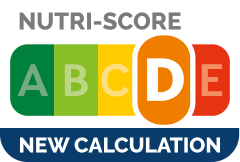 Lower nutritional quality
Nutri-Score data warning
Nutrient levels
Fat in moderate quantity (12.5%)
Saturated fat in moderate quantity (2.08%)
Sugars in high quantity (25%)
Salt in low quantity (0.104%)
Nutrition label

Nutrition facts
| Nutrition facts | As sold for 100 g / 100 ml | Compared to: Banana cereal bars |
|---|---|---|
| Energy | 1740 kcal (417 kcal) | 1,716.146 kJ (408 kcal) |
| Fat | 12.5 g | 13.032 g (-4%) |
| Saturated fat | 2.08 g | 5.382 g (-61%) |
| Trans fat | 0 g | ? |
| Cholesterol | 0 mg | ? |
| Carbohydrates | 70.8 g | 62.656 g (+13%) |
| Sugars | 25 g | 27.333 g (-9%) |
| Added sugars | 20.8 g | 23.252 g (-11%) |
| Dietary fiber | 4.17 g | ? |
| Proteins | 8.33 g | 6.738 g (+24%) |
| Salt | 0.104 mg | 0.237 g (-100%) |
| Sodium | 0.0417 mg | 0.09 g (-100%) |
| Vitamin A | 0.00075 µg | ? |
| Vitamin D | 0.0000167 µg | ? |
| Vitamin E | 0.0125 mg | ? |
| Vitamin C | 0.075 mg | ? |
| Vitamin B1 | 0.00125 mg | ? |
| Vitamin B6 | 0.00125 mg | ? |
| Potassium | 0.292 mg | 242.704 mg (-100%) |
| Calcium | 0.0417 mg | 37.594 mg (-100%) |
| Iron | 0.0025 mg | 2.136 mg (-100%) |
| Fruits, vegetables and legumes | ? | ? |
Nutrition facts (Detailed data)
| Nutrition facts | As sold for 100 g / 100 ml | As sold Per serving (legacy) |
|---|---|---|
| Energy | 1740 kcal (417 kcal) | 418 kcal (100 kcal) |
| Fat | 12.5 g | 3 g |
| Saturated fat | 2.08 g | 0.5 g |
| Trans fat | 0 g | 0 g |
| Cholesterol | 0 mg | 0 mg |
| Carbohydrates | 70.8 g | 17 g |
| Sugars | 25 g | 6 g |
| Added sugars | 20.8 g | 5 g |
| Dietary fiber | 4.17 g | 1 g |
| Proteins | 8.33 g | 2 g |
| Salt | 0.104 mg | 0.025 mg |
| Sodium | 0.0417 mg | 0.01 mg |
| Vitamin A | 0.00075 µg | 0.00018 µg |
| Vitamin D | 0.0000167 µg | 0.000004 µg |
| Vitamin E | 0.0125 mg | 0.003 mg |
| Vitamin C | 0.075 mg | 0.018 mg |
| Vitamin B1 | 0.00125 mg | 0.0003 mg |
| Vitamin B6 | 0.00125 mg | 0.0003 mg |
| Potassium | 0.292 mg | 0.07 mg |
| Calcium | 0.0417 mg | 0.01 mg |
| Iron | 0.0025 mg | 0.0006 mg |
| Fruits, vegetables and legumes | ? | ? |
Serving size
Ingredients
Ingredients image

Ingredients list
Ingredient information
Added sugars
Ingredients analysis
No ingredients containing palm oil.
Unrecognized: en:brown-rice-crisps
No non-vegan ingredients.
Unrecognized: en:brown-rice-crisps, en:vegetable-extract
No non-vegetarian ingredients.
Unrecognized: en:brown-rice-crisps, en:vegetable-extract
Food Processing
NOVA group
 Ultra-processed food and drink products
Elements that indicate the product is in NOVA group 4
How NOVA works
Additives
E406 - AgarCarrierEmulsifierHumectantStabiliserThickener
Agar (pronounced , sometimes ) or agar-agar is a jelly-like substance, obtained from red algae.Agar is a mixture of two components: the linear polysaccharide agarose, and a heterogeneous mixture of smaller molecules called agaropectin. It forms the supporting structure in the cell walls of certain species of algae, and is released on boiling. These algae are known as agarophytes, and belong to the Rhodophyta (red algae) phylum.Agar has been used as an ingredient in desserts throughout Asia, and also as a solid substrate to contain culture media for microbiological work. Agar can be used as a laxative, an appetite suppressant, a vegetarian substitute for gelatin, a thickener for soups, in fruit preserves, ice cream, and other desserts, as a clarifying agent in brewing, and for sizing paper and fabrics.The gelling agent in agar is an unbranched polysaccharide obtained from the cell walls of some species of red algae, primarily from tengusa (Gelidiaceae) and ogonori (Gracilaria). For commercial purposes, it is derived primarily from ogonori. In chemical terms, agar is a polymer made up of subunits of the sugar galactose.
Environment
Green-Score, origins bonus, and transportation impact are shown for Worldwide .
Green Score
Overall grade
 Moderate environmental impact
About Green-Score
Current scope
Life cycle analysis
Average impact of the category
 Cereal bar w fruit • Score: 74/100
Life-cycle reference
Overall environmental impact by stage (PEF)
The overall environmental impact figure (PEF) comes from ADEME's Agribalyse database, for the category: Cereal bar w fruit. Source: ADEME Agribalyse Database.
| Stage | Impact |
|---|---|
| Agriculture | 74.1 % |
| Processing | 12.8 % |
| Packaging | 7.4 % |
| Transportation | 4.2 % |
| Distribution | 1.5 % |
| Consumption | 0.0 % |
Bonuses and maluses
Declared origins
Packaging impact
Green-Score for this product
Green-Score for this product
Final score: 59/100Final score breakdown
Carbon footprint
Carbon footprint
Climate impact by stage (CO2e)
The carbon emission figure comes from ADEME's Agribalyse database, for the category: Cereal bar w fruit. Source: ADEME Agribalyse Database.
| Stage | Impact |
|---|---|
| Agriculture | 71.3 % |
| Processing | 9.7 % |
| Packaging | 11.5 % |
| Transportation | 6.7 % |
| Distribution | 0.8 % |
| Consumption | 0.0 % |
Packaging
Packaging impact
Packaging components
| Shape | Material | Recycling | Impact |
|---|---|---|---|
| 1 BOX (144 g) | Recycled Paper | Recycle | Unknown |
| 6 Wrapper (24 g) | Composite Material | Discard | Unknown |
Data precision
Transportation
Manufacturing locations
Declared origins
Data Source
Product data comes from Open Food Facts. Food Benchmark also adds translations, category comparisons and explanatory calculations.
The database is licensed under ODbL 1.0, individual contents under DbCL 1.0, and product photos under CC BY-SA 3.0.
Product added on March 10, 2017 at 11:08:46 AM UTC by usda-ndb-import .
Last edit on June 21, 2024 at 6:59:14 PM UTC by sierrakomodo .
Product page also edited by kiliweb, org-database-usda, org-label-non-gmo-project, roboto-app, sierrakomodo, usda-ndb-import, waistline-app, yogoff, yuka.sY2b0xO6T85zoF3NwEKvlmNXYvXsnzWbGxDmyBSb4Mm8FoHwRPFW7tn3Mag.
Source List
- usda-ndb
- database-usda
- label-non-gmo-project