
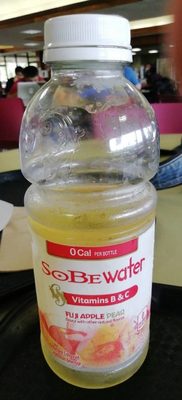
Sobe water fuji apple pear
Health
Nutrition
Nutri-Score
 Average nutritional quality
Nutri-Score data warning
Nutrient levels
Fat in low quantity (0%)
Saturated fat in low quantity (0%)
Sugars in low quantity (0%)
Salt in low quantity (0%)
Nutrition facts
| Nutrition facts | As sold for 100 ml | Compared to: Fruit-based foods and beverages |
|---|---|---|
| Energy | ~ 0 kJ (0 kcal) | 519.095 kJ (123 kcal) (-100%) |
| Fat | 0 g | 0.96 g (-100%) |
| Saturated fat | 0 g | 0.297 g (-100%) |
| Carbohydrates | 0 g | 24.091 g (-100%) |
| Sugars | 0 g | 21.085 g (-100%) |
| Dietary fiber | ? | ? |
| Proteins | 0 g | 0.7 g (-100%) |
| Salt | 0 g | 0.023 g (-100%) |
| Sodium | 0 g | 0.009 g (-100%) |
| Vitamin C | 0.004 g | ? |
| Vitamin PP | 0.000833 g | ? |
| Pantothenic acid | 0.000417 g | ? |
| Fruits, vegetables and legumes | ~ 0 % | ? |
Nutrition facts (Detailed data)
| Nutrition facts | As sold for 100 ml | As sold Per 100 ml (packaging) | As sold Per 100 g (estimate) |
|---|---|---|---|
| Energy | ~ 0 kJ (0 kcal) | ? (0 kcal) | ? |
| Fat | 0 g | 0 g | ? |
| Saturated fat | 0 g | 0 g | ? |
| Carbohydrates | 0 g | 0 g | ? |
| Sugars | 0 g | 0 g | ? |
| Dietary fiber | ? | ? | ? |
| Proteins | 0 g | 0 g | ? |
| Salt | 0 g | 0 g | ? |
| Sodium | 0 g | 0 g | ? |
| Vitamin C | 0.004 g | 0.004 g | ? |
| Vitamin PP | 0.000833 g | 0.000833 g | ? |
| Pantothenic acid | 0.000417 g | 0.000417 g | ? |
| Fruits, vegetables and legumes | ~ 0 % | ? | ~ 0 % |
Serving size
Ingredients
Ingredients image

Ingredients list
Ingredient information
Ingredients analysis
No ingredients containing palm oil.
Vegan status unknown
Unrecognized: en:garcinia-cambogia-rind-extract
Vegetarian status unknown
Unrecognized: en:garcinia-cambogia-rind-extract
Food Processing
NOVA group
 Ultra-processed food and drink products
Elements that indicate the product is in NOVA group 4
How NOVA works
Additives
E327 - calcium lactateThickener
Calcium lactate is a white crystalline salt with formula C6H10CaO6, consisting of two lactate anions H3C(CHOH)CO−2 for each calcium cation Ca2+. It forms several hydrates, the most common being the pentahydrate C6H10CaO6·5H2O. Calcium lactate is used in medicine, mainly to treat calcium deficiencies; and as a food additive with E number of E327. Some cheese crystals consist of calcium lactate.
E330 - Citric acidAntioxidantSequestrant
Citric acid is a natural organic acid found in citrus fruits such as lemons, oranges, and limes.
It is widely used in the food industry as a flavor enhancer, acidulant, and preservative due to its tart and refreshing taste.
Citric acid is safe for consumption when used in moderation and is considered a generally recognized as safe (GRAS) food additive by regulatory agencies worldwide.
E415 - Xanthan gumEmulsifierStabiliserThickener
Xanthan gum (E415) is a natural polysaccharide derived from fermented sugars, often used in the food industry as a thickening and stabilizing agent.
This versatile food additive enhances texture and prevents ingredient separation in a wide range of products, including salad dressings, sauces, and gluten-free baked goods.
It is considered safe for consumption even at high intake amounts.
E960 - Steviol glycosides EFSA overexposure risk: moderateSweetener
Steviol glycosides are the chemical compounds responsible for the sweet taste of the leaves of the South American plant Stevia rebaudiana (Asteraceae) and the main ingredients (or precursors) of many sweeteners marketed under the generic name stevia and several trade names. They also occur in the related species Stevia phlebophylla (but in no other species of Stevia) and in the plant Rubus chingii (Rosaceae).Steviol glycosides from Stevia rebaudiana have been reported to be between 30 and 320 times sweeter than sucrose, although there is some disagreement in the technical literature about these numbers. They are heat-stable, pH-stable, and do not ferment. Additionally, they do not induce a glycemic response when ingested, because humans can not metabolize stevia. This makes them attractive as natural sugar substitutes for diabetics and other people on carbohydrate-controlled diets. Steviol glycosides stimulate the insulin secretion through potentiation of the β-cell, preventing high blood glucose after a meal. The acceptable daily intake (ADI) for steviol glycosides, expressed as steviol equivalents, has been established to be 4 mg/kg body weight/day, and is based on no observed effects of a 100 fold higher dose in a rat study.
E968 - ErythritolHumectantSweetener
Erythritol ((2R,3S)-butane-1,2,3,4-tetrol) is a sugar alcohol (or polyol) that has been approved for use as a food additive in the United States and throughout much of the world. It was discovered in 1848 by Scottish chemist John Stenhouse. It occurs naturally in some fruit and fermented foods. At the industrial level, it is produced from glucose by fermentation with a yeast, Moniliella pollinis. Erythritol is 60–70% as sweet as sucrose (table sugar) yet it is almost noncaloric, does not affect blood sugar, does not cause tooth decay, and is partially absorbed by the body, excreted in urine and feces. Under U.S. Food and Drug Administration (FDA) labeling requirements, it has a caloric value of 0.2 kilocalories per gram (95% less than sugar and other carbohydrates), though nutritional labeling varies from country to country. Some countries, such as Japan and the United States, label it as zero-calorie; the European Union labels it 0 kcal/g.
Environment
Green-Score, origins bonus, and transportation impact are shown for Worldwide .
Green Score
Overall grade
 Moderate environmental impact
About Green-Score
Current scope
Life cycle analysis
Average impact of the category
 Fruit soft drink, still (fruit juice content unspecified), with sugar • Score: 69/100
Life-cycle reference
Overall environmental impact by stage (PEF)
The overall environmental impact figure (PEF) comes from ADEME's Agribalyse database, for the category: Fruit soft drink, still (fruit juice content unspecified), with sugar. Source: ADEME Agribalyse Database.
| Stage | Impact |
|---|---|
| Agriculture | 41.7 % |
| Processing | 0.1 % |
| Packaging | 27.0 % |
| Transportation | 17.1 % |
| Distribution | 11.0 % |
| Consumption | 3.1 % |
Bonuses and maluses
Declared origins
Packaging impact
Green-Score for this product
Green-Score for this product
Final score: 49/100Final score breakdown
Carbon footprint
Carbon footprint
Climate impact by stage (CO2e)
The carbon emission figure comes from ADEME's Agribalyse database, for the category: Fruit soft drink, still (fruit juice content unspecified), with sugar. Source: ADEME Agribalyse Database.
| Stage | Impact |
|---|---|
| Agriculture | 33.6 % |
| Processing | 0.0 % |
| Packaging | 24.4 % |
| Transportation | 34.5 % |
| Distribution | 6.4 % |
| Consumption | 1.2 % |
Packaging
Packaging impact
Data precision
Transportation
Declared origins
Forest footprint
Forest footprint
Deforestation risk details
Data Source
Product data comes from Open Food Facts. Food Benchmark also adds translations, category comparisons and explanatory calculations.
The database is licensed under ODbL 1.0, individual contents under DbCL 1.0, and product photos under CC BY-SA 3.0.
Product added on March 10, 2017 at 10:45:10 AM UTC by usda-ndb-import .
Last edit on March 18, 2026 at 12:40:44 AM UTC by new-nutrition-bot .
Product page also edited by jecrivaine, kiliweb, new-nutrition-bot, openfoodfacts-contributors, usda-ndb-import, yuka.WG9zc0U2aGZnOFlhdk0wbHB4cjUydXB3eHJUeEFuaUpBZlFKSWc9PQ.
Source List