

Lilys sweets caramelized salted chocolate bar
Health
Nutrition
Nutri-Score
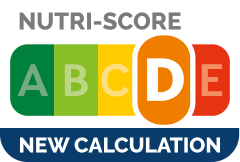 Lower nutritional quality
Nutri-Score data warning
Nutrient levels
Fat in high quantity (34.5%)
Saturated fat in high quantity (20.7%)
Sugars in moderate quantity (10.3%)
Salt in moderate quantity (0.69%)
Nutrition label

Nutrition facts
| Nutrition facts | As sold for 100 g / 100 ml | Compared to: Chocolate candies |
|---|---|---|
| Energy | 1730 kcal (414 kcal) | 2,163.344 kJ (518 kcal) |
| Fat | 34.5 g | 30.231 g (+14%) |
| Saturated fat | 20.7 g | 16.275 g (+27%) |
| Cholesterol | 0.0172 g | 8.9 mg (+93%) |
| Carbohydrates | 34.5 g | 53.615 g (-36%) |
| Sugars | 10.3 g | 46.118 g (-78%) |
| Dietary fiber | 20.7 g | ? |
| Proteins | 6.9 g | 6.193 g (+11%) |
| Salt | 0.69 g | 0.2 g (+245%) |
| Sodium | 0.276 g | 0.08 g (+245%) |
| Potassium | 0.431 g | 307.887 mg (+40%) |
| Calcium | 0.138 g | 107.301 mg (+29%) |
| Iron | 0.00448 g | 1.757 mg (+155%) |
| Fruits, vegetables and legumes | ? | ? |
Nutrition facts (Detailed data)
| Nutrition facts | As sold for 100 g / 100 ml | As sold Per serving (legacy) |
|---|---|---|
| Energy | 1730 kcal (414 kcal) | 502 kcal (120 kcal) |
| Fat | 34.5 g | 10 g |
| Saturated fat | 20.7 g | 6 g |
| Cholesterol | 0.0172 g | 0.005 g |
| Carbohydrates | 34.5 g | 10 g |
| Sugars | 10.3 g | 3 g |
| Dietary fiber | 20.7 g | 6 g |
| Proteins | 6.9 g | 2 g |
| Salt | 0.69 g | 0.2 g |
| Sodium | 0.276 g | 0.08 g |
| Potassium | 0.431 g | 0.125 g |
| Calcium | 0.138 g | 0.04 g |
| Iron | 0.00448 g | 0.0013 g |
| Fruits, vegetables and legumes | ? | ? |
Serving size
Ingredients
Ingredients image

Ingredients list
Ingredient information
Allergens
Ingredients analysis
No ingredients containing palm oil.
Unrecognized: en:stevia-extract
Contains non-vegan ingredients.
Unrecognized: en:stevia-extract
Vegetarian status unknown
Unrecognized: en:stevia-extract
Food Processing
NOVA group
 Ultra-processed food and drink products
Elements that indicate the product is in NOVA group 4
How NOVA works
Additives
E1400 - DextrinCarrierEmulsifierStabiliserThickener
Dextrins are a group of low-molecular-weight carbohydrates produced by the hydrolysis of starch or glycogen. Dextrins are mixtures of polymers of D-glucose units linked by α-(1→4) or α-(1→6) glycosidic bonds. Dextrins can be produced from starch using enzymes like amylases, as during digestion in the human body and during malting and mashing, or by applying dry heat under acidic conditions (pyrolysis or roasting). The latter process is used industrially, and also occurs on the surface of bread during the baking process, contributing to flavor, color and crispness. Dextrins produced by heat are also known as pyrodextrins. The starch hydrolyses during roasting under acidic conditions, and short-chained starch parts partially rebranch with α-(1,6) bonds to the degraded starch molecule. See also Maillard Reaction. Dextrins are white, yellow, or brown powders that are partially or fully water-soluble, yielding optically active solutions of low viscosity. Most of them can be detected with iodine solution, giving a red coloration; one distinguishes erythrodextrin (dextrin that colours red) and achrodextrin (giving no colour). White and yellow dextrins from starch roasted with little or no acid are called British gum.
E322 - LecithinsAntioxidantEmulsifier
Lecithins are natural compounds commonly used in the food industry as emulsifiers and stabilizers.
Extracted from sources like soybeans and eggs, lecithins consist of phospholipids that enhance the mixing of oil and water, ensuring smooth textures in various products like chocolates, dressings, and baked goods.
They do not present any known health risks.
E322i - LecithinAntioxidantEmulsifier
Lecithins are natural compounds commonly used in the food industry as emulsifiers and stabilizers.
Extracted from sources like soybeans and eggs, lecithins consist of phospholipids that enhance the mixing of oil and water, ensuring smooth textures in various products like chocolates, dressings, and baked goods.
They do not present any known health risks.
E968 - ErythritolHumectantSweetener
Erythritol ((2R,3S)-butane-1,2,3,4-tetrol) is a sugar alcohol (or polyol) that has been approved for use as a food additive in the United States and throughout much of the world. It was discovered in 1848 by Scottish chemist John Stenhouse. It occurs naturally in some fruit and fermented foods. At the industrial level, it is produced from glucose by fermentation with a yeast, Moniliella pollinis. Erythritol is 60–70% as sweet as sucrose (table sugar) yet it is almost noncaloric, does not affect blood sugar, does not cause tooth decay, and is partially absorbed by the body, excreted in urine and feces. Under U.S. Food and Drug Administration (FDA) labeling requirements, it has a caloric value of 0.2 kilocalories per gram (95% less than sugar and other carbohydrates), though nutritional labeling varies from country to country. Some countries, such as Japan and the United States, label it as zero-calorie; the European Union labels it 0 kcal/g.
Environment
Green-Score, origins bonus, and transportation impact are shown for Worldwide .
Green Score
Overall grade
 Unknown environmental impact
About Green-Score
Current scope
Green-Score availability
Bonuses and maluses
Production system
Declared origins
Packaging impact
Packaging
Packaging impact
Data precision
Transportation
Declared origins
Data Source
Product data comes from Open Food Facts. Food Benchmark also adds translations, category comparisons and explanatory calculations.
The database is licensed under ODbL 1.0, individual contents under DbCL 1.0, and product photos under CC BY-SA 3.0.
Product added on December 15, 2019 at 4:08:18 PM UTC by openfoodfacts-contributors .
Last edit on June 27, 2025 at 10:22:02 PM UTC by macrofactor .
Product page also edited by gaellebourdonnec, inf, kiliweb, macrofactor, openfoodfacts-contributors, org-database-usda, roboto-app, teolemon, yuka.sY2b0xO6T85zoF3NwEKvln16UNj-jzniaSDTwkTU6cepNsW1QMNOubXkbqs.
Source List
- database-usda