
Sweet smiles, sour neon worms
Health
Nutrition
Nutri-Score
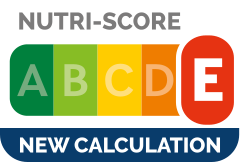 Lower nutritional quality
Nutri-Score data warning
Nutrient levels
Fat in low quantity (0%)
Saturated fat in low quantity (0%)
Sugars in high quantity (57.5%)
Salt in low quantity (0%)
Nutrition facts
| Nutrition facts | As sold for 100 g / 100 ml | Compared to: Confectioneries |
|---|---|---|
| Energy | 1360 kcal (325 kcal) | 1,789.073 kJ (424 kcal) |
| Fat | 0 g | 15.447 g (-100%) |
| Saturated fat | 0 g | 7.147 g (-100%) |
| Trans fat | 0 g | 0.026 g (-100%) |
| Cholesterol | 0 mg | 5.945 mg (-100%) |
| Carbohydrates | 77.5 g | 65.567 g (+18%) |
| Sugars | 57.5 g | 46.993 g (+22%) |
| Dietary fiber | 0 g | ? |
| Proteins | 0 g | 4.399 g (-100%) |
| Salt | 0 mg | 0.162 g (-100%) |
| Sodium | 0 mg | 0.065 g (-100%) |
| Vitamin A | 0 IU | 13.02 µg |
| Vitamin C | 0 mg | ? |
| Calcium | 0 mg | 79.411 mg (-100%) |
| Iron | 0 mg | 1.284 mg (-100%) |
| Fruits, vegetables and legumes | ? | ? |
Nutrition facts (Detailed data)
| Nutrition facts | As sold for 100 g / 100 ml | As sold Per serving (legacy) |
|---|---|---|
| Energy | 1360 kcal (325 kcal) | 544 kcal (130 kcal) |
| Fat | 0 g | 0 g |
| Saturated fat | 0 g | 0 g |
| Trans fat | 0 g | 0 g |
| Cholesterol | 0 mg | 0 mg |
| Carbohydrates | 77.5 g | 31 g |
| Sugars | 57.5 g | 23 g |
| Dietary fiber | 0 g | 0 g |
| Proteins | 0 g | 0 g |
| Salt | 0 mg | 0 mg |
| Sodium | 0 mg | 0 mg |
| Vitamin A | 0 IU | 0 IU |
| Vitamin C | 0 mg | 0 mg |
| Calcium | 0 mg | 0 mg |
| Iron | 0 mg | 0 mg |
| Fruits, vegetables and legumes | ? | ? |
Serving size
Ingredients
Ingredients list
Ingredient information
Added sugars
Allergens
Ingredients analysis
Palm oil content unknown
Unrecognized: en:fd-c-red-no, en:40, en:fd-c-yellow-no, en:5, en:fd-c-yellow-no, en:6, en:fd-c-blue-no, en:1
Contains non-vegan ingredients.
Unrecognized: en:sodium-citrate, en:fd-c-red-no, en:40, en:fd-c-yellow-no, en:5, en:fd-c-yellow-no, en:6, en:fd-c-blue-no, en:1
Contains non-vegetarian ingredients.
Unrecognized: en:sodium-citrate, en:fd-c-red-no, en:40, en:fd-c-yellow-no, en:5, en:fd-c-yellow-no, en:6, en:fd-c-blue-no, en:1
Food Processing
NOVA group
 Ultra-processed food and drink products
Elements that indicate the product is in NOVA group 4
How NOVA works
Additives
E171 - Titanium dioxideColour
Titanium dioxide, also known as titanium(IV) oxide or titania, is the naturally occurring oxide of titanium, chemical formula TiO2. When used as a pigment, it is called titanium white, Pigment White 6 (PW6), or CI 77891. Generally, it is sourced from ilmenite, rutile and anatase. It has a wide range of applications, including paint, sunscreen and food coloring. When used as a food coloring, it has E number E171. World production in 2014 exceeded 9 million metric tons. It has been estimated that titanium dioxide is used in two-thirds of all pigments, and the oxide has been valued at $13.2 billion.
E297 - Fumaric acid
Fumaric acid or trans-butenedioic acid is the chemical compound with the formula HO2CCH=CHCO2H. It is produced in eukaryotic organisms from succinate in complex 2 of the electron transport chain via the enzyme succinate dehydrogenase. It is one of two isomeric unsaturated dicarboxylic acids, the other being maleic acid. In fumaric acid the carboxylic acid groups are trans (E) and in maleic acid they are cis (Z). Fumaric acid has a fruit-like taste. The salts and esters are known as fumarates. Fumarate can also refer to the C4H2O2−4 ion (in solution).
E330 - Citric acidAntioxidantSequestrant
Citric acid is a natural organic acid found in citrus fruits such as lemons, oranges, and limes.
It is widely used in the food industry as a flavor enhancer, acidulant, and preservative due to its tart and refreshing taste.
Citric acid is safe for consumption when used in moderation and is considered a generally recognized as safe (GRAS) food additive by regulatory agencies worldwide.
E331 - Sodium citratesEmulsifierSequestrantStabiliser
DISODIUM CITRATE, more properly, disodium hydrogen citrate, is an acid salt of citric acid with the chemical formula Na2C6H6O7. It is used as an antioxidant in food and to improve the effects of other antioxidants. It is also used as an acidity regulator and sequestrant. Typical products include gelatin, jam, sweets, ice cream, carbonated beverages, milk powder, wine, and processed cheeses.
E334 - L(+)-tartaric acidAntioxidantSequestrant
TARTARIC ACID is a white, crystalline organic acid that occurs naturally in many fruits, most notably in grapes, but also in bananas, tamarinds, and citrus
E428 - Gelatine
No additive description is available yet.
Environment
Green-Score, origins bonus, and transportation impact are shown for Worldwide .
Green Score
Overall grade
 Unknown environmental impact
About Green-Score
Current scope
Green-Score availability
Bonuses and maluses
Declared origins
Packaging impact
Packaging
Packaging impact
Data precision
Transportation
Declared origins
Data Source
Product data comes from Open Food Facts. Food Benchmark also adds translations, category comparisons and explanatory calculations.
The database is licensed under ODbL 1.0, individual contents under DbCL 1.0, and product photos under CC BY-SA 3.0.
Product added on March 9, 2017 at 3:58:38 PM UTC by usda-ndb-import .
Last edit on April 22, 2020 at 8:30:09 PM UTC by org-database-usda .
Product page also edited by org-database-usda, usda-ndb-import.
Source List
- usda-ndb
- database-usda