

Sucettes mix
Health
Nutrition
Nutri-Score
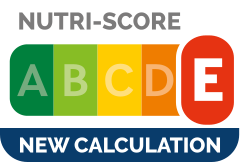 Lower nutritional quality
Nutri-Score data warning
Nutrient levels
Fat in low quantity (0.5%)
Saturated fat in low quantity (0.1%)
Sugars in high quantity (81%)
Salt in moderate quantity (0.31%)
Nutrition facts
| Nutrition facts | As sold for 100 g / 100 ml | Compared to: Lollipops |
|---|---|---|
| Energy | ~ 1625 kJ (382 kcal) | 1,661.435 kJ (389 kcal) (-2%) |
| Fat | 0.5 g | 4.896 g (-90%) |
| Saturated fat | 0.1 g | 2.911 g (-97%) |
| Carbohydrates | 94 g | 83.803 g (+12%) |
| Sugars | 81 g | 65.977 g (+23%) |
| Dietary fiber | ? | ? |
| Proteins | 0.5 g | 1.496 g (-67%) |
| Salt | 0.31 g | 0.1 g (+210%) |
| Sodium | 0.124 g | 0.04 g (+210%) |
| Fruits, vegetables and legumes | ~ 3.387451171875 % | ? |
Nutrition facts (Detailed data)
| Nutrition facts | As sold for 100 g / 100 ml | As sold Per 100 g (packaging) | As sold Per 100 g (estimate) |
|---|---|---|---|
| Energy | ~ 1625 kJ (382 kcal) | ? (382 kcal) | ? |
| Fat | 0.5 g | 0.5 g | ? |
| Saturated fat | 0.1 g | 0.1 g | ? |
| Carbohydrates | 94 g | 94 g | ? |
| Sugars | 81 g | 81 g | ? |
| Dietary fiber | ? | ? | ? |
| Proteins | 0.5 g | 0.5 g | ? |
| Salt | 0.31 g | 0.31 g | ? |
| Sodium | 0.124 g | 0.124 g | ? |
| Fruits, vegetables and legumes | ~ 3.387451171875 % | ? | ~ 3.387451171875 % |
Ingredients
Ingredients image

Ingredients list
Ingredient information
Added sugars
Allergens
Traces
Ingredients analysis
No ingredients containing palm oil.
Contains non-vegan ingredients.
Unrecognized: fr:jus-concentre-de-carotte-noire-a-propriete-colorante, fr:extrait-de-curcuma-a-propriete-colorante, fr:complexes-cuivriques-chlorophyllines
Contains non-vegetarian ingredients.
Unrecognized: fr:jus-concentre-de-carotte-noire-a-propriete-colorante, fr:extrait-de-curcuma-a-propriete-colorante, fr:complexes-cuivriques-chlorophyllines
Food Processing
NOVA group
 Ultra-processed food and drink products
Elements that indicate the product is in NOVA group 4
How NOVA works
Additives
E100 - CurcuminColour
No additive description is available yet.
E120 - CochinealColour
Cochineal extract or carmine (E120) is a natural red colorant derived from the dried bodies of the female cochineal insect.
It is widely used to impart a pink, red, or purple hue to various food and beverage products, including yogurts, ice creams, confectionery, and fruit juices.
Although it is a natural additive, E120 is known to cause severe allergic reactions, including anaphylaxis, in some individuals. It is also not suitable for vegetarians or vegans due to its insect origin.
E171 - Titanium dioxideColour
Titanium dioxide, also known as titanium(IV) oxide or titania, is the naturally occurring oxide of titanium, chemical formula TiO2. When used as a pigment, it is called titanium white, Pigment White 6 (PW6), or CI 77891. Generally, it is sourced from ilmenite, rutile and anatase. It has a wide range of applications, including paint, sunscreen and food coloring. When used as a food coloring, it has E number E171. World production in 2014 exceeded 9 million metric tons. It has been estimated that titanium dioxide is used in two-thirds of all pigments, and the oxide has been valued at $13.2 billion.
E270 - Lactic acid
LACTIC ACID is an organic compound with the formula CH3CH(OH)CO2H. In the form of its conjugate base called lactate (this is thus different and kept as a separate ingredient). Lactic acid is chiral, consisting of two optical isomers. One is known as L-(+)-lactic acid or (S)-lactic acid and the other, its mirror image, is D-(−)-lactic acid or (R)-lactic acid in food the L-variant is used
E325 - sodium lactateAntioxidantEmulsifierHumectantThickener
SODIUM LACTATE is the sodium salt of lactic acid, and has a mild saline taste. It is produced by fermentation of a sugar source, such as corn or beets. It acts as a preservative, acidity regulator, and bulking agent.
E330 - Citric acidAntioxidantSequestrant
Citric acid is a natural organic acid found in citrus fruits such as lemons, oranges, and limes.
It is widely used in the food industry as a flavor enhancer, acidulant, and preservative due to its tart and refreshing taste.
Citric acid is safe for consumption when used in moderation and is considered a generally recognized as safe (GRAS) food additive by regulatory agencies worldwide.
Environment
Green-Score, origins bonus, and transportation impact are shown for Worldwide .
Green Score
Overall grade
 Low environmental impact
About Green-Score
Current scope
Life cycle analysis
Average impact of the category
 Hard candy and lollipop • Score: 88/100
Life-cycle reference
Overall environmental impact by stage (PEF)
The overall environmental impact figure (PEF) comes from ADEME's Agribalyse database, for the category: Hard candy and lollipop. Source: ADEME Agribalyse Database.
| Stage | Impact |
|---|---|
| Agriculture | 50.2 % |
| Processing | 19.3 % |
| Packaging | 17.3 % |
| Transportation | 11.2 % |
| Distribution | 2.3 % |
| Consumption | 0.0 % |
Bonuses and maluses
Declared origins
Packaging impact
Green-Score for this product
Green-Score for this product
Final score: 68/100Final score breakdown
Carbon footprint
Carbon footprint
Climate impact by stage (CO2e)
The carbon emission figure comes from ADEME's Agribalyse database, for the category: Hard candy and lollipop. Source: ADEME Agribalyse Database.
| Stage | Impact |
|---|---|
| Agriculture | 42.2 % |
| Processing | 24.0 % |
| Packaging | 14.3 % |
| Transportation | 18.6 % |
| Distribution | 1.3 % |
| Consumption | 0.0 % |
Packaging
Packaging impact
Data precision
Transportation
Declared origins
Forest footprint
Forest footprint
Deforestation risk details
Data Source
Product data comes from Open Food Facts. Food Benchmark also adds translations, category comparisons and explanatory calculations.
The database is licensed under ODbL 1.0, individual contents under DbCL 1.0, and product photos under CC BY-SA 3.0.
Product added on August 7, 2018 at 5:18:05 PM UTC by kiliweb .
Last edit on March 18, 2026 at 12:15:38 AM UTC by new-nutrition-bot .
Product page also edited by inf, kiliweb, mrhalal, new-nutrition-bot, openfoodfacts-contributors, yuka.VzVFZENia2J2UDhGbC9abTJUM3RvOE56N2I2WmZUL21KTk1YSWc9PQ, yuka.WDdnK0U2TXErOXN3aDhZMDJ6anQzSWdxN2JPbVVFV09CK0VPSWc9PQ.