
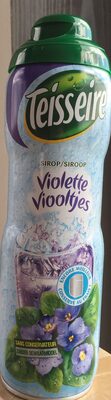
Sirop de violette
Health
Nutrition
Nutrient levels
Fat in low quantity (0%)
Saturated fat in low quantity (0%)
Sugars in moderate quantity (5.9%)
Salt in low quantity (0%)
Nutrition label
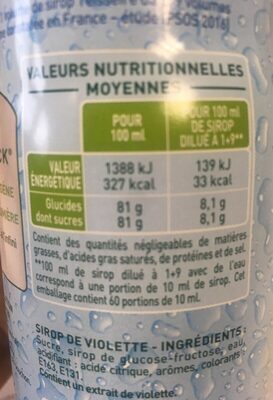
Nutrition facts
| Nutrition facts | As sold for 100 ml | Compared to: Violet Syrups |
|---|---|---|
| Energy | 107 kJ (25 kcal) | 1,160.413 kJ (265 kcal) (-91%) |
| Fat | 0 g | 0.1 g (-100%) |
| Saturated fat | 0 g | 0.027 g (-100%) |
| Carbohydrates | 6.2 g | 67.602 g (-91%) |
| Sugars | 5.9 g | 62.638 g (-91%) |
| Dietary fiber | 0 g | ? |
| Proteins | 0 g | 0.124 g (-100%) |
| Salt | 0 g | 0.02 g (-100%) |
| Sodium | 0 g | 0.008 g (-100%) |
| Fruits, vegetables and legumes | ~ 0 % | ? |
Nutrition facts (Detailed data)
| Nutrition facts | As sold for 100 ml | As sold Per 100 ml (packaging) | As sold Per 100 g (estimate) |
|---|---|---|---|
| Energy | 107 kJ (25 kcal) | 107 kJ (25 kcal) | ? |
| Fat | 0 g | 0 g | ? |
| Saturated fat | 0 g | 0 g | ? |
| Carbohydrates | 6.2 g | 6.2 g | ? |
| Sugars | 5.9 g | 5.9 g | ? |
| Dietary fiber | 0 g | 0 g | ? |
| Proteins | 0 g | 0 g | ? |
| Salt | 0 g | 0 g | ? |
| Sodium | 0 g | 0 g | ? |
| Fruits, vegetables and legumes | ~ 0 % | ? | ~ 0 % |
Serving size
Ingredients
Ingredients image
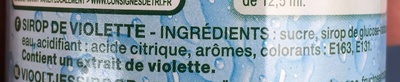
Ingredients list
Ingredient information
Added sugars
Ingredients analysis
No ingredients containing palm oil.
Vegan status unknown
Vegetarian status unknown
Food Processing
NOVA group
 Ultra-processed food and drink products
Elements that indicate the product is in NOVA group 4
How NOVA works
Additives
E131 - Patent blue v EFSA overexposure risk: moderate
PATENT BLUE V is a dark bluish synthetic triphenylmethane dye used as a food coloring. It is not widely used, but in Europe it can be found in Scotch eggs, certain jelly sweets, blue Curaçao, certain jello varieties (though not in actual Jell-O brand products), among others.
E163 - AnthocyaninsColour
Anthocyanins (also anthocyans; from Greek: ἄνθος (anthos) "flower" and κυάνεος/κυανοῦς kyaneos/kyanous "dark blue") are water-soluble vacuolar pigments that, depending on their pH, may appear red, purple, or blue. Food plants rich in anthocyanins include the blueberry, raspberry, black rice, and black soybean, among many others that are red, blue, purple, or black. Some of the colors of autumn leaves are derived from anthocyanins.Anthocyanins belong to a parent class of molecules called flavonoids synthesized via the phenylpropanoid pathway. They occur in all tissues of higher plants, including leaves, stems, roots, flowers, and fruits. Anthocyanins are derived from anthocyanidins by adding sugars. They are odorless and moderately astringent. Although approved to color foods and beverages in the European Union, anthocyanins are not approved for use as a food additive because they have not been verified as safe when used as food or supplement ingredients. There is no conclusive evidence anthocyanins have any effect on human biology or diseases.
E330 - Citric acidAntioxidantSequestrant
Citric acid is a natural organic acid found in citrus fruits such as lemons, oranges, and limes.
It is widely used in the food industry as a flavor enhancer, acidulant, and preservative due to its tart and refreshing taste.
Citric acid is safe for consumption when used in moderation and is considered a generally recognized as safe (GRAS) food additive by regulatory agencies worldwide.
Environment
Green-Score, origins bonus, and transportation impact are shown for Worldwide .
Green Score
Overall grade
 Very low environmental impact
About Green-Score
Current scope
Life cycle analysis
Average impact of the category
Syrup (mint, strawberries flavouredetc.), with sugar diluted in water • Score: 100/100Life-cycle reference
Overall environmental impact by stage (PEF)
The overall environmental impact figure (PEF) comes from ADEME's Agribalyse database, for the category: Syrup (mint, strawberries flavouredetc.), with sugar diluted in water. Source: ADEME Agribalyse Database.
| Stage | Impact |
|---|---|
| Agriculture | 64.4 % |
| Processing | 1.0 % |
| Packaging | 20.8 % |
| Transportation | 9.3 % |
| Distribution | 3.8 % |
| Consumption | 0.5 % |
Bonuses and maluses
Origins of ingredients
Packaging impact
Green-Score for this product
Green-Score for this product
Final score: 100/100Final score breakdown
Carbon footprint
Carbon footprint
Climate impact by stage (CO2e)
The carbon emission figure comes from ADEME's Agribalyse database, for the category: Syrup (mint, strawberries flavouredetc.), with sugar diluted in water. Source: ADEME Agribalyse Database.
| Stage | Impact |
|---|---|
| Agriculture | 49.3 % |
| Processing | 2.3 % |
| Packaging | 28.8 % |
| Transportation | 17.3 % |
| Distribution | 1.9 % |
| Consumption | 0.2 % |
Packaging

Packaging impact
Packaging components
| Shape | Material | Recycling | Impact |
|---|---|---|---|
| JUG | Steel | Recycle | Low |
Declared packaging
Transportation
Origins of ingredients
Origins breakdown
| Origin | Percent of ingredients | Impact |
|---|---|---|
| France | 100 % | Medium |
Forest footprint
Forest footprint
Deforestation risk details
Data Source
Product data comes from Open Food Facts. Food Benchmark also adds translations, category comparisons and explanatory calculations.
The database is licensed under ODbL 1.0, individual contents under DbCL 1.0, and product photos under CC BY-SA 3.0.
Product added on April 5, 2015 at 12:51:58 PM UTC by kewcyan .
Last edit on March 18, 2026 at 12:33:53 AM UTC by new-nutrition-bot .
Product page also edited by dorado, dorado-jerome, karbon, kewcyan, kiliweb, new-nutrition-bot, oatsbanana, packbot, quechoisir, roboto-app, sebleouf, segundo, yogoff, yuka.WHYwZUZJRXpyS2t6dlBRYnhFN1U0bzE0K3BhNVVFMm9kYzRoSVE9PQ, yuka.WktOWks0OG4rL1ZSdjhRVXpreU9vTkpsNmNlSVluaTJjdFlqSVE9PQ, yuka.ZWFVS1BxRmJndVV1d3NjaDhCelp3b04zMTZTdFVFRHRjc1lESVE9PQ, yuka.ZnFOY0g2VW5qOWtIaWRrZ3pDejQ4ZDU4enB1MmZXMlBkdXNWSWc9PQ, yuka.sY2b0xO6T85zoF3NwEKvllwfQYbPsCjkaxHiiBavx9erDbK0Yu8r2YXwaas.