

Milk Shake saveur Chocolat
Health
Nutrition
Nutri-Score data warning
Nutrient levels
Fat in moderate quantity (14%)
Saturated fat in moderate quantity (3.6%)
Sugars in high quantity (38%)
Salt in moderate quantity (1.5%)
Nutrition label

Nutrition facts
| Nutrition facts | Prepared for 100 g / 100 ml | Compared to: Low calorie milkshake meal replacement in powder reconstituted with skimmed milk |
|---|---|---|
| Energy | 1786 kJ (425 kcal) | 1,065.65 kJ (231 kcal) (+68%) |
| Fat | 14 g | 5.326 g (+163%) |
| Saturated fat | 3.6 g | 1.548 g (+133%) |
| Carbohydrates | 52 g | 17.548 g (+196%) |
| Sugars | 38 g | 8.884 g (+328%) |
| Dietary fiber | 7.6 g | ? |
| Proteins | 19 g | 24.897 g (-24%) |
| Salt | 1.5 g | 0.762 g (+97%) |
| Sodium | 0.6 g | 0.29 g (+107%) |
| Vitamin A | 0.000927 µg | ? |
| Vitamin D | 0.000005 µg | ? |
| Vitamin E | 0.019 mg | ? |
| Vitamin K | 0.000075 µg | ? |
| Vitamin C | 0.096 mg | ? |
| Vitamin B1 | 0.0019 mg | ? |
| Vitamin B2 | 0.0021 mg | ? |
| Vitamin PP | 0.02 mg | ? |
| Vitamin B6 | 0.0016 mg | ? |
| Vitamin B9 | 0.000211 µg | ? |
| Vitamin B12 | 0.0000033 µg | ? |
| Pantothenic acid | 0.0097 mg | ? |
| Potassium | 0.817 mg | ? |
| Calcium | 0.415 mg | ? |
| Phosphorus | 0.439 mg | ? |
| Iron | 0.02 mg | ? |
| Magnesium | 0.318 mg | ? |
| Zinc | 0.01 mg | ? |
| Copper | 0.0017 mg | ? |
| Manganese | 0.0027 mg | ? |
| Selenium | 0.000064 µg | ? |
| Iodine | 0.000183 µg | ? |
| Fruits, vegetables and legumes | ? | ? |
Nutrition facts (Detailed data)
| Nutrition facts | Prepared for 100 g / 100 ml | Prepared Per serving (legacy) |
|---|---|---|
| Energy | 1786 kJ (425 kcal) | ? |
| Fat | 14 g | ? |
| Saturated fat | 3.6 g | ? |
| Carbohydrates | 52 g | ? |
| Sugars | 38 g | ? |
| Dietary fiber | 7.6 g | ? |
| Proteins | 19 g | ? |
| Salt | 1.5 g | ? |
| Sodium | 0.6 g | ? |
| Vitamin A | 0.000927 µg | ? |
| Vitamin D | 0.000005 µg | ? |
| Vitamin E | 0.019 mg | ? |
| Vitamin K | 0.000075 µg | ? |
| Vitamin C | 0.096 mg | ? |
| Vitamin B1 | 0.0019 mg | ? |
| Vitamin B2 | 0.0021 mg | ? |
| Vitamin PP | 0.02 mg | ? |
| Vitamin B6 | 0.0016 mg | ? |
| Vitamin B9 | 0.000211 µg | ? |
| Vitamin B12 | 0.0000033 µg | ? |
| Pantothenic acid | 0.0097 mg | ? |
| Potassium | 0.817 mg | ? |
| Calcium | 0.415 mg | ? |
| Phosphorus | 0.439 mg | ? |
| Iron | 0.02 mg | ? |
| Magnesium | 0.318 mg | ? |
| Zinc | 0.01 mg | ? |
| Copper | 0.0017 mg | ? |
| Manganese | 0.0027 mg | ? |
| Selenium | 0.000064 µg | ? |
| Iodine | 0.000183 µg | ? |
| Fruits, vegetables and legumes | ? | ? |
Ingredients
Ingredients image
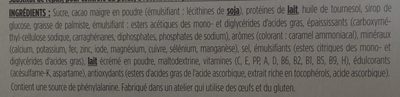
Ingredients list
Ingredient information
Added sugars
Allergens
Ingredients analysis
Contains ingredients containing palm oil.
Contains non-vegan ingredients.
Unrecognized: en:calcium, en:potassium, en:iron, en:zinc, en:iodine, en:magnesium, en:copper, en:selenium, en:manganese
Vegetarian status unknown
Unrecognized: en:calcium, en:potassium, en:iron, en:zinc, en:iodine, en:magnesium, en:copper, en:selenium, en:manganese
Food Processing
NOVA group
 Ultra-processed food and drink products
Elements that indicate the product is in NOVA group 4
How NOVA works
Additives
E150c - Ammonia caramel EFSA overexposure risk: moderateColour
No additive description is available yet.
E300 - Ascorbic acidAntioxidantSequestrant
No additive description is available yet.
E304 - Fatty acid esters of ascorbic acidAntioxidant
ASCORBYL PALMITATE is an ester formed from ascorbic acid and palmitic acid creating a fat-soluble form of vitamin C.
E306 - Tocopherol-rich extract
No additive description is available yet.
E322 - LecithinsAntioxidantEmulsifier
Lecithins are natural compounds commonly used in the food industry as emulsifiers and stabilizers.
Extracted from sources like soybeans and eggs, lecithins consist of phospholipids that enhance the mixing of oil and water, ensuring smooth textures in various products like chocolates, dressings, and baked goods.
They do not present any known health risks.
E322i - LecithinAntioxidantEmulsifier
Lecithins are natural compounds commonly used in the food industry as emulsifiers and stabilizers.
Extracted from sources like soybeans and eggs, lecithins consist of phospholipids that enhance the mixing of oil and water, ensuring smooth textures in various products like chocolates, dressings, and baked goods.
They do not present any known health risks.
E339 - Sodium phosphates EFSA overexposure risk: highEmulsifierHumectantPreservativeSequestrantStabiliserThickener
TRISODIUM PHOSPHATE is the inorganic compound with the chemical formula Na3PO4.
E407 - Carrageenan EFSA overexposure risk: highCarrierEmulsifierHumectantStabiliserThickener
Carrageenan (E407), derived from red seaweed, is widely employed in the food industry as a gelling, thickening, and stabilizing agent, notably in dairy and meat products.
It can exist in various forms, each imparting distinct textural properties to food.
However, its degraded form, often referred to as poligeenan, has raised health concerns due to its potential inflammatory effects and its classification as a possible human carcinogen (Group 2B) by the International Agency for Research on Cancer (IARC).
Nevertheless, food-grade carrageenan has been deemed safe by various regulatory bodies when consumed in amounts typically found in food.
E450 - Diphosphates EFSA overexposure risk: highEmulsifierHumectantSequestrantStabiliserThickener
Diphosphates (E450) are food additives often utilized to modify the texture of products, acting as leavening agents in baking and preventing the coagulation of canned food.
These salts can stabilize whipped cream and are also found in powdered products to maintain their flow properties. They are commonly present in baked goods, processed meats, and soft drinks.
Derived from phosphoric acid, they're part of our daily phosphate intake, which often surpasses recommended levels due to the prevalence of phosphates in processed foods and drinks.
Excessive phosphate consumption is linked to health issues, such as impaired kidney function and weakened bone health. Though diphosphates are generally regarded as safe when consumed within established acceptable daily intakes, it's imperative to monitor overall phosphate consumption to maintain optimal health.
E466 - Sodium carboxy methyl celluloseEmulsifierHumectantStabiliserThickener
Carboxymethyl cellulose (CMC) or cellulose gum or tylose powder is a cellulose derivative with carboxymethyl groups (-CH2-COOH) bound to some of the hydroxyl groups of the glucopyranose monomers that make up the cellulose backbone. It is often used as its sodium salt, sodium carboxymethyl cellulose.
E472a - Acetic acid esters of mono- and diglycerides of fatty acidsEmulsifierSequestrantStabiliser
No additive description is available yet.
E472c - Citric acid esters of mono- and diglycerides of fatty acidsAntioxidantEmulsifierSequestrantStabiliser
No additive description is available yet.
E950 - Acesulfame kSweetener
Acesulfame potassium ( AY-see-SUL-faym), also known as acesulfame K (K is the symbol for potassium) or Ace K, is a calorie-free sugar substitute (artificial sweetener) often marketed under the trade names Sunett and Sweet One. In the European Union, it is known under the E number (additive code) E950. It was discovered accidentally in 1967 by German chemist Karl Clauss at Hoechst AG (now Nutrinova). In chemical structure, acesulfame potassium is the potassium salt of 6-methyl-1,2,3-oxathiazine-4(3H)-one 2,2-dioxide. It is a white crystalline powder with molecular formula C4H4KNO4S and a molecular weight of 201.24 g/mol.
E951 - Aspartame EFSA overexposure risk: noSweetener
Aspartame (E951) is a low-calorie artificial sweetener composed of two amino acids.
It is used as a sugar substitute in thousands of "sugar-free" or "diet" products, such as carbonated soft drinks, chewing gum, yogurts, and tabletop sweeteners, to provide sweetness without the calories of sugar.
Despite being one of the most rigorously tested food additives, its safety remains controversial. While major regulatory bodies like the FDA and EFSA deem it safe for the general public, the IARC has classified it as "possibly carcinogenic to humans" (Group 2B). It must also be avoided by individuals with the genetic condition phenylketonuria (PKU).
Environment
Green-Score, origins bonus, and transportation impact are shown for Worldwide .
Green Score
Overall grade
 Moderate environmental impact
About Green-Score
Current scope
Life cycle analysis
Average impact of the category
 Meal replacement low calorie, in powder, reconstituted with skimmed milk, milkshake type • Score: 81/100
Life-cycle reference
Overall environmental impact by stage (PEF)
The overall environmental impact figure (PEF) comes from ADEME's Agribalyse database, for the category: Meal replacement low calorie, in powder, reconstituted with skimmed milk, milkshake type. Source: ADEME Agribalyse Database.
| Stage | Impact |
|---|---|
| Agriculture | 56.8 % |
| Processing | 17.1 % |
| Packaging | 15.9 % |
| Transportation | 5.8 % |
| Distribution | 3.5 % |
| Consumption | 0.9 % |
Bonuses and maluses
Declared origins
Threatened species risk
Packaging impact
Green-Score for this product
Green-Score for this product
Final score: 55/100Final score breakdown
Carbon footprint
Carbon footprint
Climate impact by stage (CO2e)
The carbon emission figure comes from ADEME's Agribalyse database, for the category: Meal replacement low calorie, in powder, reconstituted with skimmed milk, milkshake type. Source: ADEME Agribalyse Database.
| Stage | Impact |
|---|---|
| Agriculture | 68.8 % |
| Processing | 12.1 % |
| Packaging | 8.3 % |
| Transportation | 8.7 % |
| Distribution | 1.7 % |
| Consumption | 0.3 % |
Packaging
Packaging impact
Packaging components
| Shape | Material | Recycling | Impact |
|---|---|---|---|
| BAG | Plastic | Unknown | High |
| BOX | Cardboard | Unknown | Low |
Declared packaging
Transportation
Declared origins
Forest footprint
Forest footprint
Deforestation risk details
Data Source
Product data comes from Open Food Facts. Food Benchmark also adds translations, category comparisons and explanatory calculations.
The database is licensed under ODbL 1.0, individual contents under DbCL 1.0, and product photos under CC BY-SA 3.0.
Product added on August 4, 2016 at 6:11:52 PM UTC by openfoodfacts-contributors .
Last edit on September 4, 2025 at 5:57:13 PM UTC by jusdekiwi .
Product page also edited by alexfauquette, beniben, date-limite-app, ecoscore-impact-estimator, fix-serving-size-bot, foodvisor, jusdekiwi, kiliweb, laura-chaud, openfoodfacts-contributors, packbot, quechoisir, yuka.R1A0a1BJc1RyUFVobWZJVTVURGMrKzF1bkphMFRHUHRjczhySVE9PQ, yuka.U2FjRUFQb2RvZXM3dTg4QTNCVHc0NGtwd01LckJHeTlDczFKSUE9PQ, yuka.WDdFTFNhVU9nZHNVdnRnaDRRL3Q2OTFYK0s2Q2QxT1dPN1VXSWc9PQ, yuka.WFlVTEY1UWVwK0Jibk04YjdoM1U4STVLd3Eya1R6bW1DZlFWSVE9PQ, yuka.ZElveExLTTZpUDBVb3NRVTFDN00rT3hrdzhXMWVFQ01MT3d3SVE9PQ, yuka.sY2b0xO6T85zoF3NwEKvlkdXDdburyuaZwbWnHKG--ujB4ywWeltyZf7Las.