
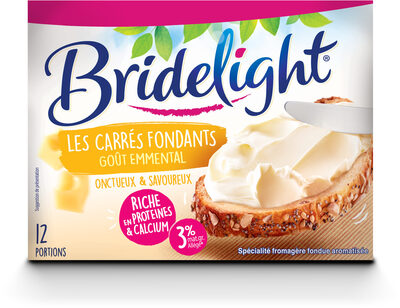
Bridelight 12 portions gout emmental 3%mg 200g
Health
Nutrition
Nutri-Score
 Average nutritional quality
Nutri-Score data warning
Nutrient levels
Fat in moderate quantity (3%)
Saturated fat in moderate quantity (2%)
Sugars in moderate quantity (8.5%)
Salt in high quantity (2%)
Nutrition label
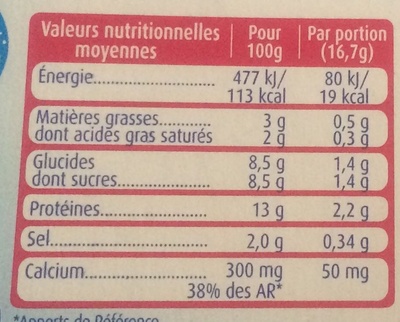
Nutrition facts
| Nutrition facts | As sold for 100 g / 100 ml | Compared to: Processed cheeses |
|---|---|---|
| Energy | 477 kJ (113 kcal) | 992.252 kJ (240 kcal) (-52%) |
| Fat | 3 g | 18.61 g (-84%) |
| Saturated fat | 2 g | 12.176 g (-84%) |
| Carbohydrates | 8.5 g | 4.025 g (+111%) |
| Sugars | 8.5 g | 3.077 g (+176%) |
| Dietary fiber | ? | ? |
| Proteins | 13 g | 12.983 g (~0%) |
| Salt | 2 g | 1.857 g (+8%) |
| Sodium | 0.8 g | 0.744 g (+8%) |
| Calcium | 0.3 g | 346.109 mg (-13%) |
| Fruits, vegetables and legumes | ~ 0 % | ? |
Nutrition facts (Detailed data)
| Nutrition facts | As sold for 100 g / 100 ml | As sold Per 100 g (packaging) | As sold Per 100 g (estimate) |
|---|---|---|---|
| Energy | 477 kJ (113 kcal) | 477 kJ (113 kcal) | ? |
| Fat | 3 g | 3 g | ? |
| Saturated fat | 2 g | 2 g | ? |
| Carbohydrates | 8.5 g | 8.5 g | ? |
| Sugars | 8.5 g | 8.5 g | ? |
| Dietary fiber | ? | ? | ? |
| Proteins | 13 g | 13 g | ? |
| Salt | 2 g | 2 g | ? |
| Sodium | 0.8 g | 0.8 g | ? |
| Calcium | 0.3 g | 0.3 g | ? |
| Fruits, vegetables and legumes | ~ 0 % | ? | ~ 0 % |
Serving size
Ingredients
Ingredients image

Ingredients list
Ingredient information
Allergens
Traces
Ingredients analysis
No ingredients containing palm oil.
Contains non-vegan ingredients.
Vegetarian status unknown
Food Processing
NOVA group
 Ultra-processed food and drink products
Elements that indicate the product is in NOVA group 4
How NOVA works
Additives
E234 - NisinPreservative
Nisin is a polycyclic antibacterial peptide produced by the bacterium Lactococcus lactis that is used as a food preservative. It has 34 amino acid residues, including the uncommon amino acids lanthionine (Lan), methyllanthionine (MeLan), didehydroalanine (Dha), and didehydroaminobutyric acid (Dhb). These unusual amino acids are introduced by posttranslational modification of the precursor peptide. In these reactions a ribosomally synthesized 57-mer is converted to the final peptide. The unsaturated amino acids originate from serine and threonine, and the enzyme-catalysed addition of cysteine residues to the didehydro amino acids result in the multiple (5) thioether bridges. Subtilin and epidermin are related to nisin. All are members of a class of molecules known as lantibiotics. In the food industry, nisin is obtained from the culturing of L. lactis on natural substrates, such as milk or dextrose, and it is not chemically synthesized. It was originally isolated in the late 1930s, and produced since the 1950s as Nisaplin from naturally occurring sources by Aplin and Barrett in laboratories in Beaminster in Dorset, and approved as an additive for food use in the USA in the late 1960s, although the Beaminster factory now is owned by DuPont.
E330 - Citric acidAntioxidantSequestrant
Citric acid is a natural organic acid found in citrus fruits such as lemons, oranges, and limes.
It is widely used in the food industry as a flavor enhancer, acidulant, and preservative due to its tart and refreshing taste.
Citric acid is safe for consumption when used in moderation and is considered a generally recognized as safe (GRAS) food additive by regulatory agencies worldwide.
E331 - Sodium citratesEmulsifierSequestrantStabiliser
DISODIUM CITRATE, more properly, disodium hydrogen citrate, is an acid salt of citric acid with the chemical formula Na2C6H6O7. It is used as an antioxidant in food and to improve the effects of other antioxidants. It is also used as an acidity regulator and sequestrant. Typical products include gelatin, jam, sweets, ice cream, carbonated beverages, milk powder, wine, and processed cheeses.
E339 - Sodium phosphates EFSA overexposure risk: highEmulsifierHumectantPreservativeSequestrantStabiliserThickener
TRISODIUM PHOSPHATE is the inorganic compound with the chemical formula Na3PO4.
E407 - Carrageenan EFSA overexposure risk: highCarrierEmulsifierHumectantStabiliserThickener
Carrageenan (E407), derived from red seaweed, is widely employed in the food industry as a gelling, thickening, and stabilizing agent, notably in dairy and meat products.
It can exist in various forms, each imparting distinct textural properties to food.
However, its degraded form, often referred to as poligeenan, has raised health concerns due to its potential inflammatory effects and its classification as a possible human carcinogen (Group 2B) by the International Agency for Research on Cancer (IARC).
Nevertheless, food-grade carrageenan has been deemed safe by various regulatory bodies when consumed in amounts typically found in food.
E415 - Xanthan gumEmulsifierStabiliserThickener
Xanthan gum (E415) is a natural polysaccharide derived from fermented sugars, often used in the food industry as a thickening and stabilizing agent.
This versatile food additive enhances texture and prevents ingredient separation in a wide range of products, including salad dressings, sauces, and gluten-free baked goods.
It is considered safe for consumption even at high intake amounts.
E450 - Diphosphates EFSA overexposure risk: highEmulsifierHumectantSequestrantStabiliserThickener
Diphosphates (E450) are food additives often utilized to modify the texture of products, acting as leavening agents in baking and preventing the coagulation of canned food.
These salts can stabilize whipped cream and are also found in powdered products to maintain their flow properties. They are commonly present in baked goods, processed meats, and soft drinks.
Derived from phosphoric acid, they're part of our daily phosphate intake, which often surpasses recommended levels due to the prevalence of phosphates in processed foods and drinks.
Excessive phosphate consumption is linked to health issues, such as impaired kidney function and weakened bone health. Though diphosphates are generally regarded as safe when consumed within established acceptable daily intakes, it's imperative to monitor overall phosphate consumption to maintain optimal health.
E452 - Polyphosphates EFSA overexposure risk: highEmulsifierHumectantSequestrantStabiliserThickener
No additive description is available yet.
E635 - Disodium 5'-ribonucleotide
No additive description is available yet.
Environment
Green-Score, origins bonus, and transportation impact are shown for Worldwide .
Green Score
Overall grade
 Moderate environmental impact
About Green-Score
Current scope
Life cycle analysis
Average impact of the category
Uncured soft cheese, spreadable, around 25% fat, in a tub • Score: 54/100Life-cycle reference
Overall environmental impact by stage (PEF)
The overall environmental impact figure (PEF) comes from ADEME's Agribalyse database, for the category: Uncured soft cheese, spreadable, around 25% fat, in a tub. Source: ADEME Agribalyse Database.
| Stage | Impact |
|---|---|
| Agriculture | 80.7 % |
| Processing | 6.4 % |
| Packaging | 6.9 % |
| Transportation | 3.7 % |
| Distribution | 1.9 % |
| Consumption | 0.5 % |
Bonuses and maluses
Declared origins
Packaging impact
Green-Score for this product
Green-Score for this product
Final score: 48/100Final score breakdown
Carbon footprint
Carbon footprint
Climate impact by stage (CO2e)
The carbon emission figure comes from ADEME's Agribalyse database, for the category: Uncured soft cheese, spreadable, around 25% fat, in a tub. Source: ADEME Agribalyse Database.
| Stage | Impact |
|---|---|
| Agriculture | 80.3 % |
| Processing | 5.7 % |
| Packaging | 8.3 % |
| Transportation | 4.8 % |
| Distribution | 0.7 % |
| Consumption | 0.1 % |
Packaging
Packaging impact
Packaging components
| Shape | Material | Recycling | Impact |
|---|---|---|---|
| BOX | Cardboard | Unknown | Low |
Declared packaging
Transportation
Manufacturing locations
Declared origins
Forest footprint
Forest footprint
Deforestation risk details
Additional information
- Preparation
- Pour agrémenter vos plats chauds d'une touche fromagère, gourmande et légère : - Ajoutez une portion Bridelight en fin de cuisson et mélangez le tout 2 minutes, - ou passez une portion Bridelight 30 secondes au micro-ondes pour la ramollir puis mélangez dans votre plat.
- Conservation conditions
- A conserver entre +4°C et +12°C. Conserver au froid après achat
- Customer service
- BRIDELIGHT, - F 53089 LAVAL Cedex 9
Data Source
Product data comes from Open Food Facts. Food Benchmark also adds translations, category comparisons and explanatory calculations.
The database is licensed under ODbL 1.0, individual contents under DbCL 1.0, and product photos under CC BY-SA 3.0.
Product added on February 16, 2013 at 10:35:06 AM UTC by openfoodfacts-contributors .
Last edit on March 17, 2026 at 11:56:07 PM UTC by new-nutrition-bot .
Product page also edited by beniben, date-limite-app, desan, driveoff, foodless, foodvisor, iliess, julie-yuka, kiliweb, macrofactor, new-nutrition-bot, openfoodfacts-contributors, org-lactalis-fromages, packbot, quechoisir, scanbot, tacite, yuka.UUtzcUZha0JoTjhieGZReThUNk00ZEI2K0thaldrMmxGZEF5SVE9PQ, yuka.Zm84aFNMOG5tZXN6aGZZWSt3dlU4ZjBrMkw3NGQxMjdNUEZPSUE9PQ, yuka.sY2b0xO6T85zoF3NwEKvlldMUcDOuCuYbi7tyFOE9v6WcL7JaNN27ofDGKs.
Source List
- lactalis-fromages