

Quiche Lorraine la french, spécial micro-ondes
Health
Nutrition
Nutri-Score
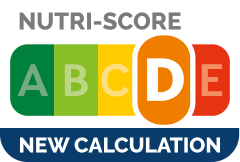 Lower nutritional quality
Nutri-Score data warning
Nutrient levels
Fat in moderate quantity (20%)
Saturated fat in high quantity (11%)
Sugars in low quantity (2.2%)
Salt in moderate quantity (1.2%)
Nutrition label

Nutrition facts
| Nutrition facts | As sold for 100 g / 100 ml | Compared to: Lorraine quiche |
|---|---|---|
| Energy | 1114 kJ (268 kcal) | 1,084.423 kJ (261 kcal) (+3%) |
| Fat | 20 g | 16.26 g (+23%) |
| Saturated fat | 11 g | 8.293 g (+33%) |
| Carbohydrates | 11 g | 18.832 g (-42%) |
| Sugars | 2.2 g | 2.221 g (-1%) |
| Dietary fiber | 0.5 g | ? |
| Proteins | 11 g | 9.424 g (+17%) |
| Salt | 1.2 g | 0.994 g (+21%) |
| Sodium | 0.48 g | 0.399 g (+20%) |
| Fruits, vegetables and legumes | ~ 0 % | ? |
Nutrition facts (Detailed data)
| Nutrition facts | As sold for 100 g / 100 ml | As sold Per 100 g (packaging) | As sold Per 100 g (estimate) |
|---|---|---|---|
| Energy | 1114 kJ (268 kcal) | 1114 kJ (268 kcal) | ~ 712.7813375 kJ (171 kcal) |
| Fat | 20 g | 20 g | ~ 15.4939645833333 g |
| Saturated fat | 11 g | 11 g | ~ 6.41869208333333 g |
| Carbohydrates | 11 g | 11 g | ~ 9.93386041666667 g |
| Sugars | 2.2 g | 2.2 g | ~ 2.05683666666667 g |
| Dietary fiber | 0.5 g | 0.5 g | ~ 0.572776666666667 g |
| Proteins | 11 g | 11 g | ~ 9.52388916666667 g |
| Salt | 1.2 g | 1.2 g | ~ 0.994569804166663 g |
| Sodium | 0.48 g | 0.48 g | ~ 0.407025447916665 g |
| Fruits, vegetables and legumes | ~ 0 % | ? | ~ 0 % |
Serving size
Ingredients
Ingredients image

Ingredients list
Ingredient information
Added sugars
Allergens
Traces
Ingredients analysis
No ingredients containing palm oil.
Contains non-vegan ingredients.
Contains non-vegetarian ingredients.
Food Processing
NOVA group
 Ultra-processed food and drink products
Elements that indicate the product is in NOVA group 4
How NOVA works
Additives
E14XX - Modified StarchEmulsifierStabiliserThickener
No additive description is available yet.
E250 - Sodium nitrite EFSA overexposure risk: highPreservative
Sodium nitrite (E250) is a salt used for curing and preserving meat products.
It plays a critical role in preventing the growth of Clostridium botulinum, the bacterium responsible for botulism, in cured meats like bacon, ham, and sausages. It also provides the characteristic pink color and flavor.
However, nitrites can react with amines in the stomach to form nitrosamines, which are potent carcinogens. High intake of processed meats containing nitrites is associated with an increased risk of colorectal cancer. Regulatory bodies have set strict limits on its use in food.
E316 - sodium erythorbate EFSA overexposure risk: noAntioxidant
SODIUM ERYTHORBATE is the sodium salt of erythorbic acid. Sodium erythorbate is produced from sugars derived from different sources, such as beets, sugar cane, and corn. It is used predominantly in meats, poultry, and soft drinks.
E325 - sodium lactateAntioxidantEmulsifierHumectantThickener
SODIUM LACTATE is the sodium salt of lactic acid, and has a mild saline taste. It is produced by fermentation of a sugar source, such as corn or beets. It acts as a preservative, acidity regulator, and bulking agent.
E415 - Xanthan gumEmulsifierStabiliserThickener
Xanthan gum (E415) is a natural polysaccharide derived from fermented sugars, often used in the food industry as a thickening and stabilizing agent.
This versatile food additive enhances texture and prevents ingredient separation in a wide range of products, including salad dressings, sauces, and gluten-free baked goods.
It is considered safe for consumption even at high intake amounts.
E920 - l-cysteine
Cysteine (symbol Cys or C; ) is a semi-essential proteinogenic amino acid with the formula HO2CCH(NH2)CH2SH. The thiol side chain in cysteine often participates in enzymatic reactions, as a nucleophile. The thiol is susceptible to oxidation to give the disulfide derivative cystine, which serves an important structural role in many proteins. When used as a food additive, it has the E number E920. It is encoded by the codons UGU and UGC. Cysteine has the same structure as serine, but with one of its oxygen atoms replaced by sulfur; replacing it with selenium gives selenocysteine. (Like other natural proteinogenic amino acids cysteine has (L) chirality in the older D/L notation based on homology to D and L glyceraldehyde. In the newer R/S system of designating chirality, based on the atomic numbers of atoms near the asymmetric carbon, cysteine (and selenocysteine) have R chirality, because of the presence of sulfur (resp. selenium) as a second neighbor to the asymmetric carbon. The remaining chiral amino acids, having lighter atoms in that position, have S chirality.)
Environment
Green-Score, origins bonus, and transportation impact are shown for Worldwide .
Green Score
Overall grade
 High environmental impact
About Green-Score
Current scope
Life cycle analysis
Average impact of the category
 Quiche Lorraine (eggs and lardoons quiche) • Score: 50/100
Life-cycle reference
Overall environmental impact by stage (PEF)
The overall environmental impact figure (PEF) comes from ADEME's Agribalyse database, for the category: Quiche Lorraine (eggs and lardoons quiche). Source: ADEME Agribalyse Database.
| Stage | Impact |
|---|---|
| Agriculture | 71.2 % |
| Processing | 8.3 % |
| Packaging | 8.4 % |
| Transportation | 3.9 % |
| Distribution | 1.8 % |
| Consumption | 6.5 % |
Bonuses and maluses
Origins of ingredients
Packaging impact
Green-Score for this product
Green-Score for this product
Final score: 42/100Final score breakdown
Carbon footprint
Carbon footprint
Climate impact by stage (CO2e)
The carbon emission figure comes from ADEME's Agribalyse database, for the category: Quiche Lorraine (eggs and lardoons quiche). Source: ADEME Agribalyse Database.
| Stage | Impact |
|---|---|
| Agriculture | 75.2 % |
| Processing | 5.5 % |
| Packaging | 10.1 % |
| Transportation | 6.3 % |
| Distribution | 0.9 % |
| Consumption | 2.1 % |
Packaging
Packaging impact
Packaging components
| Shape | Material | Recycling | Impact |
|---|---|---|---|
| Unknown | Plastic | Unknown | High |
| Unknown | Paper | Unknown | Low |
| Unknown | Cardboard | Unknown | Low |
Declared packaging
Data precision
Transportation
Manufacturing locations
Origins of ingredients
Origins breakdown
| Origin | Percent of ingredients | Impact |
|---|---|---|
| France | 100 % | Medium |
Forest footprint
Forest footprint
Ingredients linked to forest pressure
| Ingredient | Type | Percent in product | Forest footprint |
|---|---|---|---|
| Whole Fresh Eggs | Oeufs standards | 22.00 % | 0.02 |
Data Source
Product data comes from Open Food Facts. Food Benchmark also adds translations, category comparisons and explanatory calculations.
The database is licensed under ODbL 1.0, individual contents under DbCL 1.0, and product photos under CC BY-SA 3.0.
Product added on November 14, 2017 at 7:17:12 PM UTC by kiliweb .
Last edit on March 14, 2026 at 8:58:54 PM UTC by new-nutrition-bot .
Product page also edited by beniben, date-limite-app, kiliweb, new-nutrition-bot, openfoodfacts-contributors, org-systeme-u, packbot, systeme-u, systeme-u-off, yuka.YXFaZU92NWZsdElPbjlvVit5UFZwdU5wNnNmd1prcXRPdll2SVE9PQ.
Source List
- Systeme U
- systeme-u