ProductsCoraEntremet saveur vanille
Entremet saveur vanille
Barcode 3257984579610
Cora

Entremet saveur vanille

4 * 48 g (192 g)
BARCODE:3257984579610
COMMON NAME:Préparation en poudre pour flan saveur vanille
PACKAGER CODE:EMB 33063
CATEGORIES:Cooking Helpers, Dessert Mixes
PACKAGING:Cardboard
MANUFACTURING:France
COUNTRIES:France
STORES:Cora

Health

Nutrition

Nutrient levels

Fat in low quantity (0.5%)
What you need to know • A high consumption of fat, especially saturated fats, can raise cholesterol, which increases the risk of heart diseases. Recommendation: Limit the consumption of fat and saturated fat • Choose products with lower fat and saturated fat content. Source: National Health Service UK (NHS) - Fat: the facts
Saturated fat in low quantity (0.5%)
What you need to know • A high consumption of fat, especially saturated fats, can raise cholesterol, which increases the risk of heart diseases. Recommendation: Limit the consumption of fat and saturated fat • Choose products with lower fat and saturated fat content. Source: National Health Service UK (NHS) - Fat: the facts
Sugars in high quantity (78%)
What you need to know • A high consumption of sugar can cause weight gain and tooth decay. It also augments the risk of type 2 diabetes and cardio-vascular diseases. Recommendation: Limit the consumption of sugar and sugary drinks • Sugary drinks (such as sodas, fruit beverages, and fruit juices and nectars) should be limited as much as possible (no more than 1 glass a day). • Choose products with lower sugar content and reduce the consumption of products with added sugars. Source: National Health Service UK (NHS) - Sugar: the facts
Salt in low quantity (0.075%)
What you need to know • A high consumption of salt (or sodium) can cause raised blood pressure, which can increase the risk of heart disease and stroke. • Many people who have high blood pressure do not know it, as there are often no symptoms. • Most people consume too much salt (on average 9 to 12 grams per day), around twice the recommended maximum level of intake. Recommendation: Limit the consumption of salt and salted food • Reduce the quantity of salt used when cooking, and don't salt again at the table. • Limit the consumption of salty snacks and choose products with lower salt content. Source: World Health Organization (WHO) - Fact sheet - Salt reduction Source: National Health Service UK (NHS) - Salt: the facts

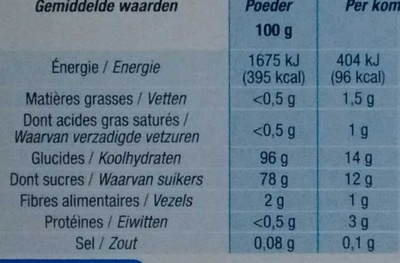
Nutrition label

Entremet saveur vanille nutrition label

Nutrition facts

Nutrition factsAs sold for 100 g / 100 mlCompared to: Dessert mixes
Energy1675 kJ (400 kcal)1,246.543 kJ (297 kcal) (+34%)
Fat0.5 g6.348 g (-92%)
Saturated fat0.5 g2.555 g (-80%)
Carbohydrates96 g49.576 g (+94%)
Sugars78 g23.763 g (+228%)
Dietary fiber2 g?
Proteins0.5 g5.635 g (-91%)
Salt0.075 g0.617 g (-88%)
Sodium0.03 g0.247 g (-88%)
Fruits, vegetables and legumes~ 0 %?

Nutrition facts (Detailed data)

Nutrition factsAs sold for 100 g / 100 mlAs sold Per 100 g (packaging)As sold Per 100 g (estimate)
Energy1675 kJ (400 kcal)1675 kJ (400 kcal)?
Fat0.5 g0.5 g?
Saturated fat0.5 g0.5 g?
Carbohydrates96 g96 g?
Sugars78 g78 g?
Dietary fiber2 g2 g?
Proteins0.5 g0.5 g?
Salt0.075 g0.075 g?
Sodium0.03 g0.03 g?
Fruits, vegetables and legumes~ 0 %?~ 0 %

Ingredients

Ingredients image

Entremet saveur vanille ingredients image

Ingredients list

Sucre - amidon de blé - gélifiant : carraghénanes - arôme vanille 2,5% - colorants: rocou, riboflavines.

Ingredient information

Sugar
54.58% (estimate)
Wheat Starch
23.96% (estimate)
Gelling Agent
11.98% (estimate)
E407
11.98% (estimate)
Vanilla Flavouring
2.5%
Colour
1.25% (estimate)
E160b
1.25% (estimate)
E101
5.73% (estimate)

Added sugars

Contains added sugars (54%) Added sugars: sugar Quantity of added sugars: 54%

Allergens

Gluten

Traces

EggsMilkNutsSoybeans

Ingredients analysis

Palm oil free
Yes

No ingredients containing palm oil.

Vegan
Unknown

Vegan status unknown

Vegetarian
Unknown

Vegetarian status unknown


Food Processing

NOVA group

4Ultra-processed food and drink products

Elements that indicate the product is in NOVA group 4

Additives
E101 - Riboflavin
Additives
E160b - Annatto
Additives
E407 - Carrageenan
Ingredients
Colour
Ingredients
Flavouring
Ingredients
Gelling Agent

How NOVA works

The NOVA classification assigns food products into 4 groups based on their degree of processing: 1. Unprocessed or minimally processed foods 2. Processed culinary ingredients 3. Processed foods 4. Ultra-processed food and drink products

Additives

E101 - RiboflavinColour

Riboflavin, also known as vitamin B2, is a vitamin found in food and used as a dietary supplement. Food sources include eggs, green vegetables, milk and other dairy product, meat, mushrooms, and almonds. Some countries require its addition to grains. As a supplement it is used to prevent and treat riboflavin deficiency and prevent migraines. It may be given by mouth or injection.It is nearly always well tolerated. Normal doses are safe during pregnancy. Riboflavin is in the vitamin B group. It is required by the body for cellular respiration.Riboflavin was discovered in 1920, isolated in 1933, and first made in 1935. It is on the World Health Organization's List of Essential Medicines, the most effective and safe medicines needed in a health system. Riboflavin is available as a generic medication and over the counter. In the United States a month of supplements costs less than 25 USD.

E101i - RiboflavinColour

No additive description is available yet.

E160b - AnnattoColour

No additive description is available yet.

E407 - Carrageenan EFSA overexposure risk: highCarrierEmulsifierHumectantStabiliserThickener

Carrageenan (E407), derived from red seaweed, is widely employed in the food industry as a gelling, thickening, and stabilizing agent, notably in dairy and meat products.

It can exist in various forms, each imparting distinct textural properties to food.

However, its degraded form, often referred to as poligeenan, has raised health concerns due to its potential inflammatory effects and its classification as a possible human carcinogen (Group 2B) by the International Agency for Research on Cancer (IARC).

Nevertheless, food-grade carrageenan has been deemed safe by various regulatory bodies when consumed in amounts typically found in food.

Environment

Green-Score, origins bonus, and transportation impact are shown for Worldwide .

Green Score

Overall grade

UnknownUnknown environmental impact

About Green-Score

The Green-Score is an experimental score that summarizes the environmental impacts of food products.

Current scope

The Green-Score was initially developed for France and it is being extended to other European countries. The Green-Score formula is subject to change as it is regularly improved to make it more precise and better suited to each country. Select a country to include the full impact of transportation in the final score.

Green-Score availability

We could not compute the Green-Score of this product because some data is missing. A more precise category, ingredients list, origins or packaging data can unlock the computation.

Bonuses and maluses

Declared origins

Origins of ingredients are missing for this product. Ingredients need to be completed before the transportation bonus can be computed precisely.

Packaging impact

Packaging with a low impact Malus: -1 Packaging score: +92

Packaging

Packaging impact

Packaging with a low impact Malus: -1 Packaging score: +92

Packaging components

ShapeMaterialRecyclingImpact
UnknownCardboardUnknownLow

Declared packaging

Cardboard

Data precision

The packaging information is not sufficiently precise to compute the most accurate packaging impact. Exact shapes and materials of all packaging components help improve the Green-Score.

Transportation

Manufacturing locations

France

Declared origins

Origins of ingredients are missing for this product. Ingredients need to be completed before the transportation bonus can be computed precisely.

Forest footprint

Forest footprint

No deforestation risk No ingredient associated with a deforestation risk. Forest Footprint The Forest Footprint is a methodology developed by the association Envol Vert to estimate the risk of deforestation related to our consumption. → More information on the methodology Forest Footprint grade: A No ingredient associated with a deforestation risk. Total Forest Footprint: 0.000 m² per kg of food

Deforestation risk details

Labels The presence of certain labels can greatly help reduce the risk of deforestation, through the presence of environmental criteria and/or through better remuneration of producers.

Data Source

Product data comes from Open Food Facts. Food Benchmark also adds translations, category comparisons and explanatory calculations.

The database is licensed under ODbL 1.0, individual contents under DbCL 1.0, and product photos under CC BY-SA 3.0.

Product added on July 30, 2015 at 1:39:10 PM UTC by tacite .

Last edit on March 17, 2026 at 11:54:07 PM UTC by new-nutrition-bot .

Product page also edited by new-nutrition-bot, packbot, tacite, yuka.VkxvS0ZLWUtuY0lHdXZKdXJqL0x4TzlseGFHNGZEcStLdGc5SVE9PQ.