
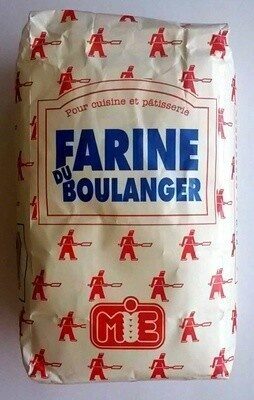
Farine du boulanger
Health
Nutrition
Nutri-Score
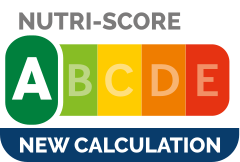 Very good nutritional quality
Nutrient levels
Fat in low quantity (0.8%)
Saturated fat in low quantity (0.16%)
Sugars in low quantity (1.82%)
Salt in low quantity (0.00725%)
Nutrition label
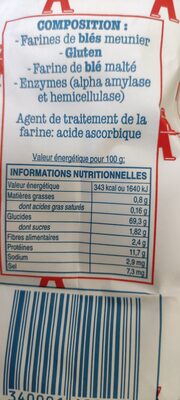
Nutrition facts
| Nutrition facts | As sold for 100 g / 100 ml | Compared to: Wheat flour type 55 for bread |
|---|---|---|
| Energy | ~ 1425.8 kJ (343 kcal) | 1,459.304 kJ (344 kcal) (-2%) |
| Fat | 0.8 g | 1.131 g (-29%) |
| Saturated fat | 0.16 g | 0.226 g (-29%) |
| Carbohydrates | 69.3 g | 71.426 g (-3%) |
| Sugars | 1.82 g | 1.426 g (+28%) |
| Dietary fiber | 2.4 g | ? |
| Proteins | 11.7 g | 10.601 g (+10%) |
| Salt | 0.00725 g | 0.012 g (-40%) |
| Sodium | 0.0029 g | 0.004 g (-28%) |
| Fruits, vegetables and legumes | ~ 0 % | ? |
Nutrition facts (Detailed data)
| Nutrition facts | As sold for 100 g / 100 ml | As sold Per 100 g (packaging) | As sold Per 100 g (estimate) |
|---|---|---|---|
| Energy | ~ 1425.8 kJ (343 kcal) | ? (343 kcal) | ? |
| Fat | 0.8 g | 0.8 g | ? |
| Saturated fat | 0.16 g | 0.16 g | ? |
| Carbohydrates | 69.3 g | 69.3 g | ? |
| Sugars | 1.82 g | 1.82 g | ? |
| Dietary fiber | 2.4 g | 2.4 g | ? |
| Proteins | 11.7 g | 11.7 g | ? |
| Salt | 0.00725 g | 0.00725 g | ? |
| Sodium | 0.0029 g | 0.0029 g | ? |
| Fruits, vegetables and legumes | ~ 0 % | ? | ~ 0 % |
Ingredients
Ingredients image

Ingredients list
Ingredient information
Allergens
Ingredients analysis
No ingredients containing palm oil.
Vegan status unknown
Unrecognized: fr:farines-de-bles-meunier
Vegetarian status unknown
Unrecognized: fr:farines-de-bles-meunier
Food Processing
NOVA group
 Ultra-processed food and drink products
Elements that indicate the product is in NOVA group 4
How NOVA works
Additives
E1100 - Alpha-Amylase
An amylase () is an enzyme that catalyses the hydrolysis of starch into sugars. Amylase is present in the saliva of humans and some other mammals, where it begins the chemical process of digestion. Foods that contain large amounts of starch but little sugar, such as rice and potatoes, may acquire a slightly sweet taste as they are chewed because amylase degrades some of their starch into sugar. The pancreas and salivary gland make amylase (alpha amylase) to hydrolyse dietary starch into disaccharides and trisaccharides which are converted by other enzymes to glucose to supply the body with energy. Plants and some bacteria also produce amylase. As diastase, amylase was the first enzyme to be discovered and isolated (by Anselme Payen in 1833). Specific amylase proteins are designated by different Greek letters. All amylases are glycoside hydrolases and act on α-1,4-glycosidic bonds.
Environment
Green-Score, origins bonus, and transportation impact are shown for Worldwide .
Green Score
Overall grade
 Very low environmental impact
About Green-Score
Current scope
Life cycle analysis
Average impact of the category
Wheat flour, type 55 (for bread) • Score: 97/100Life-cycle reference
Overall environmental impact by stage (PEF)
The overall environmental impact figure (PEF) comes from ADEME's Agribalyse database, for the category: Wheat flour, type 55 (for bread). Source: ADEME Agribalyse Database.
| Stage | Impact |
|---|---|
| Agriculture | 74.1 % |
| Processing | 4.7 % |
| Packaging | 1.8 % |
| Transportation | 11.4 % |
| Distribution | 7.7 % |
| Consumption | 0.0 % |
Bonuses and maluses
Declared origins
Packaging impact
Green-Score for this product
Green-Score for this product
Final score: 91/100Final score breakdown
Carbon footprint
Carbon footprint
Climate impact by stage (CO2e)
The carbon emission figure comes from ADEME's Agribalyse database, for the category: Wheat flour, type 55 (for bread). Source: ADEME Agribalyse Database.
| Stage | Impact |
|---|---|
| Agriculture | 70.2 % |
| Processing | 4.8 % |
| Packaging | 2.4 % |
| Transportation | 18.9 % |
| Distribution | 3.6 % |
| Consumption | 0.0 % |
Packaging
Packaging impact
Packaging components
| Shape | Material | Recycling | Impact |
|---|---|---|---|
| Unknown | Paper | Unknown | Low |
Declared packaging
Data precision
Transportation
Declared origins
Forest footprint
Forest footprint
Deforestation risk details
Data Source
Product data comes from Open Food Facts. Food Benchmark also adds translations, category comparisons and explanatory calculations.
The database is licensed under ODbL 1.0, individual contents under DbCL 1.0, and product photos under CC BY-SA 3.0.
Product added on June 14, 2015 at 4:23:33 PM UTC by aristoi .
Last edit on March 17, 2026 at 11:48:06 PM UTC by new-nutrition-bot .
Product page also edited by aristoi, kiliweb, mondat-katia, new-nutrition-bot, openfoodfacts-contributors, packbot, psn56, quentinbrd, roboto-app, yuka.VjZrbkV2by9wOVVxdHNZTzFDK0VvdnR1ektLdVJuKzdNTmMxSVE9PQ, yuka.WkxBUUhZWVIvT2szZ2NBVnJ6bk0ybzlONEx6MVlFMm5PK0U0SUE9PQ, yuka.ZEtjSksvZ2VucWMxcS8wTXh5emY4ZDVvOTRTeVhtV1ZLZVF0SVE9PQ, yuka.sY2b0xO6T85zoF3NwEKvlk16btn8kgnJDD3lmhyG6IapCp_UTfpSzIygH6s.