

Olives à la farce aux poivrons
Health
Nutrition
Nutri-Score
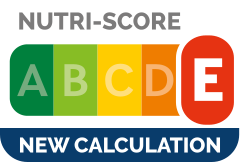 Lower nutritional quality
Nutri-Score data warning
Nutrient levels
Fat in moderate quantity (15%)
Saturated fat in moderate quantity (3%)
Sugars in low quantity (0.27%)
Salt in high quantity (3.6%)
Nutrition label

Nutrition facts
| Nutrition facts | As sold for 100 g / 100 ml | Compared to: Green olives stuffed of peppers |
|---|---|---|
| Energy | 594 kJ (144 kcal) | 561.371 kJ (138 kcal) (+6%) |
| Fat | 15 g | 13.733 g (+9%) |
| Saturated fat | 3 g | 2.423 g (+24%) |
| Trans fat | 0.2 g | ? |
| Cholesterol | 0.0008 g | 0.542 mg (+48%) |
| Carbohydrates | 0.3 g | 1.306 g (-77%) |
| Sugars | 0.27 g | 0.208 g (+30%) |
| Added sugars | 0 g | 0 g |
| Dietary fiber | 2.3 g | ? |
| Proteins | 0.9 g | 1.105 g (-19%) |
| Salt | 3.6 g | 3.42 g (+5%) |
| Sodium | 1.44 g | 1.358 g (+6%) |
| Fruits, vegetables and legumes | ~ 21.7625 % | ? |
Nutrition facts (Detailed data)
| Nutrition facts | As sold for 100 g / 100 ml | As sold Per 100 g (manufacturer) | As sold Per 100 g (packaging) | As sold Per 100 g (estimate) |
|---|---|---|---|---|
| Energy | 594 kJ (144 kcal) | 594 kJ (144 kcal) | 594 kJ (144 kcal) | ? |
| Fat | 15 g | 15 g | 15 g | ? |
| Saturated fat | 3 g | 3 g | 3 g | ? |
| Trans fat | 0.2 g | ? | 0.2 g | ? |
| Cholesterol | 0.0008 g | ? | 0.0008 g | ? |
| Carbohydrates | 0.3 g | ? | 0.3 g | ? |
| Sugars | 0.27 g | ? | 0.27 g | ? |
| Added sugars | 0 g | ? | 0 g | ~ 0 g |
| Dietary fiber | 2.3 g | 2.3 g | 2.3 g | ? |
| Proteins | 0.9 g | 0.9 g | 0.9 g | ? |
| Salt | 3.6 g | 3.6 g | 3.6 g | ? |
| Sodium | 1.44 g | 1.44 g | 1.44 g | ? |
| Fruits, vegetables and legumes | ~ 21.7625 % | ? | ? | ~ 21.7625 % |
Serving size
Ingredients
Ingredients image

Ingredients list
Ingredient information
Traces
Ingredients analysis
No ingredients containing palm oil.
No non-vegan ingredients.
No non-vegetarian ingredients.
Food Processing
NOVA group
 Ultra-processed food and drink products
Elements that indicate the product is in NOVA group 4
How NOVA works
Additives
E300 - Ascorbic acidAntioxidantSequestrant
No additive description is available yet.
E330 - Citric acidAntioxidantSequestrant
Citric acid is a natural organic acid found in citrus fruits such as lemons, oranges, and limes.
It is widely used in the food industry as a flavor enhancer, acidulant, and preservative due to its tart and refreshing taste.
Citric acid is safe for consumption when used in moderation and is considered a generally recognized as safe (GRAS) food additive by regulatory agencies worldwide.
E401 - sodium alginateCarrierEmulsifierHumectantSequestrantStabiliserThickener
No additive description is available yet.
E412 - Guar gumEmulsifierStabiliserThickener
Guar gum (E412) is a natural food additive derived from guar beans.
This white, odorless powder is valued for its remarkable thickening and stabilizing properties, making it a common ingredient in various food products, including sauces, dressings, and ice creams.
When used in moderation, guar gum is considered safe for consumption, with no known adverse health effects.
E509 - Calcium chloride EFSA overexposure risk: moderateStabiliserThickenerCoagulant
Calcium chloride is an inorganic compound, a salt with the chemical formula CaCl2. It is a colorless crystalline solid at room temperature, highly soluble in water. Calcium chloride is commonly encountered as a hydrated solid with generic formula CaCl2(H2O)x, where x = 0, 1, 2, 4, and 6. These compounds are mainly used for de-icing and dust control. Because the anhydrous salt is hygroscopic, it is used as a desiccant.
Environment
Green-Score, origins bonus, and transportation impact are shown for Worldwide .
Green Score
Overall grade
 Very low environmental impact
About Green-Score
Current scope
Life cycle analysis
Average impact of the category
 Olive, green, stuffed (anchovy, sweet peppers, etc…) • Score: 95/100
Life-cycle reference
Overall environmental impact by stage (PEF)
The overall environmental impact figure (PEF) comes from ADEME's Agribalyse database, for the category: Olive, green, stuffed (anchovy, sweet peppers, etc…). Source: ADEME Agribalyse Database.
| Stage | Impact |
|---|---|
| Agriculture | 30.4 % |
| Processing | 0.0 % |
| Packaging | 40.4 % |
| Transportation | 20.4 % |
| Distribution | 7.1 % |
| Consumption | 1.9 % |
Bonuses and maluses
Origins of ingredients
Packaging impact
Green-Score for this product
Green-Score for this product
Final score: 87/100Final score breakdown
Carbon footprint
Carbon footprint
Climate impact by stage (CO2e)
The carbon emission figure comes from ADEME's Agribalyse database, for the category: Olive, green, stuffed (anchovy, sweet peppers, etc…). Source: ADEME Agribalyse Database.
| Stage | Impact |
|---|---|
| Agriculture | 4.2 % |
| Processing | 0.0 % |
| Packaging | 59.7 % |
| Transportation | 31.9 % |
| Distribution | 3.6 % |
| Consumption | 0.6 % |
Packaging

Packaging impact
Packaging components
| Shape | Material | Recycling | Impact |
|---|---|---|---|
| 1 BOX | Metal | Recycle | High |
| 1 Seal | Metal | Recycle | High |
Declared packaging
Data precision
Transportation
Manufacturing locations
Origins of ingredients
Origins breakdown
| Origin | Percent of ingredients | Impact |
|---|---|---|
| Spain | 100 % | Medium |
Forest footprint
Forest footprint
Deforestation risk details
Additional information
- Other information
- Poids net égoutté : 150ge Idéal pour l'apéritif
- Warnings
- Les olives sont dénoyautées mécaniquement et peuvent contenir exceptionnellement un noyau ou un fragment de noyau.
- Conservation conditions
- À conserver à l'abri de la lumière et de la chaleur. Après ouverture, à conserver 7 jours au réfrigérateur dans un récipient hermétique. Pour une dégustation optimale, à consommer de préférence avant le / N° de lot : voir sur la boite.
- Customer service
- Pavé service consommateursInterdis - TSA 91431 - 91343 MASSY Cedex - France
Data Source
Product data comes from Open Food Facts. Food Benchmark also adds translations, category comparisons and explanatory calculations.
The database is licensed under ODbL 1.0, individual contents under DbCL 1.0, and product photos under CC BY-SA 3.0.
Product added on May 24, 2014 at 5:45:53 PM UTC by yanco .
Last edit on March 5, 2026 at 4:32:16 AM UTC by org-carrefour .
Product page also edited by carrefour, chevalstar, date-limite-app, driveoff, ecoscore-impact-estimator, fpdsurveys, kaitlynella, kiliweb, macrofactor, naruyoko, openfoodfacts-contributors, org-carrefour, packbot, quechoisir, sebleouf, teolemon, yanco, yuka.VElZR05QNDRvZVVybWZKbC96ak9vTUJ1OTRTUEFrZnFMclVzSVE9PQ.
Source List
- Carrefour
- carrefour