

Tonic
Health
Nutrition
Nutri-Score
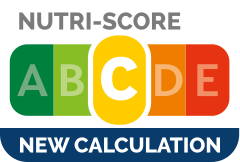 Average nutritional quality
Nutri-Score data warning
Nutrient levels
Fat in low quantity (0%)
Saturated fat in low quantity (0%)
Sugars in low quantity (0%)
Salt in low quantity (0.01%)
Nutrition facts
| Nutrition facts | As sold for 100 g / 100 ml | Compared to: Tonic water |
|---|---|---|
| Energy | 5 kJ (1 kcal) | 110.343 kJ (26 kcal) (-95%) |
| Fat | 0 g | 0.024 g (-100%) |
| Saturated fat | 0 g | 0.007 g (-100%) |
| Carbohydrates | 0 g | 6.253 g (-100%) |
| Sugars | 0 g | 6.052 g (-100%) |
| Dietary fiber | < 0.5 g | ? |
| Proteins | 0 g | 0.023 g (-100%) |
| Salt | < 0.01 g | 0.006 g (+67%) |
| Sodium | < 0.004 g | 0.002 g (+100%) |
| Alcohol | 0 % vol | ? |
| Fruits, vegetables and legumes | ~ 0 % | ? |
Nutrition facts (Detailed data)
| Nutrition facts | As sold for 100 g / 100 ml | As sold Per 100 g (manufacturer) | As sold Per 100 ml (manufacturer) | As sold Per 100 ml (packaging) | As sold Per 100 g (estimate) |
|---|---|---|---|---|---|
| Energy | 5 kJ (1 kcal) | 5 kJ (1 kcal) | 5 kJ (1 kcal) | 5 kJ (1 kcal) | ? |
| Fat | 0 g | ? | ? | 0 g | ? |
| Saturated fat | 0 g | ? | ? | 0 g | ? |
| Carbohydrates | 0 g | ? | ? | 0 g | ? |
| Sugars | 0 g | ? | ? | 0 g | ? |
| Dietary fiber | < 0.5 g | < 0.5 g | < 0.5 g | 0.5 g | ? |
| Proteins | 0 g | ? | ? | 0 g | ? |
| Salt | < 0.01 g | < 0.01 g | < 0.01 g | 0.01 g | ? |
| Sodium | < 0.004 g | ? | < 0.004 g | 0.004 g | ? |
| Alcohol | 0 % vol | ? | ? | 0 % vol | ? |
| Fruits, vegetables and legumes | ~ 0 % | ? | ? | ? | ~ 0 % |
Serving size
Ingredients
Ingredients image

Ingredients list
Ingredient information
Ingredients analysis
No ingredients containing palm oil.
Vegan status unknown
Vegetarian status unknown
Food Processing
NOVA group
 Ultra-processed food and drink products
Elements that indicate the product is in NOVA group 4
How NOVA works
Additives
E330 - Citric acidAntioxidantSequestrant
Citric acid is a natural organic acid found in citrus fruits such as lemons, oranges, and limes.
It is widely used in the food industry as a flavor enhancer, acidulant, and preservative due to its tart and refreshing taste.
Citric acid is safe for consumption when used in moderation and is considered a generally recognized as safe (GRAS) food additive by regulatory agencies worldwide.
E950 - Acesulfame kSweetener
Acesulfame potassium ( AY-see-SUL-faym), also known as acesulfame K (K is the symbol for potassium) or Ace K, is a calorie-free sugar substitute (artificial sweetener) often marketed under the trade names Sunett and Sweet One. In the European Union, it is known under the E number (additive code) E950. It was discovered accidentally in 1967 by German chemist Karl Clauss at Hoechst AG (now Nutrinova). In chemical structure, acesulfame potassium is the potassium salt of 6-methyl-1,2,3-oxathiazine-4(3H)-one 2,2-dioxide. It is a white crystalline powder with molecular formula C4H4KNO4S and a molecular weight of 201.24 g/mol.
E955 - SucraloseSweetener
Sucralose is an artificial sweetener and sugar substitute. The majority of ingested sucralose is not broken down by the body, so it is noncaloric. In the European Union, it is also known under the E number E955. It is produced by chlorination of sucrose. Sucralose is about 320 to 1,000 times sweeter than sucrose, three times as sweet as both aspartame and acesulfame potassium, and twice as sweet as sodium saccharin. Evidence of benefit is lacking for long-term weight loss with some data supporting weight gain and heart disease risks.It is stable under heat and over a broad range of pH conditions. Therefore, it can be used in baking or in products that require a long shelf life. The commercial success of sucralose-based products stems from its favorable comparison to other low-calorie sweeteners in terms of taste, stability, and safety. Common brand names of sucralose-based sweeteners are Splenda, Zerocal, Sukrana, SucraPlus, Candys, Cukren, and Nevella. Canderel Yellow also contains sucralose, but the original Canderel and Green Canderel do not.
Environment
Green-Score, origins bonus, and transportation impact are shown for Worldwide .
Green Score
Overall grade
About Green-Score
Current scope
Green-Score availability
Bonuses and maluses
Declared origins
Packaging impact
Packaging

Packaging impact
Packaging components
| Shape | Material | Recycling | Impact |
|---|---|---|---|
| Bottle | Plastic | Unknown | High |
Declared packaging
Transportation
Declared origins
Forest footprint
Forest footprint
Deforestation risk details
Additional information
- Other information
- 1,5L e ZERO* * SANS SUCRE Fabriqué en FRANCE
- Preparation
- Servir frais.
- Conservation conditions
- Avant ouverture, conservez votre bouteille dans un endroit propre, sec et frais, à l'abri de la lumière. Après ouverture, conservez-la au réfrigérateur et consommez-la dans les 3 jours. À consommer de préférence avant le / N° de lot : voir la date indiquée sur le haut de la bouteille.
- Customer service
- Interdis - TSA 91431 - 91343 MASSY Cedex - France
Data Source
Product data comes from Open Food Facts. Food Benchmark also adds translations, category comparisons and explanatory calculations.
The database is licensed under ODbL 1.0, individual contents under DbCL 1.0, and product photos under CC BY-SA 3.0.
Product added on March 25, 2016 at 3:52:29 PM UTC by openfoodfacts-contributors .
Last edit on March 18, 2026 at 4:25:05 AM UTC by org-carrefour .
Product page also edited by carrefour, cyn, ecoscore-impact-estimator, foodless, jcantou, kiliweb, mikadomika, openfoodfacts-contributors, org-carrefour, packbot, quechoisir, scanbot, spotter, yuka.SEs4eU1KZ1krNlVOd3ZZRHp6VHp4OTVreDU3eFEyU0pLOU16SUE9PQ.
Source List
- Carrefour
- carrefour