

Dame Blanche
Health
Nutrition
Nutri-Score
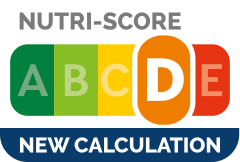 Lower nutritional quality
Nutri-Score data warning
Nutrient levels
Fat in moderate quantity (14%)
Saturated fat in high quantity (11%)
Sugars in high quantity (18%)
Salt in low quantity (0.07%)
Nutrition facts
| Nutrition facts | As sold for 100 g / 100 ml | Compared to: Chocolate desserts |
|---|---|---|
| Energy | 1247 kJ (298 kcal) | 783.233 kJ (188 kcal) (+59%) |
| Fat | 14 g | 9.304 g (+50%) |
| Saturated fat | 11 g | 5.588 g (+97%) |
| Carbohydrates | 36 g | 20.106 g (+79%) |
| Sugars | 18 g | 16.756 g (+7%) |
| Dietary fiber | 1.7 g | ? |
| Proteins | 4.3 g | 4.543 g (-5%) |
| Salt | 0.07 g | 0.172 g (-59%) |
| Sodium | 0.028 g | 0.069 g (-59%) |
| Alcohol | 1.3 % vol | ? |
| Fruits, vegetables and legumes | ~ 0 % | ? |
Nutrition facts (Detailed data)
| Nutrition facts | As sold for 100 g / 100 ml | As sold Per 100 g (packaging) | As sold Per 100 g (estimate) |
|---|---|---|---|
| Energy | 1247 kJ (298 kcal) | 1247 kJ (298 kcal) | ~ 1372.36825 kJ (327 kcal) |
| Fat | 14 g | 14 g | ~ 16.7519204166667 g |
| Saturated fat | 11 g | 11 g | ~ 12.958206875 g |
| Carbohydrates | 36 g | 36 g | ~ 40.9435625 g |
| Sugars | 18 g | 18 g | ~ 40.3674477083333 g |
| Dietary fiber | 1.7 g | 1.7 g | ~ 1.04388020833333 g |
| Proteins | 4.3 g | 4.3 g | ~ 2.60548354166667 g |
| Salt | 0.07 g | 0.07 g | ~ 0.0506031916666668 g |
| Sodium | 0.028 g | 0.028 g | ~ 0.0199817158333334 g |
| Alcohol | 1.3 % vol | 1.3 % vol | ~ 0 % vol |
| Fruits, vegetables and legumes | ~ 0 % | ? | ~ 0 % |
Serving size
Ingredients
Ingredients image

Ingredients list
Ingredient information
Added sugars
Allergens
Traces
Ingredients analysis
Palm oil content unknown
Contains non-vegan ingredients.
Unrecognized: fr:contient-1-3-d-alcool
Contains non-vegetarian ingredients.
Unrecognized: fr:contient-1-3-d-alcool
Food Processing
NOVA group
 Ultra-processed food and drink products
Elements that indicate the product is in NOVA group 4
How NOVA works
Additives
E1510 - Ethanol
Ethanol, also called alcohol, ethyl alcohol, grain alcohol, and drinking alcohol, is a chemical compound, a simple alcohol with the chemical formula C2H5OH. Its formula can be also written as CH3−CH2−OH or C2H5−OH (an ethyl group linked to a hydroxyl group), and is often abbreviated as EtOH. Ethanol is a volatile, flammable, colorless liquid with a slight characteristic odor. It is a psychoactive substance and is the principal type of alcohol found in alcoholic drinks. Ethanol is naturally produced by the fermentation of sugars by yeasts or via petrochemical processes, and is most commonly consumed as a popular recreational drug. It also has medical applications as an antiseptic and disinfectant. The compound is widely used as a chemical solvent, either for scientific chemical testing or in synthesis of other organic compounds, and is a vital substance used across many different kinds of manufacturing industries. Ethanol is also used as a clean-burning fuel source.
E322 - LecithinsAntioxidantEmulsifier
Lecithins are natural compounds commonly used in the food industry as emulsifiers and stabilizers.
Extracted from sources like soybeans and eggs, lecithins consist of phospholipids that enhance the mixing of oil and water, ensuring smooth textures in various products like chocolates, dressings, and baked goods.
They do not present any known health risks.
E322i - LecithinAntioxidantEmulsifier
Lecithins are natural compounds commonly used in the food industry as emulsifiers and stabilizers.
Extracted from sources like soybeans and eggs, lecithins consist of phospholipids that enhance the mixing of oil and water, ensuring smooth textures in various products like chocolates, dressings, and baked goods.
They do not present any known health risks.
E406 - AgarCarrierEmulsifierHumectantStabiliserThickener
Agar (pronounced , sometimes ) or agar-agar is a jelly-like substance, obtained from red algae.Agar is a mixture of two components: the linear polysaccharide agarose, and a heterogeneous mixture of smaller molecules called agaropectin. It forms the supporting structure in the cell walls of certain species of algae, and is released on boiling. These algae are known as agarophytes, and belong to the Rhodophyta (red algae) phylum.Agar has been used as an ingredient in desserts throughout Asia, and also as a solid substrate to contain culture media for microbiological work. Agar can be used as a laxative, an appetite suppressant, a vegetarian substitute for gelatin, a thickener for soups, in fruit preserves, ice cream, and other desserts, as a clarifying agent in brewing, and for sizing paper and fabrics.The gelling agent in agar is an unbranched polysaccharide obtained from the cell walls of some species of red algae, primarily from tengusa (Gelidiaceae) and ogonori (Gracilaria). For commercial purposes, it is derived primarily from ogonori. In chemical terms, agar is a polymer made up of subunits of the sugar galactose.
E428 - Gelatine
No additive description is available yet.
E471 - Mono- and diglycerides of fatty acidsEmulsifierStabiliser
Mono- and diglycerides of fatty acids (E471), are food additives commonly used as emulsifiers in various processed foods.
These compounds consist of glycerol molecules linked to one or two fatty acid chains, which help stabilize and blend water and oil-based ingredients. E471 enhances the texture and shelf life of products like margarine, baked goods, and ice cream, ensuring a smooth and consistent texture.
It is generally considered safe for consumption within established regulatory limits.
Environment
Green-Score, origins bonus, and transportation impact are shown for Worldwide .
Green Score
Overall grade
 Unknown environmental impact
About Green-Score
Current scope
Green-Score availability
Bonuses and maluses
Declared origins
Packaging impact
Packaging
Packaging impact
Packaging components
| Shape | Material | Recycling | Impact |
|---|---|---|---|
| Seal | Plastic | Unknown | High |
| Unknown | Cardboard | Unknown | Low |
| Unknown | Glass | Unknown | Low |
Declared packaging
Data precision
Transportation
Manufacturing locations
Declared origins
Forest footprint
Forest footprint
Ingredients linked to forest pressure
| Ingredient | Type | Percent in product | Forest footprint |
|---|---|---|---|
| EGG Yolk | Oeufs Importés | 3.10 % | 0.00 |
| Powdered EGG White | Oeufs Importés | 0.00 % | 0.00 |
Additional information
- Conservation conditions
- A consommer jusqu'au : voir la date indiquée sur le bord du couvercle. A conserver entre 0°C et +6°C.
- Customer service
- Interdis - TSA 91431 - 91343 MASSY Cedex - France
Data Source
Product data comes from Open Food Facts. Food Benchmark also adds translations, category comparisons and explanatory calculations.
The database is licensed under ODbL 1.0, individual contents under DbCL 1.0, and product photos under CC BY-SA 3.0.
Product added on October 3, 2017 at 11:19:47 AM UTC by kiliweb .
Last edit on March 17, 2026 at 2:30:36 PM UTC by new-nutrition-bot .
Product page also edited by date-limite-app, driveoff, fanfan54, kiliweb, new-nutrition-bot, openfoodfacts-contributors, org-carrefour, packbot, spotter, teolemon, tivoch, yuka.L7MeLMCgMJ19G_bg69oV9zSYM-H-B6J2SFMUog.
Source List
- carrefour