ProductsL'Atelier du PrimeurPâte à Tartiner à la Figue
Pâte à Tartiner à la Figue
Barcode 3700876900424
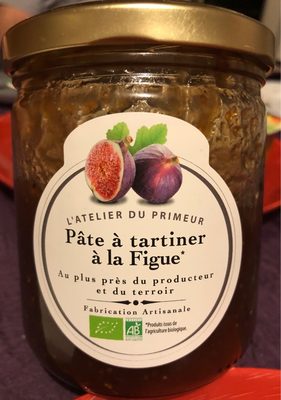
L'Atelier du Primeur

Pâte à Tartiner à la Figue

450 g
BARCODE:3700876900424
COMMON NAME:Préparation aux fruits
CATEGORIES:Breakfasts, Spreads, Sweet Spreads, Pates A Tartiner, Pates A Tartiner Aux Fruits
LABELS:Organic, Eu Organic, Non Eu Agriculture, Eu Agriculture, Eu Non Eu Agriculture, Fr Bio 01, Ab Agriculture Biologique
PACKAGING:Metal, Glass, Jar
COUNTRIES:France

Labels

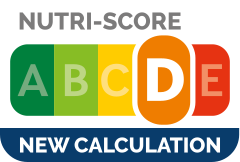
Nutri-Score
Nutri-ScorePoor nutritional quality
NOVA Group
NOVA GroupUltra-processed food and drink products
Green-Score
Green-ScoreGreen-Score not computed

Health

Nutrition

Label

DPoor nutritional quality

Nutrient levels

Fat in low quantity (0.1%)
What you need to know • A high consumption of fat, especially saturated fats, can raise cholesterol, which increases the risk of heart diseases. Recommendation: Limit the consumption of fat and saturated fat • Choose products with lower fat and saturated fat content. Source: National Health Service UK (NHS) - Fat: the facts
Saturated fat in low quantity (0%)
What you need to know • A high consumption of fat, especially saturated fats, can raise cholesterol, which increases the risk of heart diseases. Recommendation: Limit the consumption of fat and saturated fat • Choose products with lower fat and saturated fat content. Source: National Health Service UK (NHS) - Fat: the facts
Sugars in high quantity (58%)
What you need to know • A high consumption of sugar can cause weight gain and tooth decay. It also augments the risk of type 2 diabetes and cardio-vascular diseases. Recommendation: Limit the consumption of sugar and sugary drinks • Sugary drinks (such as sodas, fruit beverages, and fruit juices and nectars) should be limited as much as possible (no more than 1 glass a day). • Choose products with lower sugar content and reduce the consumption of products with added sugars. Source: National Health Service UK (NHS) - Sugar: the facts
Salt in low quantity (0.1%)
What you need to know • A high consumption of salt (or sodium) can cause raised blood pressure, which can increase the risk of heart disease and stroke. • Many people who have high blood pressure do not know it, as there are often no symptoms. • Most people consume too much salt (on average 9 to 12 grams per day), around twice the recommended maximum level of intake. Recommendation: Limit the consumption of salt and salted food • Reduce the quantity of salt used when cooking, and don't salt again at the table. • Limit the consumption of salty snacks and choose products with lower salt content. Source: World Health Organization (WHO) - Fact sheet - Salt reduction Source: National Health Service UK (NHS) - Salt: the facts

Nutrition label

Pâte à Tartiner à la Figue nutrition label

Nutrition facts

Nutrition factsAs sold for 100 g / 100 ml
Energy~ 996.5 kJ (237 kcal)
FAT0.1 g
Saturated fat0 g
Carbohydrates58 g
Sugars58 g
Dietary fiber~ 2.23 g
Proteins0.4 g
Salt0.1 g
Sodium0.04 g
Minerals
Fruits, vegetables and legumes~ 77.25 %

Nutrition facts (Detailed data)

Nutrition factsAs sold for 100 g / 100 mlAs sold Per 100 g (packaging)As sold Per 100 g (estimate)
Energy~ 996.5 kJ (237 kcal)? (237 kcal)~ 508.66 kJ (120 kcal)
FAT0.1 g0.1 g~ 0.19 g
Saturated fat0 g0 g~ 0.02 g
Cholesterol~ 0 g?~ 0 g
Carbohydrates58 g58 g~ 27.6 g
Sugars58 g58 g~ 26.63 g
Added sugars~ 18.67 g?~ 18.67 g
Sucrose~ 18.95 g?~ 18.95 g
Glucose~ 3.45 g?~ 3.45 g
Fructose~ 4.26 g?~ 4.26 g
Galactose~ 0 g?~ 0 g
Lactose~ 0.04 g?~ 0.04 g
Maltose~ 0.04 g?~ 0.04 g
Starch~ 0.07 g?~ 0.07 g
Polyols~ 0.25 g?~ 0.25 g
Dietary fiber~ 2.23 g?~ 2.23 g
Proteins0.4 g0.4 g~ 0.63 g
Salt0.1 g0.1 g~ 0.01 g
Sodium0.04 g0.04 g~ 0 g
Alcohol~ 0 % vol?~ 0 % vol
Vitamins
Vitamin A~ 0 g?~ 0 g
Beta-carotene~ 0 g?~ 0 g
Vitamin D~ 0 g?~ 0 g
Vitamin E~ 0 g?~ 0 g
Vitamin C~ 0.01 g?~ 0.01 g
Vitamin B1~ 0 g?~ 0 g
Vitamin B2~ 0 g?~ 0 g
Vitamin PP~ 0 g?~ 0 g
Vitamin B6~ 0 g?~ 0 g
Vitamin B9~ 0 g?~ 0 g
Vitamin B12~ 0 g?~ 0 g
Pantothenic acid~ 0 g?~ 0 g
Minerals
Potassium~ 0.14 g?~ 0.14 g
Calcium~ 0.03 g?~ 0.03 g
Phosphorus~ 0.01 g?~ 0.01 g
Iron~ 0 g?~ 0 g
Magnesium~ 0.01 g?~ 0.01 g
Zinc~ 0 g?~ 0 g
Copper~ 0 g?~ 0 g
Manganese~ 0 g?~ 0 g
Selenium~ 0 g?~ 0 g
Iodine~ 0 g?~ 0 g
Fruits, vegetables and legumes~ 77.25 %?~ 77.25 %
Phylloquinone~ 0 g?~ 0 g
Water~ 64.63 g?~ 64.63 g

Estimated Activity Time

Approximate time needed to burn the energy in 100 g / 100 ml: 997 kJ. Reference adult weight: 70 kg. Energy density: Low.

Walking
58 min (~5,810 steps)
Swimming
35 min
Bicycling
27 min
Running
20 min

Ingredients

Ingredients image

Pâte à Tartiner à la Figue ingredients image

Ingredients list

Figue* (40 %), pomme, sucre, jus de citron concentré*, cassis*, gélifiant : agar agar, antioxydant: acide ascorbique.

Ingredient information

Fig
40.0%
Apple
25% (estimate)
Sugar
18.67% (estimate)
Concentrated Lemon Juice
8.17% (estimate)
Blackcurrant
4.08% (estimate)
Gelling Agent
2.04% (estimate)
E406
2.04% (estimate)
Antioxidant
2.04% (estimate)
Vitamin C
2.04% (estimate)

Ingredients analysis

Palm oil free
Yes

No ingredients containing palm oil.

Vegan
Unknown

Vegan status unknown

Vegetarian
Yes

No non-vegetarian ingredients.


Food Processing

NOVA group

4Ultra-processed food and drink products

Elements that indicate the product is in NOVA group 4

Additives
E406 - Agar
Ingredients
Gelling Agent

How NOVA works

The NOVA classification assigns food products into 4 groups based on their degree of processing: 1. Unprocessed or minimally processed foods 2. Processed culinary ingredients 3. Processed foods 4. Ultra-processed food and drink products

Additives

E300 - Ascorbic acidAntioxidantSequestrant

No additive description is available yet.

E406 - AgarCarrierEmulsifierHumectantStabiliserThickener

Agar (pronounced , sometimes ) or agar-agar is a jelly-like substance, obtained from red algae.Agar is a mixture of two components: the linear polysaccharide agarose, and a heterogeneous mixture of smaller molecules called agaropectin. It forms the supporting structure in the cell walls of certain species of algae, and is released on boiling. These algae are known as agarophytes, and belong to the Rhodophyta (red algae) phylum.Agar has been used as an ingredient in desserts throughout Asia, and also as a solid substrate to contain culture media for microbiological work. Agar can be used as a laxative, an appetite suppressant, a vegetarian substitute for gelatin, a thickener for soups, in fruit preserves, ice cream, and other desserts, as a clarifying agent in brewing, and for sizing paper and fabrics.The gelling agent in agar is an unbranched polysaccharide obtained from the cell walls of some species of red algae, primarily from tengusa (Gelidiaceae) and ogonori (Gracilaria). For commercial purposes, it is derived primarily from ogonori. In chemical terms, agar is a polymer made up of subunits of the sugar galactose.

Environment

Green-Score, origins bonus, and transportation impact are shown for Worldwide .

Green Score

Overall grade

UnknownUnknown environmental impact

About Green-Score

The Green-Score is an experimental score that summarizes the environmental impacts of food products.

Current scope

The Green-Score was initially developed for France and it is being extended to other European countries. The Green-Score formula is subject to change as it is regularly improved to make it more precise and better suited to each country. Select a country to include the full impact of transportation in the final score.

Green-Score availability

We could not compute the Green-Score of this product because some data is missing. A more precise category, ingredients list, origins or packaging data can unlock the computation.

Bonuses and maluses

Production system

Bonus: +15 This bonus comes from environmental labels recognized by Open Food Facts.

Declared origins

Origins of ingredients are missing for this product. Ingredients need to be completed before the transportation bonus can be computed precisely.

Packaging impact

Packaging with a medium impact Malus: -12 Packaging score: -19

Packaging

Packaging impact

Packaging with a medium impact Malus: -12 Packaging score: -19

Packaging materials

Material%Packaging weightPackaging weight per 100 g of product
Glass
Metal
Total

Declared packaging

Metal, Glass, Jar

Data precision

The packaging information is not sufficiently precise to compute the most accurate packaging impact. Exact shapes and materials of all packaging components help improve the Green-Score.

Transportation

Declared origins

Origins of ingredients are missing for this product. Ingredients need to be completed before the transportation bonus can be computed precisely.

Data Source

Data presented on this page is sourced from the Open Food Facts database. This platform does not alter the original dataset; its purpose is solely to enhance data visualization and user accessibility.

Product added on February 2, 2018 at 8:15:19 PM UTC by openfoodfacts-contributors .

Last edit on March 18, 2026 at 1:02:34 AM UTC by new-nutrition-bot .

Product page also edited by beniben, kiliweb, new-nutrition-bot, openfoodfacts-contributors, packbot, roboto-app, yuka.UzRvNk5QMEN1ZFJWdXZFZ3p4ZUZ4UFZ5d0xteVRGMmxHY3dJSWc9PQ, yuka.V3BFdFFhZ2dxdU1WbGMxbnhEUEl4TmhIMTdDckRXYU1NT05BSVE9PQ.