
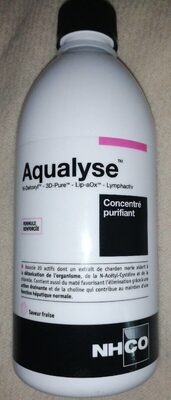
Aqualyse concentré purifiant
Health
Nutrition
Nutri-Score data warning
Nutrient levels
Fat in low quantity (0%)
Saturated fat in low quantity (0%)
Sugars in low quantity (0%)
Salt in low quantity (0%)
Nutrition label

Nutrition facts
| Nutrition facts | As sold for 100 g / 100 ml | Compared to: Artificially sweetened beverages |
|---|---|---|
| Energy | 0 kcal (0 kcal) | 44.621 kJ (11 kcal) |
| Fat | 0 g | 0.037 g (-100%) |
| Saturated fat | 0 g | 0.009 g (-100%) |
| Carbohydrates | 0 g | 2.269 g (-100%) |
| Sugars | 0 g | 2.01 g (-100%) |
| Dietary fiber | 0 g | ? |
| Proteins | 0 g | 0.062 g (-100%) |
| Salt | 0 g | 0.043 g (-100%) |
| Sodium | 0 g | 0.017 g (-100%) |
| Fruits, vegetables and legumes | ? | ? |
Nutrition facts (Detailed data)
| Nutrition facts | As sold for 100 g / 100 ml | As sold Per serving (legacy) |
|---|---|---|
| Energy | 0 kcal (0 kcal) | ? |
| Fat | 0 g | ? |
| Saturated fat | 0 g | ? |
| Carbohydrates | 0 g | ? |
| Sugars | 0 g | ? |
| Dietary fiber | 0 g | ? |
| Proteins | 0 g | ? |
| Salt | 0 g | ? |
| Sodium | 0 g | ? |
| Fruits, vegetables and legumes | ? | ? |
Ingredients
Ingredients image

Ingredients list
Ingredient information
Ingredients analysis
Palm oil content unknown
Unrecognized: fr:extrait-aqueux, fr:feuilles-et-racines-de-pissenlit, fr:feuilles-de-vigne-rouge, fr:feuilles-de-bouleau, fr:racine-de-radis-noir, fr:rhizome-de-chiendent, fr:arome-naturel-de-fruits-rouges, fr:chlorhydrate-de-l-arginine, fr:seve-de-bouleau, fr:n-acetine-cysteine, fr:l-cl, fr:truline, fr:extrait-de-graines-de-chardon-marie, fr:extrait-de-partie-aerienne-de-melilot
Vegan status unknown
Unrecognized: fr:feuilles-et-racines-de-pissenlit, fr:feuilles-de-vigne-rouge, fr:feuilles-de-bouleau, fr:racine-de-radis-noir, fr:rhizome-de-chiendent, fr:arome-naturel-de-fruits-rouges, fr:chlorhydrate-de-l-arginine, fr:seve-de-bouleau, fr:n-acetine-cysteine, fr:l-cl, fr:truline, en:vitamin-e, fr:extrait-de-graines-de-chardon-marie, fr:extrait-de-partie-aerienne-de-melilot
Vegetarian status unknown
Unrecognized: fr:feuilles-et-racines-de-pissenlit, fr:feuilles-de-vigne-rouge, fr:feuilles-de-bouleau, fr:racine-de-radis-noir, fr:rhizome-de-chiendent, fr:arome-naturel-de-fruits-rouges, fr:chlorhydrate-de-l-arginine, fr:seve-de-bouleau, fr:n-acetine-cysteine, fr:l-cl, fr:truline, en:vitamin-e, fr:extrait-de-graines-de-chardon-marie, fr:extrait-de-partie-aerienne-de-melilot
Food Processing
NOVA group
 Ultra-processed food and drink products
Elements that indicate the product is in NOVA group 4
How NOVA works
Additives
E150a - Plain caramel EFSA overexposure risk: noColour
Caramel color or caramel coloring is a water-soluble food coloring.
E162 - Beetroot redColour
Betanin, or Beetroot Red, is a red glycosidic food dye obtained from beets; its aglycone, obtained by hydrolyzing away the glucose molecule, is betanidin. As a food additive, its E number is E162. The color of betanin depends on pH; between four and five it is bright bluish-red, becoming blue-violet as the pH increases. Once the pH reaches alkaline levels betanin degrades by hydrolysis, resulting in a yellow-brown color. Betanin is a betalain pigment, together with isobetanin, probetanin, and neobetanin. Other pigments contained in beet are indicaxanthin and vulgaxanthins.
E202 - Potassium sorbate EFSA overexposure risk: highPreservative
Potassium sorbate (E202) is a synthetic food preservative commonly used to extend the shelf life of various food products.
It works by inhibiting the growth of molds, yeast, and some bacteria, preventing spoilage. When added to foods, it helps maintain their freshness and quality.
Some studies have shown that when combined with nitrites, potassium sorbate have genotoxic activity in vitro. However, potassium sorbate is generally recognized as safe (GRAS) by regulatory authorities.
E211 - Sodium benzoate EFSA overexposure risk: highPreservative
SODIUM BENZOATE is a substance which has the chemical formula NaC7H5O2
E300 - Ascorbic acidAntioxidantSequestrant
No additive description is available yet.
E330 - Citric acidAntioxidantSequestrant
Citric acid is a natural organic acid found in citrus fruits such as lemons, oranges, and limes.
It is widely used in the food industry as a flavor enhancer, acidulant, and preservative due to its tart and refreshing taste.
Citric acid is safe for consumption when used in moderation and is considered a generally recognized as safe (GRAS) food additive by regulatory agencies worldwide.
E412 - Guar gumEmulsifierStabiliserThickener
Guar gum (E412) is a natural food additive derived from guar beans.
This white, odorless powder is valued for its remarkable thickening and stabilizing properties, making it a common ingredient in various food products, including sauces, dressings, and ice creams.
When used in moderation, guar gum is considered safe for consumption, with no known adverse health effects.
E422 - GlycerolHumectantThickener
Glycerol (; also called glycerine or glycerin; see spelling differences) is a simple polyol compound. It is a colorless, odorless, viscous liquid that is sweet-tasting and non-toxic. The glycerol backbone is found in all lipids known as triglycerides. It is widely used in the food industry as a sweetener and humectant and in pharmaceutical formulations. Glycerol has three hydroxyl groups that are responsible for its solubility in water and its hygroscopic nature.
E640 - Glycine and its sodium salt
No additive description is available yet.
E640i - Glycine
No additive description is available yet.
E960a - Steviol glycosides from SteviaSweetener
No additive description is available yet.
Environment
Green-Score, origins bonus, and transportation impact are shown for Worldwide .
Green Score
Overall grade
 Unknown environmental impact
About Green-Score
Current scope
Green-Score availability
Bonuses and maluses
Declared origins
Packaging impact
Packaging
Packaging impact
Data precision
Transportation
Declared origins
Forest footprint
Forest footprint
Deforestation risk details
Data Source
Product data comes from Open Food Facts. Food Benchmark also adds translations, category comparisons and explanatory calculations.
The database is licensed under ODbL 1.0, individual contents under DbCL 1.0, and product photos under CC BY-SA 3.0.
Product added on December 3, 2019 at 3:29:37 PM UTC by kiliweb .
Last edit on March 13, 2024 at 6:55:43 PM UTC by roboto-app .
Product page also edited by kiliweb, openfoodfacts-contributors, quechoisir, roboto-app, yuka.UW9WWURZdFFxUDBzc01BNC9qcnM2NHBsNDYzemVHYXFMdVk2SUE9PQ, yuka.Ukl4Wk9wd00rOWs0eDlzQitTck4xUFJaL2JPbFFVMkxEZlVzSVE9PQ.