

Brochettes de confiserie fantaisies
Health
Nutrition
Nutri-Score
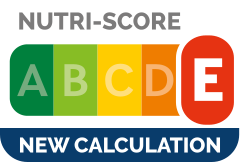 Lower nutritional quality
Nutri-Score data warning
Nutrient levels
Fat in low quantity (0.2%)
Saturated fat in low quantity (0.1%)
Sugars in high quantity (75.1%)
Salt in low quantity (0.12%)
Nutrition label

Nutrition facts
| Nutrition facts | As sold for 100 g / 100 ml | Compared to: Frozen foods |
|---|---|---|
| Energy | ~ 1475.01 kJ (346 kcal) | 768.043 kJ (184 kcal) (+92%) |
| Fat | 0.2 g | 7.714 g (-97%) |
| Saturated fat | 0.1 g | 3.856 g (-97%) |
| Carbohydrates | 83.08 g | 21.014 g (+295%) |
| Sugars | 75.08 g | 11.753 g (+539%) |
| Dietary fiber | ? | ? |
| Proteins | 3.25 g | 4.898 g (-34%) |
| Salt | 0.12 g | 0.409 g (-71%) |
| Sodium | 0.048 g | 0.163 g (-71%) |
| Fruits, vegetables and legumes | ~ 2.96223958333333 % | ? |
Nutrition facts (Detailed data)
| Nutrition facts | As sold for 100 g / 100 ml | As sold Per 100 g (packaging) | As sold Per 100 g (estimate) |
|---|---|---|---|
| Energy | ~ 1475.01 kJ (346 kcal) | ? (346 kcal) | ? |
| Fat | 0.2 g | 0.2 g | ? |
| Saturated fat | 0.1 g | 0.1 g | ? |
| Carbohydrates | 83.08 g | 83.08 g | ? |
| Sugars | 75.08 g | 75.08 g | ? |
| Dietary fiber | ? | ? | ? |
| Proteins | 3.25 g | 3.25 g | ? |
| Salt | 0.12 g | 0.12 g | ? |
| Sodium | 0.048 g | 0.048 g | ? |
| Fruits, vegetables and legumes | ~ 2.96223958333333 % | ? | ~ 2.96223958333333 % |
Ingredients
Ingredients image

Ingredients list
Ingredient information
Added sugars
Allergens
Ingredients analysis
No ingredients containing palm oil.
Contains non-vegan ingredients.
Unrecognized: fr:cassis-noir, fr:160a
Contains non-vegetarian ingredients.
Unrecognized: fr:cassis-noir, fr:160a
Food Processing
NOVA group
 Ultra-processed food and drink products
Elements that indicate the product is in NOVA group 4
How NOVA works
Additives
E120 - CochinealColour
Cochineal extract or carmine (E120) is a natural red colorant derived from the dried bodies of the female cochineal insect.
It is widely used to impart a pink, red, or purple hue to various food and beverage products, including yogurts, ice creams, confectionery, and fruit juices.
Although it is a natural additive, E120 is known to cause severe allergic reactions, including anaphylaxis, in some individuals. It is also not suitable for vegetarians or vegans due to its insect origin.
E153 - Vegetable carbon
No additive description is available yet.
E160 - Carotenoids
No additive description is available yet.
E162 - Beetroot redColour
Betanin, or Beetroot Red, is a red glycosidic food dye obtained from beets; its aglycone, obtained by hydrolyzing away the glucose molecule, is betanidin. As a food additive, its E number is E162. The color of betanin depends on pH; between four and five it is bright bluish-red, becoming blue-violet as the pH increases. Once the pH reaches alkaline levels betanin degrades by hydrolysis, resulting in a yellow-brown color. Betanin is a betalain pigment, together with isobetanin, probetanin, and neobetanin. Other pigments contained in beet are indicaxanthin and vulgaxanthins.
E202 - Potassium sorbate EFSA overexposure risk: highPreservative
Potassium sorbate (E202) is a synthetic food preservative commonly used to extend the shelf life of various food products.
It works by inhibiting the growth of molds, yeast, and some bacteria, preventing spoilage. When added to foods, it helps maintain their freshness and quality.
Some studies have shown that when combined with nitrites, potassium sorbate have genotoxic activity in vitro. However, potassium sorbate is generally recognized as safe (GRAS) by regulatory authorities.
E330 - Citric acidAntioxidantSequestrant
Citric acid is a natural organic acid found in citrus fruits such as lemons, oranges, and limes.
It is widely used in the food industry as a flavor enhancer, acidulant, and preservative due to its tart and refreshing taste.
Citric acid is safe for consumption when used in moderation and is considered a generally recognized as safe (GRAS) food additive by regulatory agencies worldwide.
E420 - SorbitolHumectantSequestrantStabiliserSweetenerThickener
Sorbitol (), less commonly known as glucitol (), is a sugar alcohol with a sweet taste which the human body metabolizes slowly. It can be obtained by reduction of glucose, which changes the aldehyde group to a hydroxyl group. Most sorbitol is made from corn syrup, but it is also found in nature, for example in apples, pears, peaches, and prunes. It is converted to fructose by sorbitol-6-phosphate 2-dehydrogenase. Sorbitol is an isomer of mannitol, another sugar alcohol; the two differ only in the orientation of the hydroxyl group on carbon 2. While similar, the two sugar alcohols have very different sources in nature, melting points, and uses.
E428 - Gelatine
No additive description is available yet.
Environment
Green-Score, origins bonus, and transportation impact are shown for Worldwide .
Green Score
Overall grade
 Unknown environmental impact
About Green-Score
Current scope
Green-Score availability
Bonuses and maluses
Declared origins
Packaging impact
Packaging
Packaging impact
Data precision
Transportation
Declared origins
Forest footprint
Forest footprint
Ingredients linked to forest pressure
| Ingredient | Type | Percent in product | Forest footprint |
|---|---|---|---|
| EGG White | Oeufs Importés | 1.46 % | 0.00 |
Data Source
Product data comes from Open Food Facts. Food Benchmark also adds translations, category comparisons and explanatory calculations.
The database is licensed under ODbL 1.0, individual contents under DbCL 1.0, and product photos under CC BY-SA 3.0.
Product added on October 27, 2018 at 1:15:53 PM UTC by kiliweb .
Last edit on March 13, 2026 at 2:07:09 PM UTC by new-nutrition-bot .
Product page also edited by autorotate-bot, halal-app-chakib, kiliweb, new-nutrition-bot, openfoodfacts-contributors, quechoisir, roboto-app, yuka.ZC80ZUw2NWJxTVVUdzhjd3BScjR3NDl4d3ErTlZFU3NKT3NzSVE9PQ, yuka.sY2b0xO6T85zoF3NwEKvlmFsQ9z_-xbVOUD4p02S5fKBDb7zf95Qz9D_DKs.