

Mandu kimchi & pork
Health
Nutrition
Nutri-Score
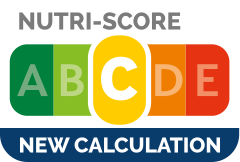 Average nutritional quality
Nutri-Score data warning
Nutrient levels
Fat in moderate quantity (6.7%)
Saturated fat in moderate quantity (2.5%)
Sugars in low quantity (2.3%)
Salt in moderate quantity (1.04%)
Nutrition label

Nutrition facts
| Nutrition facts | As sold for 100 g / 100 ml |
|---|---|
| Energy | ~ 706.9 kJ (168 kcal) |
| Fat | 6.7 g |
| Saturated fat | 2.5 g |
| Carbohydrates | 16 g |
| Sugars | 2.3 g |
| Dietary fiber | ? |
| Proteins | 11 g |
| Salt | 1.04 g |
| Sodium | 0.416 g |
| Fruits, vegetables and legumes | ~ 27.5 % |
Nutrition facts (Detailed data)
| Nutrition facts | As sold for 100 g / 100 ml | As sold Per 100 g (packaging) | As sold Per 100 g (estimate) |
|---|---|---|---|
| Energy | ~ 706.9 kJ (168 kcal) | ? (168 kcal) | ? |
| Fat | 6.7 g | 6.7 g | ? |
| Saturated fat | 2.5 g | 2.5 g | ? |
| Carbohydrates | 16 g | 16 g | ? |
| Sugars | 2.3 g | 2.3 g | ? |
| Dietary fiber | ? | ? | ? |
| Proteins | 11 g | 11 g | ? |
| Salt | 1.04 g | 1.04 g | ? |
| Sodium | 0.416 g | 0.416 g | ? |
| Fruits, vegetables and legumes | ~ 27.5 % | ? | ~ 27.5 % |
Ingredients
Ingredients image

Ingredients list
Ingredient information
Allergens
Ingredients analysis
Palm oil content unknown
Contains non-vegan ingredients.
Unrecognized: fr:chou-oignon-ciboule, fr:chou-napa-radis, fr:poudre-de-poivre-rouge, fr:e4151, fr:sauce-d-anchois-fermente, fr:poudre-de-poivre-rouge
Contains non-vegetarian ingredients.
Unrecognized: fr:chou-oignon-ciboule, fr:chou-napa-radis, fr:poudre-de-poivre-rouge, fr:e4151, fr:sauce-d-anchois-fermente, fr:poudre-de-poivre-rouge
Food Processing
NOVA group
 Ultra-processed food and drink products
Elements that indicate the product is in NOVA group 4
How NOVA works
Additives
E150c - Ammonia caramel EFSA overexposure risk: moderateColour
No additive description is available yet.
E511 - Magnesium chloride EFSA overexposure risk: moderateStabiliserCoagulant
Magnesium chloride is the name for the chemical compound with the formula MgCl2 and its various hydrates MgCl2(H2O)x. These salts are typical ionic halides, being highly soluble in water. The hydrated magnesium chloride can be extracted from brine or sea water. In North America, magnesium chloride is produced primarily from Great Salt Lake brine. It is extracted in a similar process from the Dead Sea in the Jordan Valley. Magnesium chloride, as the natural mineral bischofite, is also extracted (by solution mining) out of ancient seabeds, for example, the Zechstein seabed in northwest Europe. Some magnesium chloride is made from solar evaporation of seawater. Anhydrous magnesium chloride is the principal precursor to magnesium metal, which is produced on a large scale. Hydrated magnesium chloride is the form most readily available.
Environment
Green-Score, origins bonus, and transportation impact are shown for Worldwide .
Green Score
Overall grade
 Unknown environmental impact
About Green-Score
Current scope
Green-Score availability
Bonuses and maluses
Declared origins
Packaging impact
Packaging
Packaging impact
Packaging components
| Shape | Material | Recycling | Impact |
|---|---|---|---|
| BAG | Plastic | Unknown | High |
Declared packaging
Transportation
Manufacturing locations
Declared origins
Data Source
Product data comes from Open Food Facts. Food Benchmark also adds translations, category comparisons and explanatory calculations.
The database is licensed under ODbL 1.0, individual contents under DbCL 1.0, and product photos under CC BY-SA 3.0.
Product added on April 12, 2018 at 6:38:09 PM UTC by kiliweb .
Last edit on March 17, 2026 at 2:06:28 PM UTC by new-nutrition-bot .
Product page also edited by anmoron, beniben, kiliweb, moon-rabbit, new-nutrition-bot, openfoodfacts-contributors, packbot, quechoisir, yuka.V1lZeVRiUVJuOWNNc2ZRNXdDN0x5NDlXbmM2blZsTG9GN0FySVE9PQ, yuka.ZjVsY0tJUUJxdjhQdXNCa3Jobk8yNDkvbUpxRlp6NitLT1l5SVE9PQ, yuka.sY2b0xO6T85zoF3NwEKvlm96Cv3Tsx3GLy7Sunan69qDLLLtTIlo0tLrK6g.