

Vicks Bonbons Menthol Sans Sucre
Health
Nutrition
Nutri-Score
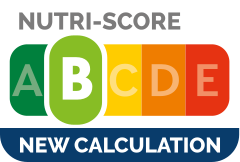 Good nutritional quality
Nutri-Score data warning
Nutrient levels
Fat in low quantity (0%)
Saturated fat in low quantity (0%)
Sugars in low quantity (0%)
Salt in low quantity (0%)
Nutrition label

Nutrition facts
| Nutrition facts | As sold for 100 g / 100 ml | Compared to: Candies |
|---|---|---|
| Energy | 970 kJ (236 kcal) | 1,498.358 kJ (350 kcal) (-35%) |
| Fat | 0 g | 1.576 g (-100%) |
| Saturated fat | 0 g | 0.88 g (-100%) |
| Carbohydrates | 99 g | 82.84 g (+20%) |
| Sugars | 0 g | 54.88 g (-100%) |
| Dietary fiber | 0 g | ? |
| Proteins | 0 g | 2.159 g (-100%) |
| Salt | 0 g | 0.129 g (-100%) |
| Sodium | 0 g | 0.052 g (-100%) |
| Fruits, vegetables and legumes | ~ 0 % | ? |
Nutrition facts (Detailed data)
| Nutrition facts | As sold for 100 g / 100 ml | As sold Per 100 g (packaging) | As sold Per 100 g (estimate) |
|---|---|---|---|
| Energy | 970 kJ (236 kcal) | 970 kJ (236 kcal) | ? |
| Fat | 0 g | 0 g | ? |
| Saturated fat | 0 g | 0 g | ? |
| Carbohydrates | 99 g | 99 g | ? |
| Sugars | 0 g | 0 g | ? |
| Dietary fiber | 0 g | 0 g | ? |
| Proteins | 0 g | 0 g | ? |
| Salt | 0 g | 0 g | ? |
| Sodium | 0 g | 0 g | ? |
| Fruits, vegetables and legumes | ~ 0 % | ? | ~ 0 % |
Ingredients
Ingredients image

Ingredients list
Ingredient information
Ingredients analysis
No ingredients containing palm oil.
Vegan status unknown
Unrecognized: fr:menthole, fr:indigatine
Vegetarian status unknown
Unrecognized: fr:menthole, fr:indigatine
Food Processing
NOVA group
 Ultra-processed food and drink products
Elements that indicate the product is in NOVA group 4
How NOVA works
Additives
E131 - Patent blue v EFSA overexposure risk: moderate
PATENT BLUE V is a dark bluish synthetic triphenylmethane dye used as a food coloring. It is not widely used, but in Europe it can be found in Scotch eggs, certain jelly sweets, blue Curaçao, certain jello varieties (though not in actual Jell-O brand products), among others.
E950 - Acesulfame kSweetener
Acesulfame potassium ( AY-see-SUL-faym), also known as acesulfame K (K is the symbol for potassium) or Ace K, is a calorie-free sugar substitute (artificial sweetener) often marketed under the trade names Sunett and Sweet One. In the European Union, it is known under the E number (additive code) E950. It was discovered accidentally in 1967 by German chemist Karl Clauss at Hoechst AG (now Nutrinova). In chemical structure, acesulfame potassium is the potassium salt of 6-methyl-1,2,3-oxathiazine-4(3H)-one 2,2-dioxide. It is a white crystalline powder with molecular formula C4H4KNO4S and a molecular weight of 201.24 g/mol.
E953 - isomaltStabiliserSweetenerThickener
ISOMALT is a sugar substitute, a type of sugar alcohol used primarily for its sugar-like physical properties. It has little to no impact on blood sugar levels, and does not stimulate the release of insulin. Isomalt is widely used for the production of sugar-free candy, especially hard-boiled candy.
E967 - XylitolEmulsifierHumectantStabiliserSweetenerThickener
Xylitol is a sugar alcohol used as a sweetener. The name derives from Ancient Greek: ξύλον, xyl[on], "wood" + suffix -itol, used to denote sugar alcohols. Xylitol is categorized as a polyalcohol or sugar alcohol (specifically an alditol). It has the formula CH2OH(CHOH)3CH2OH. It is a colorless or white solid that is soluble in water. Use of manufactured products containing xylitol may reduce tooth decay.
Environment
Green-Score, origins bonus, and transportation impact are shown for Worldwide .
Green Score
Overall grade
 Low environmental impact
About Green-Score
Current scope
Life cycle analysis
Average impact of the category
 Candies, all types • Score: 88/100
Life-cycle reference
Overall environmental impact by stage (PEF)
The overall environmental impact figure (PEF) comes from ADEME's Agribalyse database, for the category: Candies, all types. Source: ADEME Agribalyse Database.
| Stage | Impact |
|---|---|
| Agriculture | 47.6 % |
| Processing | 28.1 % |
| Packaging | 17.3 % |
| Transportation | 4.5 % |
| Distribution | 2.3 % |
| Consumption | 0.0 % |
Bonuses and maluses
Declared origins
Packaging impact
Green-Score for this product
Green-Score for this product
Final score: 68/100Final score breakdown
Carbon footprint
Carbon footprint
Climate impact by stage (CO2e)
The carbon emission figure comes from ADEME's Agribalyse database, for the category: Candies, all types. Source: ADEME Agribalyse Database.
| Stage | Impact |
|---|---|
| Agriculture | 46.7 % |
| Processing | 27.1 % |
| Packaging | 16.4 % |
| Transportation | 8.7 % |
| Distribution | 1.5 % |
| Consumption | 0.0 % |
Packaging
Packaging impact
Data precision
Transportation
Declared origins
Forest footprint
Forest footprint
Deforestation risk details
Data Source
Product data comes from Open Food Facts. Food Benchmark also adds translations, category comparisons and explanatory calculations.
The database is licensed under ODbL 1.0, individual contents under DbCL 1.0, and product photos under CC BY-SA 3.0.
Product added on October 29, 2017 at 10:22:41 AM UTC by kiliweb .
Last edit on March 14, 2026 at 6:50:57 AM UTC by new-nutrition-bot .
Product page also edited by annelotte, kiliweb, new-nutrition-bot, openfoodfacts-contributors, quechoisir, segundo, yuka.AZUSIc-OAe4QMcPO7aUIgheaJPqwCeBlIkANog, yuka.ZVk4R1M3MGM5dFlZa3NBaTJ6TFkySWhvNXBHb1VsMjJJTUEySVE9PQ.