

Tropical fruity mochi
Health
Nutrition
Nutri-Score
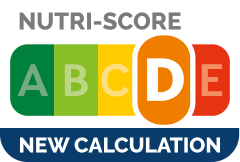 Lower nutritional quality
Nutri-Score data warning
Nutrient levels
Fat in moderate quantity (3.53%)
Saturated fat in low quantity (0%)
Sugars in high quantity (42.3%)
Salt in low quantity (0.0617%)
Nutrition label

Nutrition facts
| Nutrition facts | As sold for 100 g / 100 ml | Compared to: Mochi |
|---|---|---|
| Energy | ~ 1509.72557144204 kJ (356 kcal) | 1,394.199 kJ (328 kcal) (+8%) |
| Fat | 3.52739619495804 g | 4.584 g (-23%) |
| Saturated fat | 0 g | 1.811 g (-100%) |
| Carbohydrates | 81.130112484035 g | 68.5 g (+18%) |
| Sugars | 42.3287543394965 g | 32.545 g (+30%) |
| Dietary fiber | 0 g | ? |
| Proteins | 0 g | 2.189 g (-100%) |
| Salt | 0.0617294334117657 g | 0.105 g (-41%) |
| Sodium | 0.0246917733647063 g | 0.041 g (-40%) |
| Fruits, vegetables and legumes | ~ 22.38 % | ? |
Nutrition facts (Detailed data)
| Nutrition facts | As sold for 100 g / 100 ml | As sold Per serving (28.349523125 g) (packaging) | As sold Per 100 g (estimate) |
|---|---|---|---|
| Energy | ~ 1509.72557144204 kJ (356 kcal) | ? (101 kcal) | ? |
| Fat | 3.52739619495804 g | 1 g | ? |
| Saturated fat | 0 g | 0 g | ? |
| Carbohydrates | 81.130112484035 g | 23 g | ? |
| Sugars | 42.3287543394965 g | 12 g | ? |
| Dietary fiber | 0 g | 0 g | ? |
| Proteins | 0 g | 0 g | ? |
| Salt | 0.0617294334117657 g | 0.0175 g | ? |
| Sodium | 0.0246917733647063 g | 0.007 g | ? |
| Fruits, vegetables and legumes | ~ 22.38 % | ? | ~ 22.38 % |
Serving size
Ingredients
Ingredients image
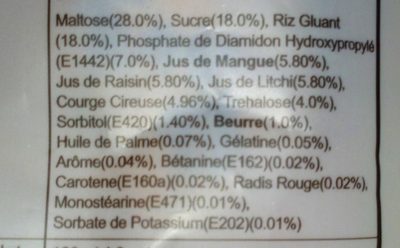
Ingredients list
Ingredient information
Added sugars
Allergens
Ingredients analysis
Contains ingredients containing palm oil.
Contains non-vegan ingredients.
Contains non-vegetarian ingredients.
Food Processing
NOVA group
 Ultra-processed food and drink products
Elements that indicate the product is in NOVA group 4
How NOVA works
Additives
E1442 - Hydroxypropyl distarch phosphateEmulsifierStabiliserThickener
Hydroxypropyl distarch phosphate (HDP) is a modified resistant starch. It is currently used as a food additive (INS number 1442). It is approved for use in the European Union (listed as E1442), the United States, Australia, Taiwan, and New Zealand.
E162 - Beetroot redColour
Betanin, or Beetroot Red, is a red glycosidic food dye obtained from beets; its aglycone, obtained by hydrolyzing away the glucose molecule, is betanidin. As a food additive, its E number is E162. The color of betanin depends on pH; between four and five it is bright bluish-red, becoming blue-violet as the pH increases. Once the pH reaches alkaline levels betanin degrades by hydrolysis, resulting in a yellow-brown color. Betanin is a betalain pigment, together with isobetanin, probetanin, and neobetanin. Other pigments contained in beet are indicaxanthin and vulgaxanthins.
E202 - Potassium sorbate EFSA overexposure risk: highPreservative
Potassium sorbate (E202) is a synthetic food preservative commonly used to extend the shelf life of various food products.
It works by inhibiting the growth of molds, yeast, and some bacteria, preventing spoilage. When added to foods, it helps maintain their freshness and quality.
Some studies have shown that when combined with nitrites, potassium sorbate have genotoxic activity in vitro. However, potassium sorbate is generally recognized as safe (GRAS) by regulatory authorities.
E420 - SorbitolHumectantSequestrantStabiliserSweetenerThickener
Sorbitol (), less commonly known as glucitol (), is a sugar alcohol with a sweet taste which the human body metabolizes slowly. It can be obtained by reduction of glucose, which changes the aldehyde group to a hydroxyl group. Most sorbitol is made from corn syrup, but it is also found in nature, for example in apples, pears, peaches, and prunes. It is converted to fructose by sorbitol-6-phosphate 2-dehydrogenase. Sorbitol is an isomer of mannitol, another sugar alcohol; the two differ only in the orientation of the hydroxyl group on carbon 2. While similar, the two sugar alcohols have very different sources in nature, melting points, and uses.
E428 - Gelatine
No additive description is available yet.
E471 - Mono- and diglycerides of fatty acidsEmulsifierStabiliser
Mono- and diglycerides of fatty acids (E471), are food additives commonly used as emulsifiers in various processed foods.
These compounds consist of glycerol molecules linked to one or two fatty acid chains, which help stabilize and blend water and oil-based ingredients. E471 enhances the texture and shelf life of products like margarine, baked goods, and ice cream, ensuring a smooth and consistent texture.
It is generally considered safe for consumption within established regulatory limits.
Environment
Green-Score, origins bonus, and transportation impact are shown for Worldwide .
Green Score
Overall grade
 Unknown environmental impact
About Green-Score
Current scope
Green-Score availability
Bonuses and maluses
Declared origins
Threatened species risk
Packaging impact
Packaging
Packaging impact
Packaging components
| Shape | Material | Recycling | Impact |
|---|---|---|---|
| BAG | Plastic | Unknown | High |
Declared packaging
Transportation
Manufacturing locations
Declared origins
Forest footprint
Forest footprint
Deforestation risk details
Data Source
Product data comes from Open Food Facts. Food Benchmark also adds translations, category comparisons and explanatory calculations.
The database is licensed under ODbL 1.0, individual contents under DbCL 1.0, and product photos under CC BY-SA 3.0.
Product added on March 18, 2018 at 7:22:13 AM UTC by kiliweb .
Last edit on March 14, 2026 at 8:54:47 AM UTC by new-nutrition-bot .
Product page also edited by beniben, inf, kiliweb, lamplis, new-nutrition-bot, openfoodfacts-contributors, packbot, yuka.U-tyHvGmPPw4M8fS8bs97hupD-jDBs14RE9Uow, yuka.Ub1YLIKJT9AqDcDZiKM18Si7LrveLvZVQEIhog, yuka.WTQwTkU1b1RxZGc3eGZReHpBemwxdHdvNlk2eWVucnVEODRNSVE9PQ, yuka.sY2b0xO6T85zoF3NwEKvlkBAQd-OmizqKRLflUyJ5eyCNp-1eotd6JTDbao, yuka.sY2b0xO6T85zoF3NwEKvlmJ5C9nMmjPvNAHvxXOlwfueH4biOYpf0pSgF6s, yuka.sY2b0xO6T85zoF3NwEKvlmVHccXPpjTBbRPfxUSFnPynPpXMT9NXvZCqLas, yuka.sY2b0xO6T85zoF3NwEKvlmlOTPjA_RHAHj7hok6r2dqJAprTYdBz5orLFas, yuka.sY2b0xO6T85zoF3NwEKvln5_bdyOjG3ALC3niXLW4uXSEJzqRvMs-JXfEqo.