

Balisto yoberry
Health
Nutrition
Nutri-Score
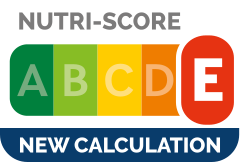 Lower nutritional quality
Nutri-Score data warning
Nutrient levels
Fat in high quantity (25%)
Saturated fat in high quantity (11%)
Sugars in high quantity (45%)
Salt in moderate quantity (0.62%)
Nutrition label

Nutrition facts
| Nutrition facts | As sold for 100 g / 100 ml |
|---|---|
| Energy | 2095 kJ (500 kcal) |
| Fat | 25 g |
| Saturated fat | 11 g |
| Carbohydrates | 61 g |
| Sugars | 45 g |
| Dietary fiber | ? |
| Proteins | 7 g |
| Salt | 0.62 g |
| Sodium | 0.248 g |
| Fruits, vegetables and legumes | ~ 2.6 % |
Nutrition facts (Detailed data)
| Nutrition facts | As sold for 100 g / 100 ml | As sold Per 100 g (packaging) | As sold Per 100 g (estimate) |
|---|---|---|---|
| Energy | 2095 kJ (500 kcal) | 2095 kJ (500 kcal) | ? |
| Fat | 25 g | 25 g | ? |
| Saturated fat | 11 g | 11 g | ? |
| Carbohydrates | 61 g | 61 g | ? |
| Sugars | 45 g | 45 g | ? |
| Dietary fiber | ? | ? | ? |
| Proteins | 7 g | 7 g | ? |
| Salt | 0.62 g | 0.62 g | ? |
| Sodium | 0.248 g | 0.248 g | ? |
| Fruits, vegetables and legumes | ~ 2.6 % | ? | ~ 2.6 % |
Serving size
Ingredients
Ingredients image

Ingredients list
Ingredient information
Allergens
Traces
Ingredients analysis
Contains ingredients containing palm oil.
Contains non-vegan ingredients.
Unrecognized: de:saiz
Vegetarian status unknown
Unrecognized: de:saiz
Food Processing
NOVA group
 Ultra-processed food and drink products
Elements that indicate the product is in NOVA group 4
How NOVA works
Additives
E330 - Citric acidAntioxidantSequestrant
Citric acid is a natural organic acid found in citrus fruits such as lemons, oranges, and limes.
It is widely used in the food industry as a flavor enhancer, acidulant, and preservative due to its tart and refreshing taste.
Citric acid is safe for consumption when used in moderation and is considered a generally recognized as safe (GRAS) food additive by regulatory agencies worldwide.
E440 - PectinsEmulsifierStabiliserThickener
Pectins (E440) are natural carbohydrates, predominantly found in fruits, that act as gelling agents in the food industry, creating the desirable jelly-like texture in jams, jellies, and marmalades.
Pectins stabilize and thicken various food products, such as desserts, confectioneries, and beverages, ensuring a uniform consistency and quality.
Recognized as safe by various health authorities, pectins have been widely used without notable adverse effects when consumed in typical dietary amounts.
E471 - Mono- and diglycerides of fatty acidsEmulsifierStabiliser
Mono- and diglycerides of fatty acids (E471), are food additives commonly used as emulsifiers in various processed foods.
These compounds consist of glycerol molecules linked to one or two fatty acid chains, which help stabilize and blend water and oil-based ingredients. E471 enhances the texture and shelf life of products like margarine, baked goods, and ice cream, ensuring a smooth and consistent texture.
It is generally considered safe for consumption within established regulatory limits.
E481 - Sodium stearoyl-2-lactylate EFSA overexposure risk: highEmulsifierStabiliser
Sodium stearoyl-2-lactylate (sodium stearoyl lactylate or SSL) is a versatile, FDA approved food additive used to improve the mix tolerance and volume of processed foods. It is one type of a commercially available lactylate. SSL is non-toxic, biodegradable, and typically manufactured using biorenewable feedstocks. Because SSL is a safe and highly effective food additive, it is used in a wide variety of products ranging from baked goods and desserts to pet foods.As described by the Food Chemicals Codex 7th edition, SSL is a cream-colored powder or brittle solid. SSL is currently manufactured by the esterification of stearic acid with lactic acid and partially neutralized with either food-grade soda ash (sodium carbonate) or caustic soda (concentrated sodium hydroxide). Commercial grade SSL is a mixture of sodium salts of stearoyl lactylic acids and minor proportions of other sodium salts of related acids. The HLB for SSL is 10-12. SSL is slightly hygroscopic, soluble in ethanol and in hot oil or fat, and dispersible in warm water. These properties are the reason that SSL is an excellent emulsifier for fat-in-water emulsions and can also function as a humectant.
E500 - Sodium carbonatesStabiliserThickener
Sodium carbonates (E500) are compounds commonly used in food preparation as leavening agents, helping baked goods rise by releasing carbon dioxide when they interact with acids.
Often found in baking soda, they regulate the pH of food, preventing it from becoming too acidic or too alkaline. In the culinary world, sodium carbonates can also enhance the texture and structure of foods, such as noodles, by modifying the gluten network.
Generally recognized as safe, sodium carbonates are non-toxic when consumed in typical amounts found in food.
Environment
Green-Score, origins bonus, and transportation impact are shown for Worldwide .
Green Score
Overall grade
 Low environmental impact
About Green-Score
Current scope
Life cycle analysis
Average impact of the category
Biscuit (cookie) • Score: 67/100Life-cycle reference
Overall environmental impact by stage (PEF)
The overall environmental impact figure (PEF) comes from ADEME's Agribalyse database, for the category: Biscuit (cookie). Source: ADEME Agribalyse Database.
| Stage | Impact |
|---|---|
| Agriculture | 68.5 % |
| Processing | 10.1 % |
| Packaging | 15.5 % |
| Transportation | 4.5 % |
| Distribution | 1.5 % |
| Consumption | 0.0 % |
Bonuses and maluses
Production system
Declared origins
Threatened species risk
Packaging impact
Green-Score for this product
Green-Score for this product
Final score: 62/100Final score breakdown
Carbon footprint
Carbon footprint
Climate impact by stage (CO2e)
The carbon emission figure comes from ADEME's Agribalyse database, for the category: Biscuit (cookie). Source: ADEME Agribalyse Database.
| Stage | Impact |
|---|---|
| Agriculture | 63.5 % |
| Processing | 5.2 % |
| Packaging | 24.5 % |
| Transportation | 5.9 % |
| Distribution | 0.7 % |
| Consumption | 0.0 % |
Packaging

Packaging impact
Packaging components
| Shape | Material | Recycling | Impact |
|---|---|---|---|
| Packet | Unknown | Unknown | High |
| Packet | Unknown | Unknown | High |
Declared packaging
Data precision
Transportation
Declared origins
Data Source
Product data comes from Open Food Facts. Food Benchmark also adds translations, category comparisons and explanatory calculations.
The database is licensed under ODbL 1.0, individual contents under DbCL 1.0, and product photos under CC BY-SA 3.0.
Product added on June 9, 2012 at 2:31:31 AM UTC by lilimarti .
Last edit on March 13, 2026 at 8:42:38 PM UTC by new-nutrition-bot .
Product page also edited by anty, asmoth, autorotate-bot, countrybot, date-limite-app, ecoscore-impact-estimator, fffood, foodvisor, halloween92, hangy, kiliweb, lilimarti, magasins-u, manu1400, new-nutrition-bot, off.1247c965-95c9-4360-a2c3-375d8f86b0c7, openfoodfacts-contributors, packbot, prepperapp, quechoisir, quentinbrd, roboto-app, twoflower, yogoff, yuka.WEprZ1M2UmRwYWNXbnM4Wnd5bnQyTWxjemJPa1ZGeXBDZVVlSVE9PQ, yuka.ZWFzZkZxOG5tOWdLdzhVK3pDenovOXR6N0lEMFEzK3BDOFZPSUE9PQ.