

Bisc. nutri-grain X6 GR37 Mirt.
Health
Nutrition
Nutri-Score
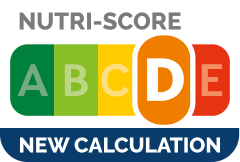 Lower nutritional quality
Nutri-Score data warning
Nutrient levels
Fat in moderate quantity (7.7%)
Saturated fat in moderate quantity (2.8%)
Sugars in high quantity (33%)
Salt in moderate quantity (0.78%)
Nutrition label

Nutrition facts
| Nutrition facts | As sold for 100 g / 100 ml | Compared to: Biscuits and crackers |
|---|---|---|
| Energy | 1477 kcal (353 kcal) | 1,963.529 kJ (468 kcal) |
| Fat | 7.7 | 20.055 g (-62%) |
| Saturated fat | 2.8 | 8.647 g (-68%) |
| Carbohydrates | 68 | 63.212 g (+8%) |
| Sugars | 33 | 23.73 g (+39%) |
| Dietary fiber | 3.5 | ? |
| Proteins | 4 | 7.002 g (-43%) |
| Salt | 0.78 | 0.738 g (+6%) |
| Sodium | 0.312 g | 0.295 g (+6%) |
| Fruits, vegetables and legumes | ? | ? |
Nutrition facts (Detailed data)
| Nutrition facts | As sold for 100 g / 100 ml | As sold Per serving (legacy) |
|---|---|---|
| Energy | 1477 kcal (353 kcal) | ? |
| Fat | 7.7 | ? |
| Saturated fat | 2.8 | ? |
| Carbohydrates | 68 | ? |
| Sugars | 33 | ? |
| Dietary fiber | 3.5 | ? |
| Proteins | 4 | ? |
| Salt | 0.78 | ? |
| Sodium | 0.312 g | ? |
| Fruits, vegetables and legumes | ? | ? |
Ingredients
Ingredients image

Ingredients list
Ingredient information
Added sugars
Allergens
Ingredients analysis
Contains ingredients containing palm oil.
Contains non-vegan ingredients.
Unrecognized: fr:orge-complet, fr:1-dextrose, fr:carbonate-de-potassium-d-hydrogene, fr:lecithine-de-toumesol, en:iron
Vegetarian status unknown
Unrecognized: fr:orge-complet, fr:1-dextrose, fr:carbonate-de-potassium-d-hydrogene, fr:lecithine-de-toumesol, en:iron
Food Processing
NOVA group
 Ultra-processed food and drink products
Elements that indicate the product is in NOVA group 4
How NOVA works
Additives
E14XX - Modified StarchEmulsifierStabiliserThickener
No additive description is available yet.
E163 - AnthocyaninsColour
Anthocyanins (also anthocyans; from Greek: ἄνθος (anthos) "flower" and κυάνεος/κυανοῦς kyaneos/kyanous "dark blue") are water-soluble vacuolar pigments that, depending on their pH, may appear red, purple, or blue. Food plants rich in anthocyanins include the blueberry, raspberry, black rice, and black soybean, among many others that are red, blue, purple, or black. Some of the colors of autumn leaves are derived from anthocyanins.Anthocyanins belong to a parent class of molecules called flavonoids synthesized via the phenylpropanoid pathway. They occur in all tissues of higher plants, including leaves, stems, roots, flowers, and fruits. Anthocyanins are derived from anthocyanidins by adding sugars. They are odorless and moderately astringent. Although approved to color foods and beverages in the European Union, anthocyanins are not approved for use as a food additive because they have not been verified as safe when used as food or supplement ingredients. There is no conclusive evidence anthocyanins have any effect on human biology or diseases.
E170 - Calcium carbonates EFSA overexposure risk: no
CALCIUM CARBONATE is a chemical compound with the formula CaCO3.
E170i - Calcium carbonate EFSA overexposure risk: noColourStabiliser
No additive description is available yet.
E296 - Malic acid
MALIC ACID is an organic compound with the molecular formula C4H6O5. Malic acid has two stereoisomeric forms (L- and D-enantiomers), though only the L-isomer exists naturally.
E322 - LecithinsAntioxidantEmulsifier
Lecithins are natural compounds commonly used in the food industry as emulsifiers and stabilizers.
Extracted from sources like soybeans and eggs, lecithins consist of phospholipids that enhance the mixing of oil and water, ensuring smooth textures in various products like chocolates, dressings, and baked goods.
They do not present any known health risks.
E322i - LecithinAntioxidantEmulsifier
Lecithins are natural compounds commonly used in the food industry as emulsifiers and stabilizers.
Extracted from sources like soybeans and eggs, lecithins consist of phospholipids that enhance the mixing of oil and water, ensuring smooth textures in various products like chocolates, dressings, and baked goods.
They do not present any known health risks.
E330 - Citric acidAntioxidantSequestrant
Citric acid is a natural organic acid found in citrus fruits such as lemons, oranges, and limes.
It is widely used in the food industry as a flavor enhancer, acidulant, and preservative due to its tart and refreshing taste.
Citric acid is safe for consumption when used in moderation and is considered a generally recognized as safe (GRAS) food additive by regulatory agencies worldwide.
E401 - sodium alginateCarrierEmulsifierHumectantSequestrantStabiliserThickener
No additive description is available yet.
E415 - Xanthan gumEmulsifierStabiliserThickener
Xanthan gum (E415) is a natural polysaccharide derived from fermented sugars, often used in the food industry as a thickening and stabilizing agent.
This versatile food additive enhances texture and prevents ingredient separation in a wide range of products, including salad dressings, sauces, and gluten-free baked goods.
It is considered safe for consumption even at high intake amounts.
E422 - GlycerolHumectantThickener
Glycerol (; also called glycerine or glycerin; see spelling differences) is a simple polyol compound. It is a colorless, odorless, viscous liquid that is sweet-tasting and non-toxic. The glycerol backbone is found in all lipids known as triglycerides. It is widely used in the food industry as a sweetener and humectant and in pharmaceutical formulations. Glycerol has three hydroxyl groups that are responsible for its solubility in water and its hygroscopic nature.
E461 - methyl celluloseEmulsifierStabiliserThickener
METHYL CELLULOSE is a chemical compound derived from cellulose. Methyl cellulose is added to food products, to generate their characteristic thick consistency, for example ice cream or croquette.
E501 - Potassium carbonatesStabiliser
Potassium carbonate (K2CO3) is a white salt, which is soluble in water (insoluble in ethanol) and forms a strongly alkaline solution. It can be made as the product of potassium hydroxide's absorbent reaction with carbon dioxide. It is deliquescent, often appearing a damp or wet solid. Potassium carbonate is used in the production of soap and glass.
E501i - Potassium carbonateStabiliser
No additive description is available yet.
Environment
Green-Score, origins bonus, and transportation impact are shown for Worldwide .
Green Score
Overall grade
 High environmental impact
About Green-Score
Current scope
Life cycle analysis
Average impact of the category
 Biscuit (cookie) • Score: 67/100
Life-cycle reference
Overall environmental impact by stage (PEF)
The overall environmental impact figure (PEF) comes from ADEME's Agribalyse database, for the category: Biscuit (cookie). Source: ADEME Agribalyse Database.
| Stage | Impact |
|---|---|
| Agriculture | 68.5 % |
| Processing | 10.1 % |
| Packaging | 15.5 % |
| Transportation | 4.5 % |
| Distribution | 1.5 % |
| Consumption | 0.0 % |
Bonuses and maluses
Origins of ingredients
Threatened species risk
Packaging impact
Green-Score for this product
Green-Score for this product
Final score: 37/100Final score breakdown
Carbon footprint
Carbon footprint
Climate impact by stage (CO2e)
The carbon emission figure comes from ADEME's Agribalyse database, for the category: Biscuit (cookie). Source: ADEME Agribalyse Database.
| Stage | Impact |
|---|---|
| Agriculture | 63.5 % |
| Processing | 5.2 % |
| Packaging | 24.5 % |
| Transportation | 5.9 % |
| Distribution | 0.7 % |
| Consumption | 0.0 % |
Packaging
Packaging impact
Data precision
Transportation
Origins of ingredients
Origins breakdown
| Origin | Percent of ingredients | Impact |
|---|---|---|
| Unknown | 100 % | High |
| Burundi | 0 % | High |
Forest footprint
Forest footprint
Deforestation risk details
Data Source
Product data comes from Open Food Facts. Food Benchmark also adds translations, category comparisons and explanatory calculations.
The database is licensed under ODbL 1.0, individual contents under DbCL 1.0, and product photos under CC BY-SA 3.0.
Product added on July 23, 2017 at 1:23:57 PM UTC by kiliweb .
Last edit on January 14, 2026 at 2:32:53 AM UTC by minerva .
Product page also edited by kiliweb, minerva, openfoodfacts-contributors, roboto-app.