
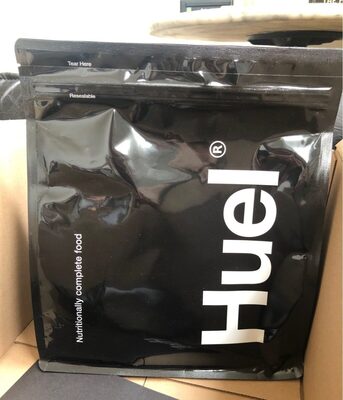
Huel Black: Vanilla v1.0
Health
Nutrition
Nutrition label

Nutrition facts
| Nutrition facts | As sold for 100 g / 100 ml | Compared to: Meal replacements |
|---|---|---|
| Energy | ~ 1869.4 kJ (442 kcal) | 1,187.133 kJ (282 kcal) (+57%) |
| Fat | 20 g | 8.528 g (+135%) |
| Saturated fat | 2.8 g | 1.905 g (+47%) |
| Carbohydrates | 19 g | 25.576 g (-26%) |
| Sugars | 4.9 g | 7.764 g (-37%) |
| Dietary fiber | 7.3 g | ? |
| Proteins | 44 g | 20.393 g (+116%) |
| Salt | 1.1 g | 0.658 g (+67%) |
| Sodium | 0.44 g | 0.261 g (+69%) |
| Fruits, vegetables and legumes | ~ 0.0954861111111143 % | ? |
Nutrition facts (Detailed data)
| Nutrition facts | As sold for 100 g / 100 ml | As sold Per 100 g (packaging) | As sold Per 100 g (estimate) |
|---|---|---|---|
| Energy | ~ 1869.4 kJ (442 kcal) | ? (442 kcal) | ? |
| Fat | 20 g | 20 g | ? |
| Saturated fat | 2.8 g | 2.8 g | ? |
| Carbohydrates | 19 g | 19 g | ? |
| Sugars | 4.9 g | 4.9 g | ? |
| Dietary fiber | 7.3 g | 7.3 g | ? |
| Proteins | 44 g | 44 g | ? |
| Salt | 1.1 g | 1.1 g | ? |
| Sodium | 0.44 g | 0.44 g | ? |
| Fruits, vegetables and legumes | ~ 0.0954861111111143 % | ? | ~ 0.0954861111111143 % |
Serving size
Ingredients
Ingredients image
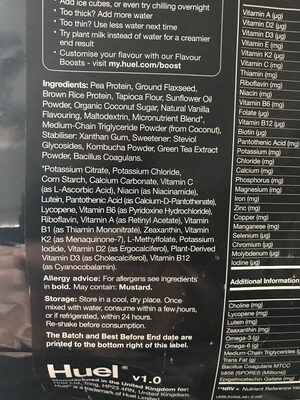
Ingredients list
Ingredient information
Added sugars
Traces
Ingredients analysis
No ingredients containing palm oil.
No non-vegan ingredients.
Unrecognized: en:brown-rice-protein, en:micronutrient-blend, en:steviol-vitamin-b12, en:chloride, en:glycosides, en:kombucha, en:as-menaquinone-7, en:l-methylfolate, en:potassium-lodide, en:phosphorus, en:lodine
No non-vegetarian ingredients.
Unrecognized: en:brown-rice-protein, en:micronutrient-blend, en:steviol-vitamin-b12, en:chloride, en:glycosides, en:kombucha, en:as-menaquinone-7, en:l-methylfolate, en:potassium-lodide, en:phosphorus, en:lodine
Food Processing
NOVA group
 Ultra-processed food and drink products
Elements that indicate the product is in NOVA group 4
How NOVA works
Additives
E160d - LycopeneColour
Lycopene (from the neo-Latin Lycopersicum, the tomato species) is a bright red carotene and carotenoid pigment and phytochemical found in tomatoes and other red fruits and vegetables, such as red carrots, watermelons, gac, and papayas, but it is not in strawberries or cherries. Although lycopene is chemically a carotene, it has no vitamin A activity. Foods that are not red may also contain lycopene, such as asparagus and parsley.In plants, algae, and other photosynthetic organisms, lycopene is an intermediate in the biosynthesis of many carotenoids, including beta-carotene, which is responsible for yellow, orange, or red pigmentation, photosynthesis, and photoprotection. Like all carotenoids, lycopene is a tetraterpene. It is insoluble in water. Eleven conjugated double bonds give lycopene its deep red color. Owing to the strong color, lycopene is useful as a food coloring (registered as E160d) and is approved for use in the USA, Australia and New Zealand (registered as 160d) and the European Union.
E161b - LuteinColour
LUTEIN is a xanthophyll and one of 600 known naturally occurring carotenoids. Lutein is extracted from the petals of African marigold (Tagetes erecta). It is approved for use in the EU and Australia and New Zealand. In the United States lutein may not be used as a food coloring for foods intended for human consumption, but can be added to animal feed.
E161h - ZeaxanthinColour
No additive description is available yet.
E415 - Xanthan gumEmulsifierStabiliserThickener
Xanthan gum (E415) is a natural polysaccharide derived from fermented sugars, often used in the food industry as a thickening and stabilizing agent.
This versatile food additive enhances texture and prevents ingredient separation in a wide range of products, including salad dressings, sauces, and gluten-free baked goods.
It is considered safe for consumption even at high intake amounts.
Environment
Green-Score, origins bonus, and transportation impact are shown for Worldwide .
Green Score
Overall grade
 Very low environmental impact
About Green-Score
Current scope
Life cycle analysis
Average impact of the category
Meal replacement low calorie, ready-to-drink • Score: 85/100Life-cycle reference
Overall environmental impact by stage (PEF)
The overall environmental impact figure (PEF) comes from ADEME's Agribalyse database, for the category: Meal replacement low calorie, ready-to-drink. Source: ADEME Agribalyse Database.
| Stage | Impact |
|---|---|
| Agriculture | 38.8 % |
| Processing | 15.5 % |
| Packaging | 32.3 % |
| Transportation | 8.0 % |
| Distribution | 4.3 % |
| Consumption | 1.1 % |
Bonuses and maluses
Origins of ingredients
Packaging impact
Green-Score for this product
Green-Score for this product
Final score: 79/100Final score breakdown
Carbon footprint
Carbon footprint
Climate impact by stage (CO2e)
The carbon emission figure comes from ADEME's Agribalyse database, for the category: Meal replacement low calorie, ready-to-drink. Source: ADEME Agribalyse Database.
| Stage | Impact |
|---|---|
| Agriculture | 36.1 % |
| Processing | 8.5 % |
| Packaging | 43.6 % |
| Transportation | 9.6 % |
| Distribution | 1.8 % |
| Consumption | 0.3 % |
Packaging
Packaging impact
Packaging components
| Shape | Material | Recycling | Impact |
|---|---|---|---|
| Film | Plastic | Unknown | High |
Declared packaging
Transportation
Origins of ingredients
Origins breakdown
| Origin | Percent of ingredients | Impact |
|---|---|---|
| Unknown | 100 % | High |
| Uganda | 0 % | High |
| Madagascar | 0 % | High |
Forest footprint
Forest footprint
Deforestation risk details
Data Source
Product data comes from Open Food Facts. Food Benchmark also adds translations, category comparisons and explanatory calculations.
The database is licensed under ODbL 1.0, individual contents under DbCL 1.0, and product photos under CC BY-SA 3.0.
Product added on January 2, 2020 at 1:54:17 PM UTC by kiliweb .
Last edit on March 17, 2026 at 11:16:43 PM UTC by new-nutrition-bot .
Product page also edited by chanyty, charlesnepote, kiliweb, lpier1969, new-nutrition-bot, openfoodfacts-contributors, packbot, scrypt, yuka.WExnRkZQb25oY0U3bHNZaW9pTHMwZFFyeHB1Slp6bnBEK1VSSWc9PQ.