

Gout Bacon
Health
Nutrition
Nutri-Score
 Lower nutritional quality
Nutri-Score data warning
Nutrient levels
Fat in moderate quantity (19%)
Saturated fat in high quantity (8.9%)
Sugars in moderate quantity (7%)
Salt in high quantity (2.2%)
Nutrition label
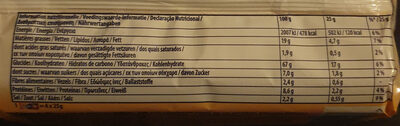
Nutrition facts
| Nutrition facts | As sold for 100 g / 100 ml | Compared to: Snacks |
|---|---|---|
| Energy | 2011 kJ (479 kcal) | 1,864.002 kJ (445 kcal) (+8%) |
| Fat | 19 g | 20.373 g (-7%) |
| Saturated fat | 8.9 g | 8.167 g (+9%) |
| Carbohydrates | 66 g | 55.719 g (+18%) |
| Sugars | 7 g | 27.394 g (-74%) |
| Dietary fiber | 2.4 g | ? |
| Proteins | 8.5 g | 6.499 g (+31%) |
| Salt | 2.2 g | 0.557 g (+295%) |
| Sodium | 0.88 g | 0.222 g (+296%) |
| Fruits, vegetables and legumes | ~ 1.1 % | ? |
Nutrition facts (Detailed data)
| Nutrition facts | As sold for 100 g / 100 ml | As sold Per 100 g (packaging) | As sold Per 100 g (estimate) |
|---|---|---|---|
| Energy | 2011 kJ (479 kcal) | 2011 kJ (479 kcal) | ? |
| Fat | 19 g | 19 g | ? |
| Saturated fat | 8.9 g | 8.9 g | ? |
| Carbohydrates | 66 g | 66 g | ? |
| Sugars | 7 g | 7 g | ? |
| Dietary fiber | 2.4 g | 2.4 g | ? |
| Proteins | 8.5 g | 8.5 g | ? |
| Salt | 2.2 g | 2.2 g | ? |
| Sodium | 0.88 g | 0.88 g | ? |
| Fruits, vegetables and legumes | ~ 1.1 % | ? | ~ 1.1 % |
Serving size
Ingredients
Ingredients image

Ingredients list
Ingredient information
Added sugars
Allergens
Traces
Ingredients analysis
No ingredients containing palm oil.
Contains non-vegan ingredients.
Contains non-vegetarian ingredients.
Food Processing
NOVA group
 Ultra-processed food and drink products
Elements that indicate the product is in NOVA group 4
How NOVA works
Additives
E120 - CochinealColour
Cochineal extract or carmine (E120) is a natural red colorant derived from the dried bodies of the female cochineal insect.
It is widely used to impart a pink, red, or purple hue to various food and beverage products, including yogurts, ice creams, confectionery, and fruit juices.
Although it is a natural additive, E120 is known to cause severe allergic reactions, including anaphylaxis, in some individuals. It is also not suitable for vegetarians or vegans due to its insect origin.
E160c - Paprika extractColour
No additive description is available yet.
E221 - Sodium sulphite EFSA overexposure risk: highAntioxidantPreservative
SODIUM SULFITE is a soluble sodium salt of sulfurous acid (sulfite) with the chemical formula Na2SO3.
E322 - LecithinsAntioxidantEmulsifier
Lecithins are natural compounds commonly used in the food industry as emulsifiers and stabilizers.
Extracted from sources like soybeans and eggs, lecithins consist of phospholipids that enhance the mixing of oil and water, ensuring smooth textures in various products like chocolates, dressings, and baked goods.
They do not present any known health risks.
E322i - LecithinAntioxidantEmulsifier
Lecithins are natural compounds commonly used in the food industry as emulsifiers and stabilizers.
Extracted from sources like soybeans and eggs, lecithins consist of phospholipids that enhance the mixing of oil and water, ensuring smooth textures in various products like chocolates, dressings, and baked goods.
They do not present any known health risks.
E500 - Sodium carbonatesStabiliserThickener
Sodium carbonates (E500) are compounds commonly used in food preparation as leavening agents, helping baked goods rise by releasing carbon dioxide when they interact with acids.
Often found in baking soda, they regulate the pH of food, preventing it from becoming too acidic or too alkaline. In the culinary world, sodium carbonates can also enhance the texture and structure of foods, such as noodles, by modifying the gluten network.
Generally recognized as safe, sodium carbonates are non-toxic when consumed in typical amounts found in food.
E503 - Ammonium carbonates
AMMONIUM BICARBONATE is an inorganic compound with formula (NH4)HCO3, simplified to NH5CO3. Ammonium bicarbonate is used in the food industry as a raising agent for flat baked goods, such as cookies and crackers, and in China in steamed buns and Chinese almond cookies. It was commonly used in the home before modern day baking powder was made available.
E621 - Monosodium glutamate EFSA overexposure risk: highFlavour Enhancer
Monosodium glutamate (MSG), or E621, is the sodium salt of glutamic acid, an amino acid found naturally in many foods.
It is widely used as a flavor enhancer to provide an "umami" or savory taste to a variety of processed foods, including soups, snack chips, and frozen meals.
MSG is generally recognized as safe (GRAS) by food authorities. However, some people report sensitivity to MSG, experiencing short-term symptoms like headaches and flushing, though scientific studies have not shown a consistent link.
E627 - Disodium guanylate
Disodium guanylate, also known as sodium 5'-guanylate and disodium 5'-guanylate, is a natural sodium salt of the flavor enhancing nucleotide guanosine monophosphate (GMP). Disodium guanylate is a food additive with the E number E627. It is commonly used in conjunction with glutamic acid. As it is a fairly expensive additive, it is not used independently of glutamic acid; if disodium guanylate is present in a list of ingredients but MSG does not appear to be, it is likely that glutamic acid is provided as part of another ingredient such as a processed soy protein complex. It is often added to foods in conjunction with disodium inosinate; the combination is known as disodium 5'-ribonucleotides. Disodium guanylate is produced from dried seaweed and is often added to instant noodles, potato chips and other snacks, savory rice, tinned vegetables, cured meats, and packaged soup.
E631 - Disodium inosinate
Disodium inosinate (E631) is the disodium salt of inosinic acid with the chemical formula C10H11N4Na2O8P. It is used as a food additive and often found in instant noodles, potato chips, and a variety of other snacks. Although it can be obtained from bacterial fermentation of sugars, it is often commercially prepared from animal sources.
Environment
Green-Score, origins bonus, and transportation impact are shown for Worldwide .
Green Score
Overall grade
 Unknown environmental impact
About Green-Score
Current scope
Green-Score availability
Bonuses and maluses
Declared origins
Packaging impact
Packaging

Packaging impact
Packaging materials
| Material | % | Packaging weight | Packaging weight per 100 g of product |
|---|---|---|---|
| Plastic | 100 % | ||
| Total | 100 % |
Packaging components
| Shape | Material | Recycling | Impact |
|---|---|---|---|
| 1 BAG | Plastic | Recycle | High |
Declared packaging
Transportation
Manufacturing locations
Declared origins
Forest footprint
Forest footprint
Ingredients linked to forest pressure
| Ingredient | Type | Percent in product | Forest footprint |
|---|---|---|---|
| EGG | Oeufs Importés | 1.10 % | 0.00 |
Data Source
Product data comes from Open Food Facts. Food Benchmark also adds translations, category comparisons and explanatory calculations.
The database is licensed under ODbL 1.0, individual contents under DbCL 1.0, and product photos under CC BY-SA 3.0.
Product added on October 22, 2012 at 7:10:14 PM UTC by clb .
Last edit on March 14, 2026 at 6:54:24 AM UTC by foodless .
Product page also edited by 5m4u9, aleene, alia, anjavl, ascrounch, bot-tags-and-languages, chevalstar, clb, date-limite-app, dorado-jerome, driveoff, ecoscore-impact-estimator, fighter-food-facts, foodless, foodrepo, halal-app-chakib, inf, insectproductadd, kiliweb, laura-chaud, louisdeconinck, loverock, magasins-u, manu1400, mathias, millecentdix, musarana, october-food-facts, off.3b1608a2-99b8-4fe0-b399-5b73e0d4f526, openfood-ch-import, openfoodfacts-contributors, packbot, prepperapp, quechoisir, quentinbrd, raphael0202, roboto-app, sandman095, scanbot, sebleouf, securita, smoothie-app, tacite, tacite-mass-editor, teolemon, thaialagata, thotem, twoflower, ysculo, yuka.SFpBQk5xSmJwOUFWaHMwMHdEWDAwUEY0d1pPRVQwTHBLdGNVSWc9PQ, yuka.VjRrRU02Z0VwTUU0aTlvYSt6R00xZmdzM3M2T1IyanNOL2NRSWc9PQ, yuka.Vzd0UkR2bytndXNVd3RvbjNBTDMvUHNsenBPZ2QwYnBGTGNLSVE9PQ, yuka.WmFjUERyOFl1OGcxcWN3eXp4VDYxTjV6OWJDcmNEKzZPc29SSVE9PQ, yuka.YUswQkFvZGJsNllRdjh3VndqTFo0dFF0N3BIM1dVbUdjdll5SVE9PQ, yuka.YjQ0NFBJYzZxS2dHdk1BdTN4cng2dDVid01LM1dudWxBT0ZPSUE9PQ, yuka.ZW9rRkVmZ2F1T0E3bnNNeTR5UE0wZEZJMTVMMFUzT1pGZHBLSUE9PQ, yuka.ZXJ3NkdxbGVoc1JYbzhNUDJ4cno0dnRSeHJqeGZYUHVGTnBCSUE9PQ, yuka.sY2b0xO6T85zoF3NwEKvlnEYUYaGhTfjbxr4pHag7e3SKbr3WtRy4pDcKKg, yukafix.