

Meda Salam Victoria
Health
Nutrition
Nutri-Score
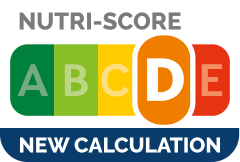 Lower nutritional quality
Nutri-Score data warning
Nutrient levels
Fat in moderate quantity (14%)
Saturated fat in high quantity (5.1%)
Sugars in low quantity (0.5%)
Salt in high quantity (2.2%)
Nutrition facts
| Nutrition facts | As sold for 100 g / 100 ml |
|---|---|
| Energy | 793 kJ (189 kcal) |
| Fat | 14 g |
| Saturated fat | 5.1 g |
| Carbohydrates | 1.2 g |
| Sugars | 0.5 g |
| Dietary fiber | ? |
| Proteins | 15 g |
| Salt | 2.2 g |
| Sodium | 0.88 g |
| Fruits, vegetables and legumes | ? |
Nutrition facts (Detailed data)
| Nutrition facts | As sold for 100 g / 100 ml | As sold Per serving (legacy) |
|---|---|---|
| Energy | 793 kJ (189 kcal) | ? |
| Fat | 14 g | ? |
| Saturated fat | 5.1 g | ? |
| Carbohydrates | 1.2 g | ? |
| Sugars | 0.5 g | ? |
| Dietary fiber | ? | ? |
| Proteins | 15 g | ? |
| Salt | 2.2 g | ? |
| Sodium | 0.88 g | ? |
| Fruits, vegetables and legumes | ? | ? |
Ingredients
Ingredients list
Ingredient information
Added sugars
Allergens
Ingredients analysis
Palm oil content unknown
Unrecognized: ro:contine-telina-si-mustar, ro:trifosfati, ro:conservanti, ro:gelifiant, ro:antioxidanti, ro:potentiator-de-aroma
Contains non-vegan ingredients.
Unrecognized: ro:contine-telina-si-mustar, ro:trifosfati, ro:conservanti, ro:gelifiant, ro:antioxidanti, ro:potentiator-de-aroma
Contains non-vegetarian ingredients.
Unrecognized: ro:contine-telina-si-mustar, ro:trifosfati, ro:conservanti, ro:gelifiant, ro:antioxidanti, ro:potentiator-de-aroma
Food Processing
NOVA group
 Ultra-processed food and drink products
Elements that indicate the product is in NOVA group 4
How NOVA works
Additives
E120 - CochinealColour
Cochineal extract or carmine (E120) is a natural red colorant derived from the dried bodies of the female cochineal insect.
It is widely used to impart a pink, red, or purple hue to various food and beverage products, including yogurts, ice creams, confectionery, and fruit juices.
Although it is a natural additive, E120 is known to cause severe allergic reactions, including anaphylaxis, in some individuals. It is also not suitable for vegetarians or vegans due to its insect origin.
E250 - Sodium nitrite EFSA overexposure risk: highPreservative
Sodium nitrite (E250) is a salt used for curing and preserving meat products.
It plays a critical role in preventing the growth of Clostridium botulinum, the bacterium responsible for botulism, in cured meats like bacon, ham, and sausages. It also provides the characteristic pink color and flavor.
However, nitrites can react with amines in the stomach to form nitrosamines, which are potent carcinogens. High intake of processed meats containing nitrites is associated with an increased risk of colorectal cancer. Regulatory bodies have set strict limits on its use in food.
E262 - Sodium acetatesPreservativeSequestrant
SODIUM ACETATE, also abbreviated NaOAc,[8] is the sodium salt of acetic acid.
E262i - Sodium acetatePreservativeSequestrant
No additive description is available yet.
E317 - Erythorbin acid
No additive description is available yet.
E326 - potassium lactateAntioxidantEmulsifierHumectant
POTASSIUM LACTATE is a compound with formula KC3H5O3. It is produced by neutralizing lactic acid which is fermented from a sugar source. Potassium lactate is commonly used in meat and poultry products to extend shelf life and increase food safety as it has a broad antimicrobial action. lactic acid and lactates can be consumed by all religious groups, vegans and vegetarians. Although the name refers to milk, it is not made from milk and thus suitable for people with milk allergy or lactose intolerance.
E407 - Carrageenan EFSA overexposure risk: highCarrierEmulsifierHumectantStabiliserThickener
Carrageenan (E407), derived from red seaweed, is widely employed in the food industry as a gelling, thickening, and stabilizing agent, notably in dairy and meat products.
It can exist in various forms, each imparting distinct textural properties to food.
However, its degraded form, often referred to as poligeenan, has raised health concerns due to its potential inflammatory effects and its classification as a possible human carcinogen (Group 2B) by the International Agency for Research on Cancer (IARC).
Nevertheless, food-grade carrageenan has been deemed safe by various regulatory bodies when consumed in amounts typically found in food.
E621 - Monosodium glutamate EFSA overexposure risk: highFlavour Enhancer
Monosodium glutamate (MSG), or E621, is the sodium salt of glutamic acid, an amino acid found naturally in many foods.
It is widely used as a flavor enhancer to provide an "umami" or savory taste to a variety of processed foods, including soups, snack chips, and frozen meals.
MSG is generally recognized as safe (GRAS) by food authorities. However, some people report sensitivity to MSG, experiencing short-term symptoms like headaches and flushing, though scientific studies have not shown a consistent link.
Environment
Green-Score, origins bonus, and transportation impact are shown for Worldwide .
Green Score
Overall grade
 Unknown environmental impact
About Green-Score
Current scope
Green-Score availability
Bonuses and maluses
Declared origins
Packaging impact
Packaging
Packaging impact
Packaging components
| Shape | Material | Recycling | Impact |
|---|---|---|---|
| Unknown | Plastic | Unknown | Unknown |
Declared packaging
Data precision
Transportation
Manufacturing locations
Declared origins
Data Source
Product data comes from Open Food Facts. Food Benchmark also adds translations, category comparisons and explanatory calculations.
The database is licensed under ODbL 1.0, individual contents under DbCL 1.0, and product photos under CC BY-SA 3.0.
Product added on February 22, 2018 at 10:00:30 PM UTC by brandprivat .
Last edit on February 11, 2022 at 11:02:38 AM UTC by packbot .
Product page also edited by packbot, tacite-mass-editor, brandprivat.