

Barra Multigrano Linaza Bimbo 42GR.
Health
Nutrition
Nutri-Score
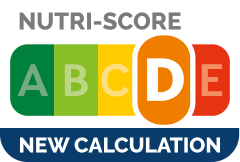 Lower nutritional quality
Nutri-Score data warning
Nutrient levels
Fat in high quantity (23%)
Saturated fat in high quantity (6.9%)
Sugars in high quantity (14%)
Salt in moderate quantity (0.505%)
Nutrition facts
| Nutrition facts | As sold for 100 g / 100 ml |
|---|---|
| Energy | 1860 kcal (444 kcal) |
| Fat | 23 g |
| Saturated fat | 6.9 g |
| Monounsaturated fat | 8.3 g |
| Polyunsaturated fat | 7.8 g |
| Cholesterol | 0.041 g |
| Carbohydrates | 48.4 g |
| Sugars | 14 g |
| Dietary fiber | 10.1 g |
| Proteins | 10.4 g |
| Salt | 0.505 g |
| Sodium | 0.202 g |
| Vitamin E | 0.0022 g |
| Vitamin B1 | 0.000156 g |
| Vitamin B2 | 0.000138 g |
| Vitamin PP | 0.00562 % DV |
| Vitamin B6 | 0.000219 g |
| Iron | 0.0018 g |
| Magnesium | 0.052 g |
| Zinc | 0.00135 g |
| Fruits, vegetables and legumes | ? |
Nutrition facts (Detailed data)
| Nutrition facts | As sold for 100 g / 100 ml | As sold Per serving (legacy) |
|---|---|---|
| Energy | 1860 kcal (444 kcal) | 594 kcal (142 kcal) |
| Fat | 23 g | 7.36 g |
| Saturated fat | 6.9 g | 2.208 g |
| Monounsaturated fat | 8.3 g | 2.656 g |
| Polyunsaturated fat | 7.8 g | 2.496 g |
| Cholesterol | 0.041 g | 0.01312 g |
| Carbohydrates | 48.4 g | 15.5 g |
| Sugars | 14 g | 4.48 g |
| Dietary fiber | 10.1 g | 3.232 g |
| Proteins | 10.4 g | 3.328 g |
| Salt | 0.505 g | 0.1616 g |
| Sodium | 0.202 g | 0.06464 g |
| Vitamin E | 0.0022 g | 0.000704 g |
| Vitamin B1 | 0.000156 g | 0.00005 g |
| Vitamin B2 | 0.000138 g | 0.000044 g |
| Vitamin PP | 0.00562 % DV | 0.0018 % DV |
| Vitamin B6 | 0.000219 g | 0.00007 g |
| Iron | 0.0018 g | 0.000576 g |
| Magnesium | 0.052 g | 0.01664 g |
| Zinc | 0.00135 g | 0.000432 g |
| Fruits, vegetables and legumes | ? | ? |
Serving size
Ingredients
Ingredients list
Ingredient information
Added sugars
Allergens
Traces
Ingredients analysis
Palm oil content unknown
Contains non-vegan ingredients.
Unrecognized: es:leche-fibra-de-avena, es:0mega-3, es:bicarbonato-de-sodio-saborizante-natural-y-artificial, en:zinc, en:iron
Vegetarian status unknown
Unrecognized: es:leche-fibra-de-avena, es:0mega-3, es:bicarbonato-de-sodio-saborizante-natural-y-artificial, en:zinc, en:iron
Food Processing
NOVA group
 Ultra-processed food and drink products
Elements that indicate the product is in NOVA group 4
How NOVA works
Additives
E304 - Fatty acid esters of ascorbic acidAntioxidant
ASCORBYL PALMITATE is an ester formed from ascorbic acid and palmitic acid creating a fat-soluble form of vitamin C.
E304i - Ascorbyl palmitateAntioxidant
No additive description is available yet.
E307 - Alpha-tocopherol
α-Tocopherol is a type of vitamin E. It has E number "E307". Vitamin E exists in eight different forms, four tocopherols and four tocotrienols. All feature a chromane ring, with a hydroxyl group that can donate a hydrogen atom to reduce free radicals and a hydrophobic side chain which allows for penetration into biological membranes. Compared to the others, α-tocopherol is preferentially absorbed and accumulated in humans.
E319 - Tertiary-butylhydroquinone (tbhq)Antioxidant
tert-Butylhydroquinone (TBHQ, tertiary butylhydroquinone) is a synthetic aromatic organic compound which is a type of phenol. It is a derivative of hydroquinone, substituted with a tert-butyl group.
E322 - LecithinsAntioxidantEmulsifier
Lecithins are natural compounds commonly used in the food industry as emulsifiers and stabilizers.
Extracted from sources like soybeans and eggs, lecithins consist of phospholipids that enhance the mixing of oil and water, ensuring smooth textures in various products like chocolates, dressings, and baked goods.
They do not present any known health risks.
E322i - LecithinAntioxidantEmulsifier
Lecithins are natural compounds commonly used in the food industry as emulsifiers and stabilizers.
Extracted from sources like soybeans and eggs, lecithins consist of phospholipids that enhance the mixing of oil and water, ensuring smooth textures in various products like chocolates, dressings, and baked goods.
They do not present any known health risks.
E392 - Extracts of rosemary
No additive description is available yet.
E500 - Sodium carbonatesStabiliserThickener
Sodium carbonates (E500) are compounds commonly used in food preparation as leavening agents, helping baked goods rise by releasing carbon dioxide when they interact with acids.
Often found in baking soda, they regulate the pH of food, preventing it from becoming too acidic or too alkaline. In the culinary world, sodium carbonates can also enhance the texture and structure of foods, such as noodles, by modifying the gluten network.
Generally recognized as safe, sodium carbonates are non-toxic when consumed in typical amounts found in food.
E500ii - Sodium hydrogen carbonateStabiliserThickener
Sodium hydrogen carbonate, also known as E500ii, is a food additive commonly used as a leavening agent.
When added to recipes, it releases carbon dioxide gas upon exposure to heat or acids, causing dough to rise and resulting in a light, fluffy texture in baked goods.
It is generally recognized as safe (GRAS) by regulatory authorities when used in appropriate quantities and poses no significant health risks when consumed in typical food applications.
E960 - Steviol glycosides EFSA overexposure risk: moderateSweetener
Steviol glycosides are the chemical compounds responsible for the sweet taste of the leaves of the South American plant Stevia rebaudiana (Asteraceae) and the main ingredients (or precursors) of many sweeteners marketed under the generic name stevia and several trade names. They also occur in the related species Stevia phlebophylla (but in no other species of Stevia) and in the plant Rubus chingii (Rosaceae).Steviol glycosides from Stevia rebaudiana have been reported to be between 30 and 320 times sweeter than sucrose, although there is some disagreement in the technical literature about these numbers. They are heat-stable, pH-stable, and do not ferment. Additionally, they do not induce a glycemic response when ingested, because humans can not metabolize stevia. This makes them attractive as natural sugar substitutes for diabetics and other people on carbohydrate-controlled diets. Steviol glycosides stimulate the insulin secretion through potentiation of the β-cell, preventing high blood glucose after a meal. The acceptable daily intake (ADI) for steviol glycosides, expressed as steviol equivalents, has been established to be 4 mg/kg body weight/day, and is based on no observed effects of a 100 fold higher dose in a rat study.
Environment
Green-Score, origins bonus, and transportation impact are shown for Worldwide .
Green Score
Overall grade
 Unknown environmental impact
About Green-Score
Current scope
Green-Score availability
Bonuses and maluses
Declared origins
Packaging impact
Packaging
Packaging impact
Packaging components
| Shape | Material | Recycling | Impact |
|---|---|---|---|
| BAG | Unknown | Unknown | High |
Declared packaging
Data precision
Transportation
Manufacturing locations
Declared origins
Forest footprint
Forest footprint
Ingredients linked to forest pressure
| Ingredient | Type | Percent in product | Forest footprint |
|---|---|---|---|
| EGG | Oeufs Importés | 7.50 % | 0.01 |
Data Source
Product data comes from Open Food Facts. Food Benchmark also adds translations, category comparisons and explanatory calculations.
The database is licensed under ODbL 1.0, individual contents under DbCL 1.0, and product photos under CC BY-SA 3.0.
Product added on October 21, 2019 at 1:36:32 PM UTC by openfoodfacts-contributors .
Last edit on June 2, 2025 at 5:04:03 PM UTC by macrofactor .
Product page also edited by femmenoire, kiliweb, macrofactor, openfoodfacts-contributors, packbot, roboto-app, yuka.sY2b0xO6T85zoF3NwEKvlmhiWMrwiD3DOCX4wWS1_PuiAo3vPuN_y6TVE6o.