

Chocapic
Health
Nutrition
Nutri-Score
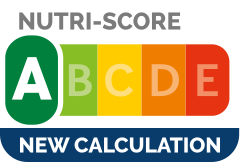 Very good nutritional quality
Nutri-Score data warning
Nutrient levels
Fat in moderate quantity (3.7%)
Saturated fat in low quantity (1.3%)
Sugars in low quantity (1.6%)
Salt in moderate quantity (0.943%)
Nutrition facts
| Nutrition facts | Prepared for 100 g / 100 ml | Compared to: Chocolate wheat shells |
|---|---|---|
| Energy | 1339 kcal (320 kcal) | 1,611.786 kJ (382 kcal) |
| Fat | 3.7 g | 3.502 g (+6%) |
| Saturated fat | 1.3 g | 1.317 g (-1%) |
| Monounsaturated fat | 0.9 g | 0.82 g (+10%) |
| Polyunsaturated fat | 1.4 g | 0.702 g (+99%) |
| Trans fat | 0 g | ? |
| Cholesterol | 0.0001 mg | 0.022 mg (-100%) |
| Carbohydrates | 62.9 g | 75.26 g (-16%) |
| Sugars | 1.6 g | 24.719 g (-94%) |
| Sucrose | 1.5 g | 20.96 g (-93%) |
| Polyols | 8.8 g | ? |
| Dietary fiber | 14.3 g | ? |
| Soluble fiber | 5.5 g | ? |
| Insoluble fiber | 8.8 g | ? |
| Proteins | 10.3 g | 9.121 g (+13%) |
| Salt | 0.9425 mg | 0.341 g (-100%) |
| Sodium | 0.377 mg | 0.138 g (-100%) |
| Vitamin B2 | 0.0011 mg | ? |
| Vitamin PP | 0.0128 mg | ? |
| Vitamin B6 | 0.0014 mg | ? |
| Vitamin B9 | 0.000164 µg | ? |
| Pantothenic acid | 0.0061 mg | ? |
| Calcium | 0.99 mg | ? |
| Iron | 0.0188 mg | ? |
| Zinc | 0.0046 mg | ? |
| Fruits, vegetables and legumes | ? | ? |
Nutrition facts (Detailed data)
| Nutrition facts | Prepared for 100 g / 100 ml | Prepared Per serving (legacy) |
|---|---|---|
| Energy | 1339 kcal (320 kcal) | 402 kcal (96 kcal) |
| Fat | 3.7 g | 1.11 g |
| Saturated fat | 1.3 g | 0.39 g |
| Monounsaturated fat | 0.9 g | 0.27 g |
| Polyunsaturated fat | 1.4 g | 0.42 g |
| Trans fat | 0 g | 0 g |
| Cholesterol | 0.0001 mg | 0.00003 mg |
| Carbohydrates | 62.9 g | 18.9 g |
| Sugars | 1.6 g | 0.48 g |
| Sucrose | 1.5 g | 0.45 g |
| Polyols | 8.8 g | 2.64 g |
| Dietary fiber | 14.3 g | 4.29 g |
| Soluble fiber | 5.5 g | 1.65 g |
| Insoluble fiber | 8.8 g | 2.64 g |
| Proteins | 10.3 g | 3.09 g |
| Salt | 0.9425 mg | 0.283 mg |
| Sodium | 0.377 mg | 0.113 mg |
| Vitamin B2 | 0.0011 mg | 0.00033 mg |
| Vitamin PP | 0.0128 mg | 0.00384 mg |
| Vitamin B6 | 0.0014 mg | 0.00042 mg |
| Vitamin B9 | 0.000164 µg | 0.0000492 µg |
| Pantothenic acid | 0.0061 mg | 0.00183 mg |
| Calcium | 0.99 mg | 0.297 mg |
| Iron | 0.0188 mg | 0.00564 mg |
| Zinc | 0.0046 mg | 0.00138 mg |
| Fruits, vegetables and legumes | ? | ? |
Serving size
Ingredients
Ingredients list
Ingredient information
Added sugars
Allergens
Traces
Ingredients analysis
Contains ingredients containing palm oil.
Vegan status unknown
Unrecognized: es:granos-de-cereal, es:fuente-de-calcio, es:agente-emulsionante, es:saborizante-identico-al-natural, en:vanillin, es:concentrado-de-tocoferoles-mixtos, en:thiamin, en:reduced-iron, en:zinc-oxide
Vegetarian status unknown
Unrecognized: es:granos-de-cereal, es:fuente-de-calcio, es:agente-emulsionante, es:saborizante-identico-al-natural, en:vanillin, es:concentrado-de-tocoferoles-mixtos, en:thiamin, en:reduced-iron, en:zinc-oxide
Food Processing
NOVA group
 Ultra-processed food and drink products
Elements that indicate the product is in NOVA group 4
How NOVA works
Additives
E304 - Fatty acid esters of ascorbic acidAntioxidant
ASCORBYL PALMITATE is an ester formed from ascorbic acid and palmitic acid creating a fat-soluble form of vitamin C.
E304i - Ascorbyl palmitateAntioxidant
No additive description is available yet.
E341 - Calcium phosphates EFSA overexposure risk: highEmulsifierHumectantSequestrantStabiliserThickener
Calcium phosphate is a family of materials and minerals containing calcium ions (Ca2+) together with inorganic phosphate anions. Some so-called calcium phosphates contain oxide and hydroxide as well. They are white solids of nutritious value.
E341ii - Dicalcium phosphateEmulsifierHumectantSequestrantStabiliserThickener
No additive description is available yet.
E433 - Polyoxyethylene sorbitan monooleate EFSA overexposure risk: moderateEmulsifierStabiliser
Polysorbate 80 is a nonionic surfactant and emulsifier often used in foods and cosmetics. This synthetic compound is a viscous, water-soluble yellow liquid.
E490 - Propylene glycol
Propylene glycol (IUPAC name: propane-1,2-diol) is a synthetic organic compound with the chemical formula C3H8O2. It is a viscous, colorless liquid which is nearly odorless but possesses a faintly sweet taste. Chemically it is classed as a diol and is miscible with a broad range of solvents, including water, acetone, and chloroform. It is produced on a large scale and is primarily used in the production of polymers, but also sees use in food processing, and as a process fluid in low-temperature heat-exchange applications. In the European Union, it has the E-number E1520 for food applications. For cosmetics and pharmacology, the number is E490. Propylene glycol is also present in propylene glycol alginate which known as E405. The compound is sometimes called (alpha) α-propylene glycol to distinguish it from the isomer propane-1,3-diol, known as (beta) β-propylene glycol.
Environment
Green-Score, origins bonus, and transportation impact are shown for Worldwide .
Green Score
Overall grade
 Very high environmental impact
About Green-Score
Current scope
Life cycle analysis
Average impact of the category
 Breakfast cereals, mix of puffed or extruded cereals, fortified with vitamins and chemical elements • Score: 45/100
Life-cycle reference
Overall environmental impact by stage (PEF)
The overall environmental impact figure (PEF) comes from ADEME's Agribalyse database, for the category: Breakfast cereals, mix of puffed or extruded cereals, fortified with vitamins and chemical elements. Source: ADEME Agribalyse Database.
| Stage | Impact |
|---|---|
| Agriculture | 78.9 % |
| Processing | 12.6 % |
| Packaging | 3.8 % |
| Transportation | 3.9 % |
| Distribution | 0.8 % |
| Consumption | 0.0 % |
Bonuses and maluses
Origins of ingredients
Threatened species risk
Packaging impact
Green-Score for this product
Green-Score for this product
Final score: 21/100Final score breakdown
Carbon footprint
Carbon footprint
Climate impact by stage (CO2e)
The carbon emission figure comes from ADEME's Agribalyse database, for the category: Breakfast cereals, mix of puffed or extruded cereals, fortified with vitamins and chemical elements. Source: ADEME Agribalyse Database.
| Stage | Impact |
|---|---|
| Agriculture | 68.8 % |
| Processing | 15.3 % |
| Packaging | 8.0 % |
| Transportation | 7.3 % |
| Distribution | 0.6 % |
| Consumption | 0.0 % |
Packaging
Packaging impact
Packaging components
| Shape | Material | Recycling | Impact |
|---|---|---|---|
| 1 BOX | Cardboard | Recycle | Unknown |
| 1 BAG | Plastic | Recycle | Unknown |
Transportation
Manufacturing locations
Origins of ingredients
Origins breakdown
| Origin | Percent of ingredients | Impact |
|---|---|---|
| Chile | 100 % | High |
Data Source
Product data comes from Open Food Facts. Food Benchmark also adds translations, category comparisons and explanatory calculations.
The database is licensed under ODbL 1.0, individual contents under DbCL 1.0, and product photos under CC BY-SA 3.0.
Product added on July 17, 2018 at 2:37:56 PM UTC by veganeamos .
Last edit on May 14, 2024 at 8:56:37 PM UTC by 5m4u9 .
Product page also edited by 5m4u9, icaicedo89, moon-rabbit, openfoodfacts-contributors, teolemon, veganeamos.