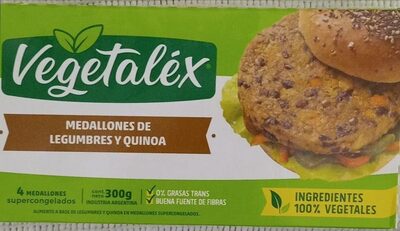
ProductsVegetalexMedallones de legumbres y quinoa
Medallones de legumbres y quinoa
Barcode 7790174001202
Vegetalex

Medallones de legumbres y quinoa

BARCODE:7790174001202
CATEGORIES:Plant Based Foods And Beverages, Plant Based Foods, Meat Alternatives, Meat Analogues, Prepared Vegetables, Vegetable Patties
LABELS:Source Of Fibre, 100 Vegetable, No Trans Fat
ORIGIN:Argentina
MANUFACTURING:Argentina
COUNTRIES:Argentina, Chile, Paraguay, Spain, Uruguay

Health

Nutrition

Nutri-Score

BGood nutritional quality

Nutri-Score data warning

Warning: the amount of fruits, vegetables and nuts is not specified on the label, it was estimated from the list of ingredients: 27

Nutrient levels

Fat in moderate quantity (5.6%)
What you need to know • A high consumption of fat, especially saturated fats, can raise cholesterol, which increases the risk of heart diseases. Recommendation: Limit the consumption of fat and saturated fat • Choose products with lower fat and saturated fat content. Source: National Health Service UK (NHS) - Fat: the facts
Saturated fat in low quantity (0.667%)
What you need to know • A high consumption of fat, especially saturated fats, can raise cholesterol, which increases the risk of heart diseases. Recommendation: Limit the consumption of fat and saturated fat • Choose products with lower fat and saturated fat content. Source: National Health Service UK (NHS) - Fat: the facts
Sugars in low quantity (2.67%)
What you need to know • A high consumption of sugar can cause weight gain and tooth decay. It also augments the risk of type 2 diabetes and cardio-vascular diseases. Recommendation: Limit the consumption of sugar and sugary drinks • Sugary drinks (such as sodas, fruit beverages, and fruit juices and nectars) should be limited as much as possible (no more than 1 glass a day). • Choose products with lower sugar content and reduce the consumption of products with added sugars. Source: National Health Service UK (NHS) - Sugar: the facts
Salt in moderate quantity (1.19%)
What you need to know • A high consumption of salt (or sodium) can cause raised blood pressure, which can increase the risk of heart disease and stroke. • Many people who have high blood pressure do not know it, as there are often no symptoms. • Most people consume too much salt (on average 9 to 12 grams per day), around twice the recommended maximum level of intake. Recommendation: Limit the consumption of salt and salted food • Reduce the quantity of salt used when cooking, and don't salt again at the table. • Limit the consumption of salty snacks and choose products with lower salt content. Source: World Health Organization (WHO) - Fact sheet - Salt reduction Source: National Health Service UK (NHS) - Salt: the facts

Nutrition facts

Nutrition factsAs sold for 100 g / 100 mlCompared to: Vegetable patties
Energy840 kJ (267 kcal)695.968 kJ (166 kcal) (+21%)
Fat5.6 g7.37 g (-24%)
Saturated fat0.667 g0.904 g (-26%)
Monounsaturated fat1.6 g?
Polyunsaturated fat2.8 g?
Trans fat0 g?
Cholesterol0 mg6.715 mg (-100%)
Carbohydrates32 g16.382 g (+95%)
Sugars2.67 g2.522 g (+6%)
Dietary fiber5.47 g?
Proteins5.6 g5.647 g (-1%)
Salt1.19 mg0.985 g (-100%)
Sodium0.475 mg0.394 g (-100%)
Fruits, vegetables and legumes??

Nutrition facts (Detailed data)

Nutrition factsAs sold for 100 g / 100 mlAs sold Per serving (legacy)
Energy840 kJ (267 kcal)630 kJ (200 kcal)
Fat5.6 g4.2 g
Saturated fat0.667 g0.5 g
Monounsaturated fat1.6 g1.2 g
Polyunsaturated fat2.8 g2.1 g
Trans fat0 g0 g
Cholesterol0 mg0 mg
Carbohydrates32 g24 g
Sugars2.67 g2 g
Dietary fiber5.47 g4.1 g
Proteins5.6 g4.2 g
Salt1.19 mg0.89 mg
Sodium0.475 mg0.356 mg
Fruits, vegetables and legumes??

Serving size

1 unidad 75 g

Ingredients

Ingredients list

POROTO ADZUKI, LENTEJAS, QUINOA, ARROZ INTEGRAL, ZANAHORIA, AVENA, HARINA DE TRIGO ENRIQUECIDA SEGUN LEY 25630 (harina de trigo, hierro, ácido fólico, vitamina B1, vitamina B2, niacina), CEBOLLA, AGUA, ACEITE DE GIRASOL, SAL, AJO, PEREJIL, COMINO. CONTIENE: TRIGO, AVENA.

Ingredient information

Poroto Adzuki
52.27% (estimate)
Lentils
23.86% (estimate)
Quinoa
11.93% (estimate)
Brown Rice
5.97% (estimate)
Carrot
2.98% (estimate)
Oat
1.49% (estimate)
Harina De Trigo Enriquecida Segun Ley 25630
0.75% (estimate)
Wheat Flour
0.37% (estimate)
Iron
0.19% (estimate)
Folic Acid
0.09% (estimate)
Thiamin
0.05% (estimate)
Vitamins
0.02% (estimate)
E101
0.01% (estimate)
E375
0.01% (estimate)
Onion
0% (estimate)
Water
0% (estimate)
Sunflower Oil
0% (estimate)
Salt
0% (estimate)
Garlic
0% (estimate)
Parsley
0% (estimate)
Cumin
0% (estimate)
Oat
0% (estimate)

Allergens

Gluten

Ingredients analysis

Palm oil free
Yes

No ingredients containing palm oil.

Unrecognized: es:poroto-adzuki

Vegan
Unknown

Vegan status unknown

Unrecognized: es:poroto-adzuki, en:iron

Vegetarian
Unknown

Vegetarian status unknown

Unrecognized: es:poroto-adzuki, en:iron


Food Processing

NOVA group

3Processed foods

Elements that indicate the product is in NOVA group 3

Ingredients
Salt
Ingredients
Vegetable Oil

How NOVA works

The NOVA classification assigns food products into 4 groups based on their degree of processing: 1. Unprocessed or minimally processed foods 2. Processed culinary ingredients 3. Processed foods 4. Ultra-processed food and drink products

Additives

No additives detected or data is missing.

Environment

Green-Score, origins bonus, and transportation impact are shown for Worldwide .

Green Score

Overall grade

UnknownUnknown environmental impact

About Green-Score

The Green-Score is an experimental score that summarizes the environmental impacts of food products.

Current scope

The Green-Score was initially developed for France and it is being extended to other European countries. The Green-Score formula is subject to change as it is regularly improved to make it more precise and better suited to each country. Select a country to include the full impact of transportation in the final score.

Green-Score availability

We could not compute the Green-Score of this product because some data is missing. A more precise category, ingredients list, origins or packaging data can unlock the computation.

Bonuses and maluses

Origins of ingredients

Declared origins: Argentina Origins malus: -3 Transportation (Worldwide): 0 Environmental policy adjustment: -3 Select a country to include the full impact of transportation.

Packaging impact

Packaging with a high impact Malus: -15 The information about the packaging of this product is not filled in.

Packaging

Packaging impact

Packaging with a high impact Malus: -15 The information about the packaging of this product is not filled in.

Data precision

The packaging information is not sufficiently precise to compute the most accurate packaging impact. Exact shapes and materials of all packaging components help improve the Green-Score.

Transportation

Manufacturing locations

Argentina

Origins of ingredients

Declared origins: Argentina Origins malus: -3 Transportation (Worldwide): 0 Environmental policy adjustment: -3 Select a country to include the full impact of transportation.

Origins breakdown

OriginPercent of ingredientsImpact
Argentina100 %High

Data Source

Product data comes from Open Food Facts. Food Benchmark also adds translations, category comparisons and explanatory calculations.

The database is licensed under ODbL 1.0, individual contents under DbCL 1.0, and product photos under CC BY-SA 3.0.

Product added on December 29, 2019 at 12:40:42 AM UTC by elcoco .

Last edit on May 9, 2024 at 6:23:37 PM UTC by roboto-app .

Product page also edited by elcoco, elcoco.0a5d9656a78b2959ed7ea35c800dabca, flipwared, kiliweb, openfoodfacts-contributors, raphael0202, roboto-app, teolemon, yuka.sY2b0xO6T85zoF3NwEKvlnIdA_Hwi22dMA3ng0La19uhFLXiMfJr5ZPeKag.