
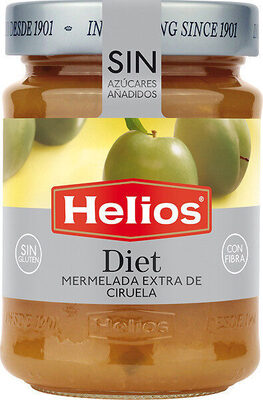
Diet mermelada de ciruela sin azúcar y sin gluten
Health
Nutrition
Nutri-Score
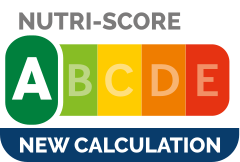 Very good nutritional quality
Nutri-Score data warning
Nutrient levels
Fat in low quantity (0%)
Saturated fat in low quantity (0%)
Sugars in low quantity (4.5%)
Salt in low quantity (0%)
Nutrition label

Nutrition facts
| Nutrition facts | As sold for 100 g / 100 ml | Compared to: Plum jams |
|---|---|---|
| Energy | 187 kJ (45 kcal) | 883.364 kJ (208 kcal) (-79%) |
| Fat | 0 g | 0.208 g (-100%) |
| Saturated fat | 0 g | 0.037 g (-100%) |
| Carbohydrates | 16 g | 50.63 g (-68%) |
| Sugars | 4.5 g | 47.793 g (-91%) |
| Polyols | 3.8 g | ? |
| Dietary fiber | 8 g | ? |
| Proteins | 0.5 g | 0.445 g (+12%) |
| Salt | 0 g | 0.019 g (-100%) |
| Sodium | 0 g | 0.007 g (-100%) |
| Fruits, vegetables and legumes | ~ 56.25 % | ? |
Nutrition facts (Detailed data)
| Nutrition facts | As sold for 100 g / 100 ml | As sold Per 100 g (packaging) | As sold Per 100 g (estimate) |
|---|---|---|---|
| Energy | 187 kJ (45 kcal) | 187 kJ (45 kcal) | ? |
| Fat | 0 g | 0 g | ? |
| Saturated fat | 0 g | 0 g | ? |
| Carbohydrates | 16 g | 16 g | ? |
| Sugars | 4.5 g | 4.5 g | ? |
| Polyols | 3.8 g | 3.8 g | ? |
| Dietary fiber | 8 g | 8 g | ? |
| Proteins | 0.5 g | 0.5 g | ? |
| Salt | 0 g | 0 g | ? |
| Sodium | 0 g | 0 g | ? |
| Fruits, vegetables and legumes | ~ 56.25 % | ? | ~ 56.25 % |
Ingredients
Ingredients image

Ingredients list
Ingredient information
Ingredients analysis
No ingredients containing palm oil.
No non-vegan ingredients.
No non-vegetarian ingredients.
Food Processing
NOVA group
 Ultra-processed food and drink products
Elements that indicate the product is in NOVA group 4
How NOVA works
Additives
E202 - Potassium sorbate EFSA overexposure risk: highPreservative
Potassium sorbate (E202) is a synthetic food preservative commonly used to extend the shelf life of various food products.
It works by inhibiting the growth of molds, yeast, and some bacteria, preventing spoilage. When added to foods, it helps maintain their freshness and quality.
Some studies have shown that when combined with nitrites, potassium sorbate have genotoxic activity in vitro. However, potassium sorbate is generally recognized as safe (GRAS) by regulatory authorities.
E330 - Citric acidAntioxidantSequestrant
Citric acid is a natural organic acid found in citrus fruits such as lemons, oranges, and limes.
It is widely used in the food industry as a flavor enhancer, acidulant, and preservative due to its tart and refreshing taste.
Citric acid is safe for consumption when used in moderation and is considered a generally recognized as safe (GRAS) food additive by regulatory agencies worldwide.
E440 - PectinsEmulsifierStabiliserThickener
Pectins (E440) are natural carbohydrates, predominantly found in fruits, that act as gelling agents in the food industry, creating the desirable jelly-like texture in jams, jellies, and marmalades.
Pectins stabilize and thicken various food products, such as desserts, confectioneries, and beverages, ensuring a uniform consistency and quality.
Recognized as safe by various health authorities, pectins have been widely used without notable adverse effects when consumed in typical dietary amounts.
E955 - SucraloseSweetener
Sucralose is an artificial sweetener and sugar substitute. The majority of ingested sucralose is not broken down by the body, so it is noncaloric. In the European Union, it is also known under the E number E955. It is produced by chlorination of sucrose. Sucralose is about 320 to 1,000 times sweeter than sucrose, three times as sweet as both aspartame and acesulfame potassium, and twice as sweet as sodium saccharin. Evidence of benefit is lacking for long-term weight loss with some data supporting weight gain and heart disease risks.It is stable under heat and over a broad range of pH conditions. Therefore, it can be used in baking or in products that require a long shelf life. The commercial success of sucralose-based products stems from its favorable comparison to other low-calorie sweeteners in terms of taste, stability, and safety. Common brand names of sucralose-based sweeteners are Splenda, Zerocal, Sukrana, SucraPlus, Candys, Cukren, and Nevella. Canderel Yellow also contains sucralose, but the original Canderel and Green Canderel do not.
E965 - maltitolEmulsifierHumectantStabiliserSweetenerThickener
MALTITOL is a sugar alcohol (a polyol) used as a sugar substitute. It has 75–90% of the sweetness of sucrose (table sugar) and nearly identical properties, except for browning. Maltitol's high sweetness allows it to be used without being mixed with other sweeteners. It is used in candy manufacture, particularly sugar-free hard candy, chewing gum, chocolates, baked goods, and ice cream.
Environment
Green-Score, origins bonus, and transportation impact are shown for Worldwide .
Green Score
Overall grade
 Low environmental impact
About Green-Score
Current scope
Life cycle analysis
Average impact of the category
 Jam, apricot • Score: 82/100
Life-cycle reference
Overall environmental impact by stage (PEF)
The overall environmental impact figure (PEF) comes from ADEME's Agribalyse database, for the category: Jam, apricot. Source: ADEME Agribalyse Database.
| Stage | Impact |
|---|---|
| Agriculture | 54.4 % |
| Processing | 12.7 % |
| Packaging | 23.4 % |
| Transportation | 6.5 % |
| Distribution | 2.1 % |
| Consumption | 1.0 % |
Bonuses and maluses
Declared origins
Packaging impact
Green-Score for this product
Green-Score for this product
Final score: 62/100Final score breakdown
Carbon footprint
Carbon footprint
Climate impact by stage (CO2e)
The carbon emission figure comes from ADEME's Agribalyse database, for the category: Jam, apricot. Source: ADEME Agribalyse Database.
| Stage | Impact |
|---|---|
| Agriculture | 30.0 % |
| Processing | 11.1 % |
| Packaging | 44.0 % |
| Transportation | 13.1 % |
| Distribution | 1.6 % |
| Consumption | 0.4 % |
Packaging
Packaging impact
Declared packaging
Data precision
Transportation
Declared origins
Forest footprint
Forest footprint
Deforestation risk details
Data Source
Product data comes from Open Food Facts. Food Benchmark also adds translations, category comparisons and explanatory calculations.
The database is licensed under ODbL 1.0, individual contents under DbCL 1.0, and product photos under CC BY-SA 3.0.
Product added on March 19, 2019 at 7:42:18 PM UTC by kiliweb .
Last edit on March 18, 2026 at 12:48:12 AM UTC by new-nutrition-bot .
Product page also edited by alia, aquilax, categorizador, civicko, kiliweb, musarana, new-nutrition-bot, openfoodfacts-contributors, roboto-app, spotter, thaialagata, yuka.YUt0WlFhYzdodDBzcHNjQXp6UDgvTk56bDVxeEFtS3djT1lnSVE9PQ, yuka.sY2b0xO6T85zoF3NwEKvlmhrVYH5-jOcEDjTsFDbl8nRP5y2fsxSwbb-E6o.