

Leche Omega 3
Health
Nutrition
Nutri-Score
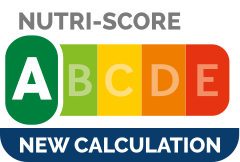 Very good nutritional quality
Nutri-Score data warning
Nutrient levels
Fat in low quantity (2.1%)
Saturated fat in low quantity (0.5%)
Sugars in low quantity (4.8%)
Salt in low quantity (0.14%)
Nutrition label

Nutrition facts
| Nutrition facts | As sold for 100 g / 100 ml | Compared to: Dairy variety packs |
|---|---|---|
| Energy | ~ 212 kJ (51 kcal) | 581.966 kJ (143 kcal) (-64%) |
| Fat | 2.1 g | 6.979 g (-70%) |
| Saturated fat | 0.5 g | 4.447 g (-89%) |
| Carbohydrates | 4.8 g | 12.986 g (-63%) |
| Sugars | 4.8 g | 10.728 g (-55%) |
| Dietary fiber | ? | ? |
| Proteins | 3.1 g | 4.151 g (-25%) |
| Salt | 0.14 g | 0.31 g (-55%) |
| Sodium | 0.056 g | 0.124 g (-55%) |
| Fruits, vegetables and legumes | ~ 0 % | ? |
Nutrition facts (Detailed data)
| Nutrition facts | As sold for 100 g / 100 ml | As sold Per 100 g (packaging) | As sold Per 100 g (estimate) |
|---|---|---|---|
| Energy | ~ 212 kJ (51 kcal) | ? (51 kcal) | ? |
| Fat | 2.1 g | 2.1 g | ? |
| Saturated fat | 0.5 g | 0.5 g | ? |
| Carbohydrates | 4.8 g | 4.8 g | ? |
| Sugars | 4.8 g | 4.8 g | ? |
| Dietary fiber | ? | ? | ? |
| Proteins | 3.1 g | 3.1 g | ? |
| Salt | 0.14 g | 0.14 g | ? |
| Sodium | 0.056 g | 0.056 g | ? |
| Fruits, vegetables and legumes | ~ 0 % | ? | ~ 0 % |
Ingredients
Ingredients image

Ingredients list
Ingredient information
Allergens
Ingredients analysis
No ingredients containing palm oil.
Unrecognized: es:oliva, es:aceite-rico-en-dha-y-epa-procedente-de-las-microalgas-schizochytrium-sp, es:monogli, es:ceridos-y-digliceridos-de-acidos-grasos, es:acido-pteroilmonoglutamati, es:co, es:clorhidrato-de-piridoxi, es:na
Contains non-vegan ingredients.
Unrecognized: es:oliva, es:aceite-rico-en-dha-y-epa-procedente-de-las-microalgas-schizochytrium-sp, es:monogli, es:ceridos-y-digliceridos-de-acidos-grasos, es:acido-pteroilmonoglutamati, es:clorhidrato-de-piridoxi
Vegetarian status unknown
Unrecognized: es:oliva, es:aceite-rico-en-dha-y-epa-procedente-de-las-microalgas-schizochytrium-sp, es:monogli, es:ceridos-y-digliceridos-de-acidos-grasos, es:acido-pteroilmonoglutamati, es:clorhidrato-de-piridoxi
Food Processing
NOVA group
 Ultra-processed food and drink products
Elements that indicate the product is in NOVA group 4
How NOVA works
Additives
E451 - Triphosphates EFSA overexposure risk: highEmulsifierHumectantSequestrantStabiliserThickener
Sodium triphosphate (STP), also sodium tripolyphosphate (STPP), or tripolyphosphate (TPP),) is an inorganic compound with formula Na5P3O10. It is the sodium salt of the polyphosphate penta-anion, which is the conjugate base of triphosphoric acid. It is produced on a large scale as a component of many domestic and industrial products, especially detergents. Environmental problems associated with eutrophication are attributed to its widespread use.
E507 - Hydrochloric acid EFSA overexposure risk: moderate
Hydrochloric acid is a colorless inorganic chemical system with the formula H2O:HCl. Hydrochloric acid has a distinctive pungent smell. It is mainly produced as a precursor to vinyl chloride for PVC. It is classified as strongly acidic and can attack the skin over a wide composition range, since the hydrogen chloride practically dissociates completely in solution. Hydrochloric acid is the simplest chlorine-based acid system containing water. It consists of hydrogen chloride and water, and a variety of other chemical species, including hydronium and chloride ions. It is an important chemical reagent and industrial chemical, used primarily in the production of polyvinyl chloride for plastic. In households, diluted hydrochloric acid is often used as a descaling agent. In the food industry, hydrochloric acid used as a food additive and in the production of gelatin. Hydrochloric acid is also used in leather processing. Hydrochloric acid was discovered by the alchemist Jabir ibn Hayyan around the year 800 AD. Hydrochloric acid was historically called acidum salis, muriatic acid, and spirits of salt because it was produced from rock salt and "green vitriol" (Iron(II) sulfate) (by Basilius Valentinus in the 15th century) and later from the chemically similar common salt and sulfuric acid (by Johann Rudolph Glauber in the 17th century). Free hydrochloric acid was first formally described in the 16th century by Libavius. Later, it was used by chemists such as Glauber, Priestley, and Davy in their scientific research. Unless pressurized or cooled, hydrochloric acid will turn into a gas if there is around 60% or less of water. Hydrochloric acid is also known as hydronium chloride.
Environment
Green-Score, origins bonus, and transportation impact are shown for Worldwide .
Green Score
Overall grade
 Unknown environmental impact
About Green-Score
Current scope
Green-Score availability
Bonuses and maluses
Declared origins
Packaging impact
Packaging

Packaging impact
Data precision
Transportation
Declared origins
Forest footprint
Forest footprint
Deforestation risk details
Data Source
Product data comes from Open Food Facts. Food Benchmark also adds translations, category comparisons and explanatory calculations.
The database is licensed under ODbL 1.0, individual contents under DbCL 1.0, and product photos under CC BY-SA 3.0.
Product added on November 1, 2019 at 7:22:34 PM UTC by kiliweb .
Last edit on March 4, 2026 at 10:51:21 AM UTC by adcl .
Product page also edited by 5m4u9, adcl, kiliweb, naruyoko, teolemon, yuka.Rjc0N05hc2d0c1JWcHRzMThUakhvTXBrM3NDRlcwVHVLUFF1SVE9PQ.