

Longaniza Linguica
Health
Nutrition
Nutri-Score
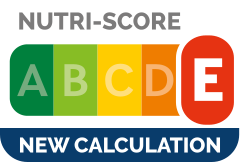 Lower nutritional quality
Nutri-Score data warning
Nutrient levels
Fat in high quantity (41%)
Saturated fat in high quantity (16%)
Sugars in low quantity (0.7%)
Salt in high quantity (3.7%)
Nutrition label

Nutrition facts
| Nutrition facts | As sold for 100 g / 100 ml | Compared to: Pork |
|---|---|---|
| Energy | 2110 kcal (505 kcal) | 954.921 kJ (232 kcal) |
| Fat | 41 g | 16.18 g (+153%) |
| Saturated fat | 16 g | 6.121 g (+161%) |
| Carbohydrates | 2 g | 1.288 g (+55%) |
| Sugars | 0.7 g | 0.605 g (+16%) |
| Dietary fiber | ? | ? |
| Proteins | 32 g | 18.762 g (+71%) |
| Salt | 3.7 g | 1.93 g (+92%) |
| Sodium | 1.48 g | 0.772 g (+92%) |
| Fruits, vegetables and legumes | ? | ? |
Nutrition facts (Detailed data)
| Nutrition facts | As sold for 100 g / 100 ml | As sold Per serving (legacy) |
|---|---|---|
| Energy | 2110 kcal (505 kcal) | 2113 kcal (505 kcal) |
| Fat | 41 g | 41 g |
| Saturated fat | 16 g | 16 g |
| Carbohydrates | 2 g | 2 g |
| Sugars | 0.7 g | 0.7 g |
| Dietary fiber | ? | ? |
| Proteins | 32 g | 32 g |
| Salt | 3.7 g | 3.7 g |
| Sodium | 1.48 g | 1.48 g |
| Fruits, vegetables and legumes | ? | ? |
Serving size
Ingredients
Ingredients image

Ingredients list
Ingredient information
Added sugars
Allergens
Ingredients analysis
No ingredients containing palm oil.
Unrecognized: en:edible-collagen-wrap, en:packaged-in-protective-atmosphere
Contains non-vegan ingredients.
Unrecognized: en:edible-collagen-wrap, en:packaged-in-protective-atmosphere
Contains non-vegetarian ingredients.
Unrecognized: en:edible-collagen-wrap, en:packaged-in-protective-atmosphere
Food Processing
NOVA group
 Ultra-processed food and drink products
Elements that indicate the product is in NOVA group 4
How NOVA works
Additives
E1400 - DextrinCarrierEmulsifierStabiliserThickener
Dextrins are a group of low-molecular-weight carbohydrates produced by the hydrolysis of starch or glycogen. Dextrins are mixtures of polymers of D-glucose units linked by α-(1→4) or α-(1→6) glycosidic bonds. Dextrins can be produced from starch using enzymes like amylases, as during digestion in the human body and during malting and mashing, or by applying dry heat under acidic conditions (pyrolysis or roasting). The latter process is used industrially, and also occurs on the surface of bread during the baking process, contributing to flavor, color and crispness. Dextrins produced by heat are also known as pyrodextrins. The starch hydrolyses during roasting under acidic conditions, and short-chained starch parts partially rebranch with α-(1,6) bonds to the degraded starch molecule. See also Maillard Reaction. Dextrins are white, yellow, or brown powders that are partially or fully water-soluble, yielding optically active solutions of low viscosity. Most of them can be detected with iodine solution, giving a red coloration; one distinguishes erythrodextrin (dextrin that colours red) and achrodextrin (giving no colour). White and yellow dextrins from starch roasted with little or no acid are called British gum.
E250 - Sodium nitrite EFSA overexposure risk: highPreservative
Sodium nitrite (E250) is a salt used for curing and preserving meat products.
It plays a critical role in preventing the growth of Clostridium botulinum, the bacterium responsible for botulism, in cured meats like bacon, ham, and sausages. It also provides the characteristic pink color and flavor.
However, nitrites can react with amines in the stomach to form nitrosamines, which are potent carcinogens. High intake of processed meats containing nitrites is associated with an increased risk of colorectal cancer. Regulatory bodies have set strict limits on its use in food.
E301 - Sodium ascorbateAntioxidant
SODIUM ASCORBATE is one of a number of mineral salts of ascorbic acid (vitamin C).
Environment
Green-Score, origins bonus, and transportation impact are shown for Worldwide .
Green Score
Overall grade
 Unknown environmental impact
About Green-Score
Current scope
Green-Score availability
Bonuses and maluses
Declared origins
Packaging impact
Packaging

Packaging impact
Declared packaging
Data precision
Transportation
Declared origins
Data Source
Product data comes from Open Food Facts. Food Benchmark also adds translations, category comparisons and explanatory calculations.
The database is licensed under ODbL 1.0, individual contents under DbCL 1.0, and product photos under CC BY-SA 3.0.
Product added on March 3, 2018 at 10:27:50 AM UTC by kiliweb .
Last edit on October 21, 2025 at 8:14:04 PM UTC by thaialagata .
Product page also edited by anamanzana, autorotate-bot, date-limite-app, ecoscore-impact-estimator, elcoco, fsilva25002, hungergames, inf, javiluisi, kiliweb, macrofactor, navig491, openfoodfacts-contributors, roboto-app, tacite-mass-editor, teolemon, thaialagata, wills106, wolfgang8741, yuka.VDdvQ0twa2g5dmNJc2ZZWjJ6bjg1OUJJNEpHMFFYS21PdFF6SVE9PQ.