

Mixups Cheese
Health
Nutrition
Nutri-Score
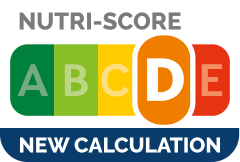 Lower nutritional quality
Nutrient levels
Fat in high quantity (27%)
Saturated fat in moderate quantity (3.5%)
Sugars in low quantity (4.3%)
Salt in high quantity (1.6%)
Nutrition label

Nutrition facts
| Nutrition facts | As sold for 100 g / 100 ml | Compared to: Crisps |
|---|---|---|
| Energy | 2113 kcal (505 kcal) | 2,109.078 kJ (505 kcal) |
| Fat | 27 g | 27.499 g (-2%) |
| Saturated fat | 3.5 g | 3.519 g (-1%) |
| Carbohydrates | 59 g | 55.482 g (+6%) |
| Sugars | 4.3 g | 2.385 g (+80%) |
| Dietary fiber | 3.7 g | ? |
| Proteins | 6 g | 6.217 g (-3%) |
| Salt | 1.6 g | 1.35 g (+19%) |
| Sodium | 0.64 g | 0.538 g (+19%) |
| Fruits, vegetables and legumes | ? | ? |
Nutrition facts (Detailed data)
| Nutrition facts | As sold for 100 g / 100 ml | As sold Per serving (legacy) |
|---|---|---|
| Energy | 2113 kcal (505 kcal) | 634 kcal (152 kcal) |
| Fat | 27 g | 8.1 g |
| Saturated fat | 3.5 g | 1.05 g |
| Carbohydrates | 59 g | 17.7 g |
| Sugars | 4.3 g | 1.29 g |
| Dietary fiber | 3.7 g | 1.11 g |
| Proteins | 6 g | 1.8 g |
| Salt | 1.6 g | 0.48 g |
| Sodium | 0.64 g | 0.192 g |
| Fruits, vegetables and legumes | ? | ? |
Serving size
Ingredients
Ingredients image

Ingredients list
Ingredient information
Added sugars
Allergens
Ingredients analysis
No ingredients containing palm oil.
Contains non-vegan ingredients.
Unrecognized: fr:don-lait, fr:inositate-disodique
Vegetarian status unknown
Unrecognized: fr:don-lait, fr:inositate-disodique
Food Processing
NOVA group
 Ultra-processed food and drink products
Elements that indicate the product is in NOVA group 4
How NOVA works
Additives
E150 - Caramel
CARAMEL is a medium to dark-orange confectionery product made by heating a variety of sugars.
E160b - AnnattoColour
No additive description is available yet.
E160c - Paprika extractColour
No additive description is available yet.
E270 - Lactic acid
LACTIC ACID is an organic compound with the formula CH3CH(OH)CO2H. In the form of its conjugate base called lactate (this is thus different and kept as a separate ingredient). Lactic acid is chiral, consisting of two optical isomers. One is known as L-(+)-lactic acid or (S)-lactic acid and the other, its mirror image, is D-(−)-lactic acid or (R)-lactic acid in food the L-variant is used
E330 - Citric acidAntioxidantSequestrant
Citric acid is a natural organic acid found in citrus fruits such as lemons, oranges, and limes.
It is widely used in the food industry as a flavor enhancer, acidulant, and preservative due to its tart and refreshing taste.
Citric acid is safe for consumption when used in moderation and is considered a generally recognized as safe (GRAS) food additive by regulatory agencies worldwide.
E500 - Sodium carbonatesStabiliserThickener
Sodium carbonates (E500) are compounds commonly used in food preparation as leavening agents, helping baked goods rise by releasing carbon dioxide when they interact with acids.
Often found in baking soda, they regulate the pH of food, preventing it from becoming too acidic or too alkaline. In the culinary world, sodium carbonates can also enhance the texture and structure of foods, such as noodles, by modifying the gluten network.
Generally recognized as safe, sodium carbonates are non-toxic when consumed in typical amounts found in food.
E500ii - Sodium hydrogen carbonateStabiliserThickener
Sodium hydrogen carbonate, also known as E500ii, is a food additive commonly used as a leavening agent.
When added to recipes, it releases carbon dioxide gas upon exposure to heat or acids, causing dough to rise and resulting in a light, fluffy texture in baked goods.
It is generally recognized as safe (GRAS) by regulatory authorities when used in appropriate quantities and poses no significant health risks when consumed in typical food applications.
E508 - Potassium chloride EFSA overexposure risk: moderateStabiliserThickenerPreservative
Potassium chloride (KCl) is a metal halide salt composed of potassium and chlorine. It is odorless and has a white or colorless vitreous crystal appearance. The solid dissolves readily in water and its solutions have a salt-like taste. KCl is used as a fertilizer, in medicine, in scientific applications, and in food processing. In a few states of the United States it is used to cause cardiac arrest as the third drug in the "three drug cocktail" for executions by lethal injection. It occurs naturally as the mineral sylvite, and in combination with sodium chloride as sylvinite.The version for injection is on the World Health Organization's List of Essential Medicines, the most important medications needed in a basic health system.
E621 - Monosodium glutamate EFSA overexposure risk: highFlavour Enhancer
Monosodium glutamate (MSG), or E621, is the sodium salt of glutamic acid, an amino acid found naturally in many foods.
It is widely used as a flavor enhancer to provide an "umami" or savory taste to a variety of processed foods, including soups, snack chips, and frozen meals.
MSG is generally recognized as safe (GRAS) by food authorities. However, some people report sensitivity to MSG, experiencing short-term symptoms like headaches and flushing, though scientific studies have not shown a consistent link.
E627 - Disodium guanylate
Disodium guanylate, also known as sodium 5'-guanylate and disodium 5'-guanylate, is a natural sodium salt of the flavor enhancing nucleotide guanosine monophosphate (GMP). Disodium guanylate is a food additive with the E number E627. It is commonly used in conjunction with glutamic acid. As it is a fairly expensive additive, it is not used independently of glutamic acid; if disodium guanylate is present in a list of ingredients but MSG does not appear to be, it is likely that glutamic acid is provided as part of another ingredient such as a processed soy protein complex. It is often added to foods in conjunction with disodium inosinate; the combination is known as disodium 5'-ribonucleotides. Disodium guanylate is produced from dried seaweed and is often added to instant noodles, potato chips and other snacks, savory rice, tinned vegetables, cured meats, and packaged soup.
Environment
Green-Score, origins bonus, and transportation impact are shown for Worldwide .
Green Score
Overall grade
 Unknown environmental impact
About Green-Score
Current scope
Green-Score availability
Bonuses and maluses
Declared origins
Packaging impact
Packaging
Packaging impact
Packaging components
| Shape | Material | Recycling | Impact |
|---|---|---|---|
| BAG | Plastic | Unknown | High |
Declared packaging
Transportation
Declared origins
Forest footprint
Forest footprint
Deforestation risk details
Data Source
Product data comes from Open Food Facts. Food Benchmark also adds translations, category comparisons and explanatory calculations.
The database is licensed under ODbL 1.0, individual contents under DbCL 1.0, and product photos under CC BY-SA 3.0.
Product added on April 14, 2018 at 9:55:29 AM UTC by kiliweb .
Last edit on February 5, 2026 at 3:16:11 PM UTC by off-replace-bot .
Product page also edited by halal-app-chakib, kiliweb, off-replace-bot, openfoodfacts-contributors, packbot, roboto-app, sachab, tacite, tacite-mass-editor, yuka.V1pFUENJZ2loNmtndWYwRjJFUFU0TjlleUpQemVqcXVkK01LSWc9PQ, yuka.sY2b0xO6T85zoF3NwEKvlmhmV8Ti_T77biLjhla23YmVN6bua4FJxKrrY6o.