

Vitaminbar banana & cinnamon
Health
Nutrition
Nutri-Score
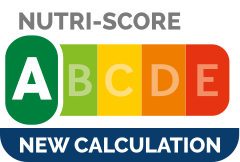 Very good nutritional quality
Nutri-Score data warning
Nutrient levels
Fat in moderate quantity (14.2%)
Saturated fat in low quantity (1.4%)
Sugars in moderate quantity (12%)
Salt in moderate quantity (0.6%)
Nutrition label

Nutrition facts
| Nutrition facts | As sold for 100 g / 100 ml | Compared to: Bars |
|---|---|---|
| Energy | 1641 kJ (393 kcal) | 1,862.584 kJ (439 kcal) (-12%) |
| Fat | 14.2 g | 20.027 g (-29%) |
| Saturated fat | 1.4 g | 8.125 g (-83%) |
| Carbohydrates | 40.7 g | 51.126 g (-20%) |
| Sugars | 12 g | 28.572 g (-58%) |
| Dietary fiber | 6.8 g | ? |
| Proteins | 22.1 g | 11.386 g (+94%) |
| Salt | 0.6 g | 0.363 g (+65%) |
| Sodium | 0.24 g | 0.145 g (+66%) |
| Vitamin A | 0.00024 g | 9.71 µg (+2372%) |
| Vitamin D | 0.000003 g | 0.284 µg (+956%) |
| Vitamin E | 0.0054 g | 2.309 mg (+134%) |
| Vitamin K | 0.000022 g | 0.205 µg (+10632%) |
| Vitamin C | 0.024 g | ? |
| Vitamin PP | 0.0048 g | ? |
| Biotin | 0.000015 g | 33.799 µg (-56%) |
| Pantothenic acid | 0.0018 g | ? |
| Potassium | 0.601 g | 336.834 mg (+78%) |
| Chloride | 0.239 g | 132.496 mg (+80%) |
| Calcium | 0.241 g | 106.123 mg (+127%) |
| Phosphorus | 0.414 g | 144.148 mg (+187%) |
| Iron | 0.0066 g | 2.347 mg (+181%) |
| Magnesium | 0.113 g | 58.214 mg (+94%) |
| Zinc | 0.003 g | 1.021 mg (+194%) |
| Copper | 0.0003 g | 0.243 mg (+23%) |
| Manganese | 0.0006 g | 0.623 mg (-4%) |
| Selenium | 0.000017 g | 5.064 µg (+236%) |
| Chromium | 0.000012 g | 13.176 µg (-9%) |
| Molybdenum | 0.000015 g | 20.145 µg (-26%) |
| Iodine | 0.0451 g | 8.337 µg (+540862%) |
| Fruits, vegetables and legumes | ~ 10 % | ? |
Nutrition facts (Detailed data)
| Nutrition facts | As sold for 100 g / 100 ml | As sold Per 100 g (packaging) | As sold Per 100 g (estimate) |
|---|---|---|---|
| Energy | 1641 kJ (393 kcal) | 1641 kJ (393 kcal) | ? |
| Fat | 14.2 g | 14.2 g | ? |
| Saturated fat | 1.4 g | 1.4 g | ? |
| Carbohydrates | 40.7 g | 40.7 g | ? |
| Sugars | 12 g | 12 g | ? |
| Dietary fiber | 6.8 g | 6.8 g | ? |
| Proteins | 22.1 g | 22.1 g | ? |
| Salt | 0.6 g | 0.6 g | ? |
| Sodium | 0.24 g | 0.24 g | ? |
| Vitamin A | 0.00024 g | 0.00024 g | ? |
| Vitamin D | 0.000003 g | 0.000003 g | ? |
| Vitamin E | 0.0054 g | 0.0054 g | ? |
| Vitamin K | 0.000022 g | 0.000022 g | ? |
| Vitamin C | 0.024 g | 0.024 g | ? |
| Vitamin PP | 0.0048 g | 0.0048 g | ? |
| Biotin | 0.000015 g | 0.000015 g | ? |
| Pantothenic acid | 0.0018 g | 0.0018 g | ? |
| Potassium | 0.601 g | 0.601 g | ? |
| Chloride | 0.239 g | 0.239 g | ? |
| Calcium | 0.241 g | 0.241 g | ? |
| Phosphorus | 0.414 g | 0.414 g | ? |
| Iron | 0.0066 g | 0.0066 g | ? |
| Magnesium | 0.113 g | 0.113 g | ? |
| Zinc | 0.003 g | 0.003 g | ? |
| Copper | 0.0003 g | 0.0003 g | ? |
| Manganese | 0.0006 g | 0.0006 g | ? |
| Selenium | 0.000017 g | 0.000017 g | ? |
| Chromium | 0.000012 g | 0.000012 g | ? |
| Molybdenum | 0.000015 g | 0.000015 g | ? |
| Iodine | 0.0451 g | 0.0451 g | ? |
| Fruits, vegetables and legumes | ~ 10 % | ? | ~ 10 % |
Ingredients
Ingredients image

Ingredients list
Ingredient information
Added sugars
Allergens
Ingredients analysis
No ingredients containing palm oil.
Unrecognized: en:glucose-synup, en:ferrialdiphosphate, en:cinnamon-0-2-bulking-agent, en:tocopheryl-acetate, en:coppertidgluconate, en:ill-chloride, en:k-biotin
Vegan status unknown
Unrecognized: en:glucose-synup, en:ferrialdiphosphate, en:tocopheryl-acetate, en:coppertidgluconate, en:ill-chloride, en:k-biotin
Vegetarian status unknown
Unrecognized: en:glucose-synup, en:ferrialdiphosphate, en:tocopheryl-acetate, en:coppertidgluconate, en:ill-chloride, en:k-biotin
Food Processing
NOVA group
 Ultra-processed food and drink products
Elements that indicate the product is in NOVA group 4
How NOVA works
Additives
E160d - LycopeneColour
Lycopene (from the neo-Latin Lycopersicum, the tomato species) is a bright red carotene and carotenoid pigment and phytochemical found in tomatoes and other red fruits and vegetables, such as red carrots, watermelons, gac, and papayas, but it is not in strawberries or cherries. Although lycopene is chemically a carotene, it has no vitamin A activity. Foods that are not red may also contain lycopene, such as asparagus and parsley.In plants, algae, and other photosynthetic organisms, lycopene is an intermediate in the biosynthesis of many carotenoids, including beta-carotene, which is responsible for yellow, orange, or red pigmentation, photosynthesis, and photoprotection. Like all carotenoids, lycopene is a tetraterpene. It is insoluble in water. Eleven conjugated double bonds give lycopene its deep red color. Owing to the strong color, lycopene is useful as a food coloring (registered as E160d) and is approved for use in the USA, Australia and New Zealand (registered as 160d) and the European Union.
E322 - LecithinsAntioxidantEmulsifier
Lecithins are natural compounds commonly used in the food industry as emulsifiers and stabilizers.
Extracted from sources like soybeans and eggs, lecithins consist of phospholipids that enhance the mixing of oil and water, ensuring smooth textures in various products like chocolates, dressings, and baked goods.
They do not present any known health risks.
E322i - LecithinAntioxidantEmulsifier
Lecithins are natural compounds commonly used in the food industry as emulsifiers and stabilizers.
Extracted from sources like soybeans and eggs, lecithins consist of phospholipids that enhance the mixing of oil and water, ensuring smooth textures in various products like chocolates, dressings, and baked goods.
They do not present any known health risks.
E330 - Citric acidAntioxidantSequestrant
Citric acid is a natural organic acid found in citrus fruits such as lemons, oranges, and limes.
It is widely used in the food industry as a flavor enhancer, acidulant, and preservative due to its tart and refreshing taste.
Citric acid is safe for consumption when used in moderation and is considered a generally recognized as safe (GRAS) food additive by regulatory agencies worldwide.
E340 - Potassium phosphates EFSA overexposure risk: highEmulsifierHumectantSequestrantStabiliserThickener
Potassium phosphate is a generic term for the salts of potassium and phosphate ions including: Monopotassium phosphate (KH2PO4) (Molar mass approx: 136 g/mol) Dipotassium phosphate (K2HPO4) (Molar mass approx: 174 g/mol) Tripotassium phosphate (K3PO4) (Molar mass approx: 212.27 g/mol)As food additives, potassium phosphates have the E number E340.
E340ii - Dipotassium phosphateEmulsifierHumectantSequestrantStabiliserThickener
No additive description is available yet.
Environment
Green-Score, origins bonus, and transportation impact are shown for Worldwide .
Green Score
Overall grade
 Unknown environmental impact
About Green-Score
Current scope
Green-Score availability
Bonuses and maluses
Declared origins
Packaging impact
Packaging
Packaging impact
Data precision
Transportation
Declared origins
Forest footprint
Forest footprint
Deforestation risk details
Data Source
Product data comes from Open Food Facts. Food Benchmark also adds translations, category comparisons and explanatory calculations.
The database is licensed under ODbL 1.0, individual contents under DbCL 1.0, and product photos under CC BY-SA 3.0.
Product added on March 29, 2018 at 10:24:20 AM UTC by kiliweb .
Last edit on March 13, 2026 at 7:25:21 PM UTC by new-nutrition-bot .
Product page also edited by aleene, casten, hungergames, kiliweb, kiwikern, mrrico, naruyoko, new-nutrition-bot, openfoodfacts-contributors, stivolonski, yuka.J71_APOtGcYlIPWP-Kgv9xWwL8PBDKFJQnIiow, yuka.Ri85ZEhaZ3d1L0JXcDhFRHhpdksvY3hPMWJpalVHV2xkclVVSWc9PQ, yuka.WFpBZ05wZ1pwOVFIdk5vQTJrdis5UE5rOVp5MVQzSHVPL1ZLSUE9PQ, yuka.sY2b0xO6T85zoF3NwEKvlnNsf9f7uQL0KR_vmmer_sWwMIfWZ_Yi4dnQIas.