

Mogu Mogu Strawberry Juice
Health
Nutrition
Nutri-Score
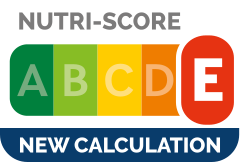 Lower nutritional quality
Nutri-Score data warning
Nutrient levels
Fat in low quantity (0%)
Sugars in high quantity (13.4%)
Salt in low quantity (0.125%)
Nutrition label

Nutrition facts
| Nutrition facts | As sold for 100 g / 100 ml | Compared to: Sweetened beverages |
|---|---|---|
| Energy | 235 kcal (56 kcal) | 233.11 kJ (55 kcal) |
| Fat | 0 g | 0.193 g (-100%) |
| Saturated fat | ? | 0.08 g |
| Carbohydrates | 13.8 g | 12.309 g (+12%) |
| Sugars | 13.4 g | 11.329 g (+18%) |
| Added sugars | 13.1 g | 11.801 g (+11%) |
| Dietary fiber | 0.312 g | ? |
| Proteins | 0 g | 0.307 g (-100%) |
| Salt | 0.125 g | 0.035 g (+257%) |
| Sodium | 0.05 g | 0.014 g (+257%) |
| Calcium | 0.0156 g | 34.717 mg (-55%) |
| Fruits, vegetables and legumes | ? | ? |
Nutrition facts (Detailed data)
| Nutrition facts | As sold for 100 g / 100 ml | As sold Per serving (legacy) |
|---|---|---|
| Energy | 235 kcal (56 kcal) | 753 kcal (180 kcal) |
| Fat | 0 g | 0 g |
| Saturated fat | ? | ? |
| Carbohydrates | 13.8 g | 44 g |
| Sugars | 13.4 g | 43 g |
| Added sugars | 13.1 g | 42 g |
| Dietary fiber | 0.312 g | 1 g |
| Proteins | 0 g | 0 g |
| Salt | 0.125 g | 0.4 g |
| Sodium | 0.05 g | 0.16 g |
| Calcium | 0.0156 g | 0.05 g |
| Fruits, vegetables and legumes | ? | ? |
Serving size
Ingredients
Ingredients image

Ingredients list
Ingredient information
Added sugars
Ingredients analysis
No ingredients containing palm oil.
Vegan status unknown
Unrecognized: en:pete
Vegetarian status unknown
Unrecognized: en:pete
Food Processing
NOVA group
 Ultra-processed food and drink products
Elements that indicate the product is in NOVA group 4
How NOVA works
Additives
E102 - TartrazineColour
Tartrazine (E102) is a synthetic lemon-yellow azo dye used as a food coloring.
It is found in a wide range of products such as soft drinks, desserts, candies, and snack foods to give them a vibrant yellow appearance.
While approved by many regulatory agencies, tartrazine has been linked to allergic reactions, such as hives, in a small portion of the population. Some studies have also suggested a link to increased hyperactivity in children, particularly when consumed with other additives like benzoates.
E122 - Azorubine EFSA overexposure risk: noColour
Azorubine is an azo dye produced as a disodium salt. In its dry form, the product appears red to maroon. It is mainly used in foods which are heat-treated after fermentation. It has E number E122.
E124 - Ponceau 4rColour
Ponceau 4R (known by more than 100 synonyms, including as C.I. 16255, Cochineal Red A, C.I. Acid Red 18, Brilliant Scarlet 3R, Brilliant Scarlet 4R, New Coccine, is a synthetic colourant that may be used as a food colouring. It is denoted by E Number E124. Its chemical name is 1-(4-sulpho-1-napthylazo)- 2-napthol- 6,8-disulphonic acid, trisodium salt. Ponceau (17th century French for "poppy-coloured") is the generic name for a family of azo dyes. Ponceau 4R is a strawberry red azo dye which can be used in a variety of food products, and is usually synthesized from aromatic hydrocarbons; it is stable to light, heat, and acid but fades in the presence of ascorbic acid.It is used in Europe, Asia and Australia, but has not been approved by the US FDA.
E202 - Potassium sorbate EFSA overexposure risk: highPreservative
Potassium sorbate (E202) is a synthetic food preservative commonly used to extend the shelf life of various food products.
It works by inhibiting the growth of molds, yeast, and some bacteria, preventing spoilage. When added to foods, it helps maintain their freshness and quality.
Some studies have shown that when combined with nitrites, potassium sorbate have genotoxic activity in vitro. However, potassium sorbate is generally recognized as safe (GRAS) by regulatory authorities.
E211 - Sodium benzoate EFSA overexposure risk: highPreservative
SODIUM BENZOATE is a substance which has the chemical formula NaC7H5O2
E260 - Acetic acidPreservative
ACETIC ACID, systematically named ethanoic acid, is a colourless liquid organic compound with the chemical formula CH3COOH (also written as CH3CO2H or C2H4O2).
E327 - calcium lactateThickener
Calcium lactate is a white crystalline salt with formula C6H10CaO6, consisting of two lactate anions H3C(CHOH)CO−2 for each calcium cation Ca2+. It forms several hydrates, the most common being the pentahydrate C6H10CaO6·5H2O. Calcium lactate is used in medicine, mainly to treat calcium deficiencies; and as a food additive with E number of E327. Some cheese crystals consist of calcium lactate.
E330 - Citric acidAntioxidantSequestrant
Citric acid is a natural organic acid found in citrus fruits such as lemons, oranges, and limes.
It is widely used in the food industry as a flavor enhancer, acidulant, and preservative due to its tart and refreshing taste.
Citric acid is safe for consumption when used in moderation and is considered a generally recognized as safe (GRAS) food additive by regulatory agencies worldwide.
E418 - Gellan gumStabiliserThickener
GELLAN GUM is a water-soluble anionic polysaccharide produced by the bacterium Sphingomonas elodea. It is used in plant-based milks to keep plant protein suspended in the milk.
Environment
Green-Score, origins bonus, and transportation impact are shown for Worldwide .
Green Score
Overall grade
 Unknown environmental impact
About Green-Score
Current scope
Green-Score availability
Bonuses and maluses
Origins of ingredients
Packaging impact
Packaging
Packaging impact
Packaging materials
| Material | % | Packaging weight | Packaging weight per 100 g of product |
|---|---|---|---|
| Unknown | 100 % | 28,918 g | 9,036.88 g |
| Total | 100 % | 28,918 g | 9,036.88 g |
Packaging components
| Shape | Material | Recycling | Impact |
|---|---|---|---|
| 1522 Cylindrical (320) | 1 | Recycle AS Green Waste | High |
Data precision
Transportation
Origins of ingredients
Origins breakdown
| Origin | Percent of ingredients | Impact |
|---|---|---|
| Philippines | 100 % | High |
Forest footprint
Forest footprint
Deforestation risk details
Data Source
Product data comes from Open Food Facts. Food Benchmark also adds translations, category comparisons and explanatory calculations.
The database is licensed under ODbL 1.0, individual contents under DbCL 1.0, and product photos under CC BY-SA 3.0.
Product added on December 25, 2017 at 3:48:04 PM UTC by deogracia .
Last edit on February 17, 2026 at 2:50:40 AM UTC by foodless .
Product page also edited by aaruswartz, deogracia, foodless, inf, kiliweb, macrofactor, openfoodfacts-contributors, roboto-app, scanbot, shahani, yuka.VDVwZk5QaFpuOEExdk5zN3hRdlcwUGRKekptRVIwV2FDdXNVSWc9PQ, yuka.sY2b0xO6T85zoF3NwEKvllZaaeXcnRfUFD3TkGqi482VKaS0SvBv66PeM6g.