

LE BIG MAC™
Health
Nutrition
Nutri-Score
 Lower nutritional quality
Nutri-Score data warning
Nutrient levels
Fat in moderate quantity (11%)
Saturated fat in moderate quantity (4.2%)
Sugars in low quantity (4%)
Salt in moderate quantity (1%)
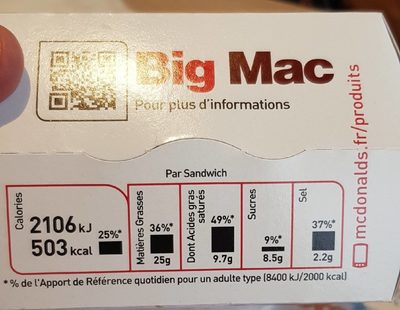
Nutrition facts
| Nutrition facts | As sold for 100 g / 100 ml | Compared to: Hamburgers from fast food |
|---|---|---|
| Energy | 967 kJ (231 kcal) | 1,068.708 kJ (258 kcal) (-10%) |
| Fat | 11 g | 14.281 g (-23%) |
| Saturated fat | 4.2 g | 5.859 g (-28%) |
| Cholesterol | 0.03393 g | ? |
| Carbohydrates | 19 g | 18.645 g (+2%) |
| Sugars | 4 g | 3.391 g (+18%) |
| Dietary fiber | 1.4 g | ? |
| Proteins | 12 g | 13.782 g (-13%) |
| Salt | 1 g | 1.181 g (-15%) |
| Sodium | 0.4 g | 0.472 g (-15%) |
| Fruits, vegetables and legumes | ~ 0.375830608865492 % | ? |
Nutrition facts (Detailed data)
| Nutrition facts | As sold for 100 g / 100 ml | As sold Per 100 g (packaging) | As sold Per 100 g (estimate) |
|---|---|---|---|
| Energy | 967 kJ (231 kcal) | 967 kJ (231 kcal) | ? |
| Fat | 11 g | 11 g | ? |
| Saturated fat | 4.2 g | 4.2 g | ? |
| Cholesterol | 0.03393 g | 0.03393 g | ? |
| Carbohydrates | 19 g | 19 g | ? |
| Sugars | 4 g | 4 g | ? |
| Dietary fiber | 1.4 g | 1.4 g | ? |
| Proteins | 12 g | 12 g | ? |
| Salt | 1 g | 1 g | ? |
| Sodium | 0.4 g | 0.4 g | ? |
| Fruits, vegetables and legumes | ~ 0.375830608865492 % | ? | ~ 0.375830608865492 % |
Serving size
Ingredients
Ingredients image
Ingredients list
Ingredient information
Added sugars
Allergens
Ingredients analysis
Palm oil content unknown
Contains non-vegan ingredients.
Unrecognized: fr:steak-hache-de-boeuf, en:mustard, fr:orgine, en:sulfite, en:mustard
Contains non-vegetarian ingredients.
Unrecognized: fr:steak-hache-de-boeuf, en:mustard, fr:orgine, en:sulfite, en:mustard
Food Processing
NOVA group
 Ultra-processed food and drink products
Elements that indicate the product is in NOVA group 4
How NOVA works
Additives
E211 - Sodium benzoate EFSA overexposure risk: highPreservative
SODIUM BENZOATE is a substance which has the chemical formula NaC7H5O2
E220 - Sulphur dioxide EFSA overexposure risk: highAntioxidantPreservative
SULPHUR DIOXIDE is the chemical compound with the formula SO2.
E281 - Sodium propionatePreservative
Sodium propanoate or SODIUM PROPIONATE is the sodium salt of propionic acid.
E282 - calcium propionatePreservative
CALCIUM PROPIONATE has the formula Ca(C2H5COO)2. Calcium propionate is used as a preservative in a wide variety of products, including but not limited to:bread, other baked goods, processed meat, whey, and other dairy products.
E330 - Citric acidAntioxidantSequestrant
Citric acid is a natural organic acid found in citrus fruits such as lemons, oranges, and limes.
It is widely used in the food industry as a flavor enhancer, acidulant, and preservative due to its tart and refreshing taste.
Citric acid is safe for consumption when used in moderation and is considered a generally recognized as safe (GRAS) food additive by regulatory agencies worldwide.
E338 - Phosphoric acid EFSA overexposure risk: highAntioxidantSequestrant
Phosphoric acid (also known as orthophosphoric acid or phosphoric(V) acid) is a weak acid with the chemical formula H3PO4. Orthophosphoric acid refers to phosphoric acid, which is the IUPAC name for this compound. The prefix ortho- is used to distinguish the acid from related phosphoric acids, called polyphosphoric acids. Orthophosphoric acid is a non-toxic acid, which, when pure, is a solid at room temperature and pressure. The conjugate base of phosphoric acid is the dihydrogen phosphate ion, H2PO−4, which in turn has a conjugate base of hydrogen phosphate, HPO2−4, which has a conjugate base of phosphate, PO3−4. Phosphates are essential for life.The most common source of phosphoric acid is an 85% aqueous solution; such solutions are colourless, odourless, and non-volatile. The 85% solution is a syrupy liquid, but still pourable. Although phosphoric acid does not meet the strict definition of a strong acid, the 85% solution is acidic enough to be corrosive. Because of the high percentage of phosphoric acid in this reagent, at least some of the orthophosphoric acid is condensed into polyphosphoric acids; for the sake of labeling and simplicity, the 85% represents H3PO4 as if it were all in the ortho form. Dilute aqueous solutions of phosphoric acid exist in the ortho form.
E385 - Calcium disodium ethylenediaminetetraacetateAntioxidantPreservativeSequestrant
No additive description is available yet.
E415 - Xanthan gumEmulsifierStabiliserThickener
Xanthan gum (E415) is a natural polysaccharide derived from fermented sugars, often used in the food industry as a thickening and stabilizing agent.
This versatile food additive enhances texture and prevents ingredient separation in a wide range of products, including salad dressings, sauces, and gluten-free baked goods.
It is considered safe for consumption even at high intake amounts.
E433 - Polyoxyethylene sorbitan monooleate EFSA overexposure risk: moderateEmulsifierStabiliser
Polysorbate 80 is a nonionic surfactant and emulsifier often used in foods and cosmetics. This synthetic compound is a viscous, water-soluble yellow liquid.
E434 - Polyoxyethylene sorbitan monopalmitate EFSA overexposure risk: moderateEmulsifier
No additive description is available yet.
E450 - Diphosphates EFSA overexposure risk: highEmulsifierHumectantSequestrantStabiliserThickener
Diphosphates (E450) are food additives often utilized to modify the texture of products, acting as leavening agents in baking and preventing the coagulation of canned food.
These salts can stabilize whipped cream and are also found in powdered products to maintain their flow properties. They are commonly present in baked goods, processed meats, and soft drinks.
Derived from phosphoric acid, they're part of our daily phosphate intake, which often surpasses recommended levels due to the prevalence of phosphates in processed foods and drinks.
Excessive phosphate consumption is linked to health issues, such as impaired kidney function and weakened bone health. Though diphosphates are generally regarded as safe when consumed within established acceptable daily intakes, it's imperative to monitor overall phosphate consumption to maintain optimal health.
E471 - Mono- and diglycerides of fatty acidsEmulsifierStabiliser
Mono- and diglycerides of fatty acids (E471), are food additives commonly used as emulsifiers in various processed foods.
These compounds consist of glycerol molecules linked to one or two fatty acid chains, which help stabilize and blend water and oil-based ingredients. E471 enhances the texture and shelf life of products like margarine, baked goods, and ice cream, ensuring a smooth and consistent texture.
It is generally considered safe for consumption within established regulatory limits.
E509 - Calcium chloride EFSA overexposure risk: moderateStabiliserThickenerCoagulant
Calcium chloride is an inorganic compound, a salt with the chemical formula CaCl2. It is a colorless crystalline solid at room temperature, highly soluble in water. Calcium chloride is commonly encountered as a hydrated solid with generic formula CaCl2(H2O)x, where x = 0, 1, 2, 4, and 6. These compounds are mainly used for de-icing and dust control. Because the anhydrous salt is hygroscopic, it is used as a desiccant.
E520 - Aluminium sulphate
Aluminium sulfate is a chemical compound with the formula Al2(SO4)3. It is soluble in water and is mainly used as a coagulating agent (promoting particle collision by neutralizing charge) in the purification of drinking water and waste water treatment plants, and also in paper manufacturing. The anhydrous form occurs naturally as a rare mineral millosevichite, found e.g. in volcanic environments and on burning coal-mining waste dumps. Aluminium sulfate is rarely, if ever, encountered as the anhydrous salt. It forms a number of different hydrates, of which the hexadecahydrate Al2(SO4)3•16H2O and octadecahydrate Al2(SO4)3•18H2O are the most common. The heptadecahydrate, whose formula can be written as [Al(H2O)6]2(SO4)3•5H2O, occurs naturally as the mineral alunogen. Aluminium sulfate is sometimes called alum or papermaker's alum in certain industries. However, the name "alum" is more commonly and properly used for any double sulfate salt with the generic formula XAl(SO4)2·12H2O, where X is a monovalent cation such as potassium or ammonium.
E927 - Azodicarbonamide and Carbamide
No additive description is available yet.
E927a - Azodicarbonamide
No additive description is available yet.
Environment
Green-Score, origins bonus, and transportation impact are shown for Worldwide .
Green Score
Overall grade
 Very high environmental impact
About Green-Score
Current scope
Life cycle analysis
Average impact of the category
 Hamburger, from fast foods restaurant • Score: 15/100
Life-cycle reference
Overall environmental impact by stage (PEF)
The overall environmental impact figure (PEF) comes from ADEME's Agribalyse database, for the category: Hamburger, from fast foods restaurant. Source: ADEME Agribalyse Database.
| Stage | Impact |
|---|---|
| Agriculture | 90.5 % |
| Processing | 3.0 % |
| Packaging | 2.4 % |
| Transportation | 1.3 % |
| Distribution | 0.5 % |
| Consumption | 2.0 % |
Bonuses and maluses
Origins of ingredients
Packaging impact
Green-Score for this product
Green-Score for this product
Final score: 0/100Final score breakdown
Carbon footprint
Carbon footprint
Climate impact by stage (CO2e)
The carbon emission figure comes from ADEME's Agribalyse database, for the category: Hamburger, from fast foods restaurant. Source: ADEME Agribalyse Database.
| Stage | Impact |
|---|---|
| Agriculture | 92.5 % |
| Processing | 1.5 % |
| Packaging | 3.6 % |
| Transportation | 1.6 % |
| Distribution | 0.2 % |
| Consumption | 0.5 % |
Packaging
Packaging impact
Declared packaging
Data precision
Transportation
Manufacturing locations
Origins of ingredients
Origins breakdown
| Origin | Percent of ingredients | Impact |
|---|---|---|
| Unknown | 76 % | High |
| France | 24 % | High |
| United Kingdom | 0 % | High |
Forest footprint
Forest footprint
Ingredients linked to forest pressure
| Ingredient | Type | Percent in product | Forest footprint |
|---|---|---|---|
| EGG Yolk | Oeufs Importés | 0.02 % | 0.00 |
| EGG | Oeufs Importés | 0.00 % | 0.00 |
Data Source
Product data comes from Open Food Facts. Food Benchmark also adds translations, category comparisons and explanatory calculations.
The database is licensed under ODbL 1.0, individual contents under DbCL 1.0, and product photos under CC BY-SA 3.0.
Product added on December 29, 2018 at 11:07:37 AM UTC by kiliweb .
Last edit on March 17, 2026 at 4:27:11 PM UTC by new-nutrition-bot .
Product page also edited by anthn, anthony3, cewihec, christoufff, jinava76, kiliweb, new-nutrition-bot, openfoodfacts-contributors, yuka.SDZBNUxLNWNpOHM3c2NBaHBqZUlwUGhNenI2N0JrU2ROZG9LSWc9PQ.