

Johnsonville salchichas ahumadas con queso cheddar
Health
Nutrition
Nutri-Score
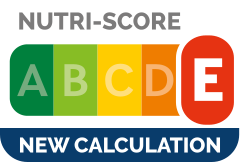 Lower nutritional quality
Nutri-Score data warning
Nutrient levels
Fat in high quantity (27.2%)
Saturated fat in high quantity (10.6%)
Sugars in low quantity (1.51%)
Salt in high quantity (2%)
Nutrition label

Nutrition facts
| Nutrition facts | As sold for 100 g / 100 ml | Compared to: Refrigerated foods |
|---|---|---|
| Energy | 1290 kJ (308 kcal) | 730.825 kJ (175 kcal) (+77%) |
| Fat | 27.2 g | 8.836 g (+208%) |
| Saturated fat | 10.6 g | 2.983 g (+255%) |
| Carbohydrates | 3.03 g | 13.939 g (-78%) |
| Sugars | 1.51 g | 2.999 g (-50%) |
| Dietary fiber | 0 g | ? |
| Proteins | 13.6 g | 7.097 g (+92%) |
| Salt | 2 mg | 0.958 g (-100%) |
| Sodium | 0.799 mg | 0.383 g (-100%) |
| Fruits, vegetables and legumes | ? | ? |
Nutrition facts (Detailed data)
| Nutrition facts | As sold for 100 g / 100 ml | As sold Per serving (legacy) |
|---|---|---|
| Energy | 1290 kJ (308 kcal) | 853 kJ (203 kcal) |
| Fat | 27.2 g | 18 g |
| Saturated fat | 10.6 g | 7 g |
| Carbohydrates | 3.03 g | 2 g |
| Sugars | 1.51 g | 1 g |
| Dietary fiber | 0 g | 0 g |
| Proteins | 13.6 g | 9 g |
| Salt | 2 mg | 1.3208 mg |
| Sodium | 0.799 mg | 0.52832 mg |
| Fruits, vegetables and legumes | ? | ? |
Serving size
Ingredients
Ingredients image

Ingredients list
Ingredient information
Added sugars
Allergens
Traces
Ingredients analysis
No ingredients containing palm oil.
Unrecognized: es:queso-cheddar-pasteurizado-procesado, es:grasa-de-leche-de-vaca, es:acido-sorbico-beta-apo-8-carotenal, es:eritorbato-de-sodio, es:forros-de-colageno
Contains non-vegan ingredients.
Unrecognized: es:queso-cheddar-pasteurizado-procesado, es:grasa-de-leche-de-vaca, es:acido-sorbico-beta-apo-8-carotenal, es:eritorbato-de-sodio, es:forros-de-colageno
Contains non-vegetarian ingredients.
Unrecognized: es:queso-cheddar-pasteurizado-procesado, es:grasa-de-leche-de-vaca, es:acido-sorbico-beta-apo-8-carotenal, es:eritorbato-de-sodio, es:forros-de-colageno
Food Processing
NOVA group
 Ultra-processed food and drink products
Elements that indicate the product is in NOVA group 4
How NOVA works
Additives
E200 - Sorbic acid EFSA overexposure risk: highPreservative
SORBIC ACID, or 2,4-hexadienoic acid, is a natural organic compound used as a food preservative. It has the chemical formula CH3(CH)4CO2H.
E250 - Sodium nitrite EFSA overexposure risk: highPreservative
Sodium nitrite (E250) is a salt used for curing and preserving meat products.
It plays a critical role in preventing the growth of Clostridium botulinum, the bacterium responsible for botulism, in cured meats like bacon, ham, and sausages. It also provides the characteristic pink color and flavor.
However, nitrites can react with amines in the stomach to form nitrosamines, which are potent carcinogens. High intake of processed meats containing nitrites is associated with an increased risk of colorectal cancer. Regulatory bodies have set strict limits on its use in food.
E262 - Sodium acetatesPreservativeSequestrant
SODIUM ACETATE, also abbreviated NaOAc,[8] is the sodium salt of acetic acid.
E262ii - Sodium diacetatePreservativeSequestrant
No additive description is available yet.
E326 - potassium lactateAntioxidantEmulsifierHumectant
POTASSIUM LACTATE is a compound with formula KC3H5O3. It is produced by neutralizing lactic acid which is fermented from a sugar source. Potassium lactate is commonly used in meat and poultry products to extend shelf life and increase food safety as it has a broad antimicrobial action. lactic acid and lactates can be consumed by all religious groups, vegans and vegetarians. Although the name refers to milk, it is not made from milk and thus suitable for people with milk allergy or lactose intolerance.
E460 - CelluloseCarrierEmulsifierHumectantStabiliserThickener
CELLULOSE is an organic compound with the formula (C6H10O5)n, a polysaccharide consisting of a linear chain of several hundred to many thousands of linked D-glucose units. Cellulose is used as emulsifier, thickener and stabilizer in processed foods. Cellulose powder is, for example, used in processed cheese to prevent caking inside the package.
E460ii - Powdered celluloseCarrierEmulsifierHumectantStabiliserThickener
No additive description is available yet.
E621 - Monosodium glutamate EFSA overexposure risk: highFlavour Enhancer
Monosodium glutamate (MSG), or E621, is the sodium salt of glutamic acid, an amino acid found naturally in many foods.
It is widely used as a flavor enhancer to provide an "umami" or savory taste to a variety of processed foods, including soups, snack chips, and frozen meals.
MSG is generally recognized as safe (GRAS) by food authorities. However, some people report sensitivity to MSG, experiencing short-term symptoms like headaches and flushing, though scientific studies have not shown a consistent link.
Environment
Green-Score, origins bonus, and transportation impact are shown for Worldwide .
Green Score
Overall grade
 Unknown environmental impact
About Green-Score
Current scope
Green-Score availability
Bonuses and maluses
Origins of ingredients
Packaging impact
Packaging
Packaging impact
Packaging components
| Shape | Material | Recycling | Impact |
|---|---|---|---|
| Unknown | Plastic | Unknown | Unknown |
Declared packaging
Data precision
Transportation
Manufacturing locations
Origins of ingredients
Origins breakdown
| Origin | Percent of ingredients | Impact |
|---|---|---|
| United States | 100 % | Medium |
Data Source
Product data comes from Open Food Facts. Food Benchmark also adds translations, category comparisons and explanatory calculations.
The database is licensed under ODbL 1.0, individual contents under DbCL 1.0, and product photos under CC BY-SA 3.0.
Product added on October 17, 2018 at 4:27:33 PM UTC by openfoodfactsmx4 .
Last edit on February 10, 2022 at 5:05:35 PM UTC by packbot .
Product page also edited by openfoodfactsmx4, packbot.